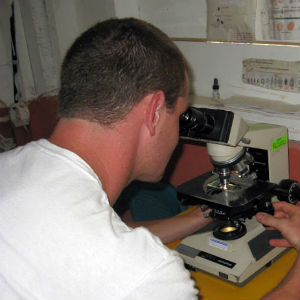
 Graduate students in the medical field do not usually study abroad as part of their collegiate experience. But the two-year-old MA in biomedicine program at Eastern Mennonite University is designed to teach its students to look at biomedicine from a broad, multi-faceted perspective.
“Our philosophy is very different,” said biology professor Roman Miller, PhD, who directs the program. “Biomedicine, health and healing need to be holistic. It takes more than biology, math and physic courses to understand the human person.”
Early visionaries decided to adapt the undergraduate cross-cultural requirement to biomedicine graduate students, giving it a medical twist. They believed that students needed exposure to the kind of diversity they were likely to encounter as biomedical professionals.
The result is a three-week summer course titled Cross-Cultural Health Care/Biomedicine in which students examine the“differentiation of resources, social, psychological, and spiritual ideas, contrasting the student’s personal culture with the explored culture,” according the course description. It also explains that students may study in a variety of different settings, but are expected to keep reflective journals and ultimately write a paper on their experience.
EMU professors recommend two organizations to biomedical students. One, Concern America, works in Guatemala, and the other, Appalachian Regional Healthcare, has several locations in Kentucky. Four of the eight students that went on biomedicine cross-culturals this summer went to one of these locations. (One of the leaders in Guatemala of Concern America is EMU nursing alumna Jeanette Nisly.) The other four went to Tanzania, Costa Rica, Panama, and West Virginia, as well as to rural Bluefield, Virginia.
The student’s experiences were “eye-opening” said both Matt Tieszen (Guatemala) and Asad Ali (Kentucky) in separate interviews. Both Tieszen and Ali spent most of their time shadowing healthcare professionals as they worked in clinics and hospitals, or did home visits.
“You read about development work and the importance of improving things like maternal healthcare, but you don’t really get to see a lot of it in the States,” said Tieszen, who went to Guatemala (with fellow student Chris Dreikhorn). Tieszen hopes to become a physician’s assistant and is interested in practicing health work in an international setting.
Ali (along with student David Abraham) traveled to Hazard and Whitesburg, Kentucky. For Ali, who is from Harrisburg, Pennsylvania, rural Appalachia was just as foreign as crossing the border. He observed patients who came into the hospital with black lung from working in coalmines and shadowed a home health nurse on her house calls. “There were diseases there you just don’t see in a city,” he said. “I thought that small isolated towns didn’t exist anymore, but the cross-cultural was an eye-opener; it showed me that they do.”
Cross-culturals are “necessary for training health professionals because there is such a diversity in healthcare,” said nursing and biomedicine professor Ann Hershberger, PhD. She added that even though many graduate programs do not require cross-culturals, she believes that the healthcare immersion experience helps students to become more well-rounded, compassionate healthcare providers by exposing them to the kind of variety they are likely to encounter in practice.
Article by: Kara Lofton
Photo courtesy of: Matt Tieszen


 Share
Share
AFP