After 16 years of Tony Bennett-style basketball, UVA Basketball fans are going to have to get used to the new, faster, more analytics-friendly game that Ryan Odom prefers.
Odom’s VCU team averaged 66.1 possessions per game this past season, nearly five more than the 61.2 per game that UVA averaged under interim coach Ron Sanchez, a Bennett disciple.
That’ll be the first adjustment that we need to make, watching-wise.
ICYMI
The Rams averaged 12.3 fast-break points per game, eight more than the 4.1 break points per game for the ‘Hoos.
The willingness to run will, no doubt, help with recruiting.
We already heard Chance Mallory, the #2-ranked point guard recruit in the Class of 2025, mention that after he committed to Virginia on Saturday.
ICYMI
The Rams shot more threes – 28.6 per game, 22nd most nationally, to the 22.2 per game for Virginia, which ranked 203rd nationally.
And it’s not all bombs-away: VCU averaged 16.8 shot attempts at the rim and 26.2 shot attempts in the paint, to UVA’s 13.8 shots at the rim and 22.5 per game in the paint.
Downhill basketball – attack the paint and the rim, if defenses work to take that away, kick out to open shooters.
And more offensive rebounds, which means more shot attempts – VCU averaged 13.1 offensive boards per game last season, nearly double the 6.8 offensive rebounds per game for Virginia.
This translated into 12.9 second-chance points per game for VCU, to UVA’s 8.4.
Bennett Ball emphasizes getting four offensive players to drop back to take away transition opportunities.
Odom Ball focuses on getting more buckets in transition, more threes, more shots at the rim and in the paint, more second chances.
And far fewer low-percentage shots in the midrange: VCU averaged 3.9 midrange jumpers per game last season.
Virginia averaged 8.7 midrange jumpers per game.
The Odom approach on offense is much more analytically sound – you want more shots at the rim, from three and in transition, and as few shots as necessary from the midrange.
What will surprise you is that, playing at a faster pace, the Rams actually allowed fewer points per game in 2024-2025 than Sanchez’s Cavaliers – 62.9 per game, ranking 10th nationally, to the 66.8 per game that Virginia allowed this past season.
This, as VCU averaged 76.9 points per game, to Virginia’s 64.8.
As with the Bennett system, the defense feeds the offense, though in the Odom system, it does so differently.
VCU got 16.2 points per game off turnovers in 2024-2025, five more than the 11.1 points per game generated off turnovers by UVA.
The Rams averaged 8.2 steals per game, to Virginia’s 5.5.
And more blocked shots – 5.4 to 3.8.
More steals and blocked shots is where you get the more fast breaks.
Overall shot attempts per game is another representation of the different styles of play.
VCU averaged 5.1 more field-goal attempts per game than its opponents last season. Virginia averaged 2.3 fewer shot attempts per game, and over the last seven seasons, dating back to the 2019 national champs, the ‘Hoos have averaged just 0.2 more shot attempts per game than their opponents.
So, building on what we know, Odom’s teams get more shots, get more higher-percentage shots, more high-yield shots in terms of threes, don’t waste possessions on midrange jumpers.
An odd find inside the numbers: despite the overall faster tempo, the VCU defense ranked 358th nationally in average time of possession on defense, at 18.8 seconds.
The Virginia D, which is known for making opponents work to get shots, actually had slightly shorter time of possession on D, at 18.6 seconds, ranking 349th nationally.
Where Odom’s teams make up the difference: the 17.2-second average time of possession on offense, which ranked 121st nationally.
Virginia, as long-time observers are well-aware, worked the clock under the Bennett approach, and averaged 20.3 seconds per offensive possession last year, ranking 359th nationally.
Something that we seemed to see way, way too often was late-shot-clock offense, and the numbers bear that out: UVA averaged 8.7 shot attempts per game in the final five seconds of the shot clock; VCU averaged 5.0.
In terms of roster and rotation, there are similarities between Odom Ball and Bennett Ball.
Both go with a base three-guard lineup – Odom’s 2024-2025 VCU team went with a starting backcourt of 6’0” point guard Zeb Jackson (10.8 ppg, 2.1 assists/g, 39.1% FG, 32.4% 3FG), 6’4” off-guard Joe Bamisile (15.0 ppg, 45.8% FG, 31.4% 3FG) and 6’5” off-guard Max Shulga (15.0 ppg, 4.0 assists/g, 43.5% FG, 38.7% 3FG).
Where Odom differs is how he uses his bigs. He likes having a stretch four, which on his 2024-2025 VCU team was the 6’10” Jack Clark (9.7 ppg, 6.9 rebounds/g, 47.8% FG, 34.8% 3FG), who put up 4.0 three-point attempts per game.
Odom’s 2022-2023 team at Utah State had a 6’9” stretch four, Taylor Funk (13.4 ppg, 5.5 rebounds/g, 45.1% FG, 37.0% 3FG), who averaged 6.4 attempts per game from three.
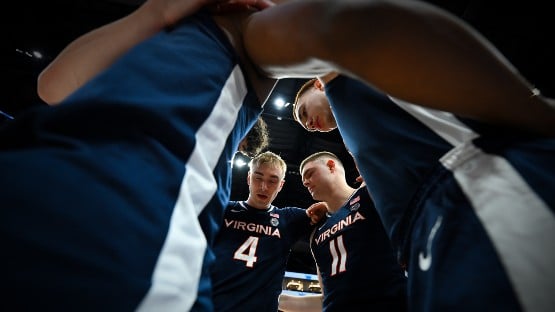
This is where I wonder aloud if Odom may decide to prioritize the retention of 6’8” rising senior Elijah Saunders (10.4 ppg, 5.0 rebounds/g, 42.0% FG, 34.7% 3FG), to be his stretch four for 2025-2026.
And then maybe a starting backcourt of Mallory at point and 6’4 rising senior Isaac McKneely (14.4 ppg, 43.9% FG, 42.1% 3FG) in the Max Shulga role.
I still like 6’6” rising senior Andrew Rohde (9.3 ppg, 4.3 assists/g, 43.2% FG, 41.3% 3FG) as the second-team point guard next season.
Find another shooter for the backcourt, a guy to rebound, play D and protect the rim at the five, and some depth, and …
I like where things are headed.
Support AFP



 Share
Share

Chris Graham