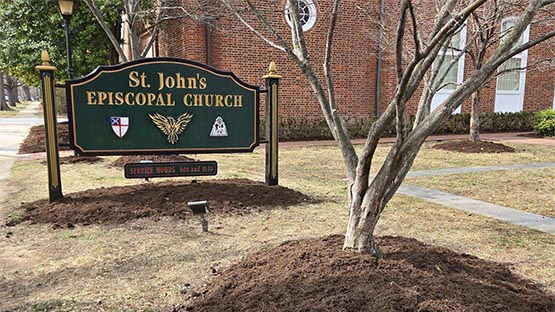
A church in Waynesboro hopes to have a hand in helping the area’s unhoused population get back on their feet, but in the meantime, wants to help those more fortunate find common ground with people living in poverty.
Rev. Tom DuMontier is hoping that the recent attention on the issue, brought about by a letter distributed throughout the neighborhood, can lead to some positive momentum and bring churches and the faith community together to be a part of a solution to serve all residents, including the poor and unhoused.
“It’s a slow process, but I think when we really listen to each other, there’s a lot more charity in people’s hearts,” said the pastor of St. John’s Episcopal Church.
At an Oct. 7 meeting at the church, nearly 100 people showed up, many asking how they could help the church in its outreach with the city’s homeless population.
The meeting demonstrated that there are a lot of people looking to do something and many different ideas as far as the right approach.
“It’s kind of like we’re on an archeological dig,” DuMontier said. “This is a long process.”
Door is always open to housed, unhoused
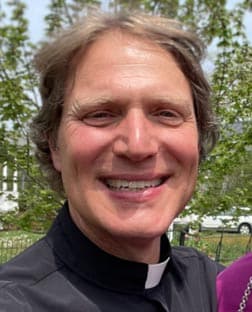
DuMontier’s background working for Habitat for Humanity and his desire to help others is what drew him to seminary school. St. John’s is his first call as a priest.
As a church, when a stranger shows up at its door, housed or unhoused, it’s hard to turn them away, he said. Sometimes they come to St. John’s looking for a cup of coffee or a prayer; other times, a place to leave their belongings for a couple of hours or a moment to just sit in the chapel and rest.
Recently, one unhoused resident with schizophrenia slept in the bushes and hung out around the church for a few days.
“I think for our housed neighbors, that was a jolt and a shock to their system,” he said.
“Looking back on that in hindsight, you know, that could have been something that was better communicated, and sometimes, as a church, the charity that we reach out to people and extend, just because that’s what we’re called to do, love our neighbor and welcome the stranger, we probably hit a point where we were a little bit overextended.”
DuMontier believes that talking with neighbors might remove some of the fear they have when they see an unhoused person in the neighborhood. For example, sharing a person’s name and story could take away the feeling that it’s “just a scary person that I don’t know.”
“It’s kind of challenging to articulate where the church stands. We welcome those in need, but we’re not welcoming to the point of having a tent city or a sanctuary space, or other things like that, because we’re not equipped for that ministry.
“At the same time, it’s not appropriate for a church to put up ‘no trespassing after dark’ signs. It just doesn’t seem in line with gospel teaching.”
The church has served as an overflow location for the cold-weather shelter operated by Waynesboro Area Refuge Ministry. Having eight to 12 unhoused individuals at the church has proved to be an educational opportunity for church members.
“We’re just kind of beginning to open up to that ministry, as it presents itself, into our community.”
The church is working to find the right balance between befriending those in need and being a good neighbor.
“Our interactions with the unhoused have just been trying to welcome them the way that we would welcome anybody that came into our church or treat them just as we would the housed neighbors in our community.”
Background: Couple upset with church for its ‘accommodating attitude’
St. John’s Episcopal Church drew the ire of a couple next door who were upset about its “accommodating attitude” toward unhoused individuals that put families and property at risk, according to a letter distributed by Michelle Weeks and Michael Jacobs approximately one month ago.
The letter raised concerns about future plans to use the church as a community outreach and work re-education center for the homeless.
The couple’s historic home, formerly operated as the Weems-Watkins Hospital in the 30s, and the church, are located in the Tree Streets historic district in Waynesboro.
Weeks and Jacobs asked residents to attend a meeting with the church in an effort to protect the neighborhood from the “large percentage” of homeless persons suffering from mental illness and drug addiction. The couple wrote that they were concerned that the “permissive space” for the homeless could lead to increased crime rates and affect the safety, property values and the character and charm of the neighborhood.
While the letter was meant to rally the community to oppose actions that might draw homeless individuals to Wayne Avenue, instead, a large number of people turned out to support the church and ask how they could help.
Those in attendance were pleased that it was a respectful forum where people could share their thoughts on the issue. There wasn’t any resolution or decision made at the meeting on the future of the church and its role in helping the unhoused population.
At a time when essential healthcare for millions of Americans is being threatened, jobs are being cut and federal food benefits are being eliminated, it’s appears to be more important than ever for community members and churches to step in to fill the void.
The church is in very preliminary conversations about what it would look like for their fellowship hall to be a place for the poor and unhoused to come to navigate health care, mental health and other forms and community resources, DuMontier told AFP.
ICYMI
- Waynesboro: Church turnout shows people want to help homeless, not send them away
- Waynesboro | Neighbors disagree with couple’s efforts to push homeless out
- At risk? Tree Streets couple want homeless out of their Waynesboro neighborhood
An unsigned letter to AFP criticized our coverage of the issue and said any simple internet search reveals the facts: “There is clear evidence of an association between homelessness and increased risk of crime, particularly property crime.” That was bolded.
“Homelessness also brings serious public-health and community challenges – increased transmission of respiratory infections; environmental contamination (trash, urine, feces) from lack of sanitation; more frequent rescue-squad calls; accumulation of waste and discarded materials; damage or neglect of public infrastructure (just look at the gazebo next to the Waynesboro library); depressed property values; higher municipal costs; disruption to local commerce; and yes, serious harm to the homeless individuals themselves.”
In the letter, our coverage was called “a biased hit job disguised as journalism,” and the anonymous writer said the article “ignores verifiable evidence of how unmanaged homelessness adversely affects a neighborhood.
“Let’s cut to the chase. Self-righteousness from afar never looks good on anyone, and it doesn’t look good on you. It’s easy to preach compassion for the homeless when it’s someone else’s neighborhood on the line. Everyone is for ‘helping the homeless’ – until the tents go up next to their own home.”
Pastor: ‘Visible poverty is in our city’
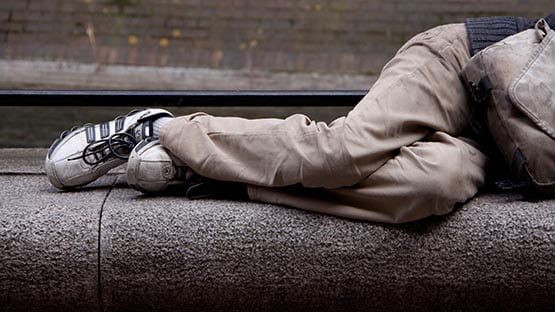
It’s easy to dismiss the unhoused as people who struggle with mental health and substance abuse, and just like many Americans, some certainly do. It is estimated that one in five individuals in the U.S. live with a mental illness; one in four Americans over the age of 12 have also used illegal drugs or misused prescription drugs in the last year.
Addiction is the most common stereotype of chronic homeless people, but there are many other causes including domestic violence, job loss or unemployment, foreclosure or eviction, post-traumatic stress, grief and despair, health issues and the lack of affordable housing in communities.
Among the homeless are teenagers (8 percent), military veterans (5.3 percent) and women (29 percent).
Everyone should be able to see a little of themselves in the people who struggle with poverty or are homeless: the worry about an unexpected tax bill, the rising cost of health insurance or a car failing inspection.
Most people are much closer to homelessness than becoming rich.
“The more people that I interact with, whether it’s in my parish or out in the community, there are a lot of people that people assume are getting by and doing well, but you know, once you look underneath and you see what’s really happening in people’s stories, it’s heartbreaking.”
The church gets phone calls from people in desperate situations, literally calling every church they can find a phone number for, hoping someone, anyone, can help them.
“Visible poverty is in our city,” he said. “It’s something where you can’t just put your head in the sand and deny it. I just see this as being an ongoing reality.
“I think if this city had a thoughtful approach to housing, and I think that would lead to having some sort of shelter in a place for those in need, we’re going to all be better for it. And if you just put your head in the sand and say, well, that’s not going to happen in Waynesboro, well, in 10 years, we’re going to already be behind. When you get behind, I think you’re operating to catch up and more in a triage mode, as opposed to offering hope and charity and the best of ourselves to people. I think we can be more proactive.”
DuMontier said that he is grateful for what he has, but he’s worried about the middle class being squeezed lower and lower.
“That person that you call homeless, that person who’s unhoused, you know, that’s a child of God, and that’s somebody’s son,” he said.
“I think we are really good at articulating what we’re afraid of. I hope as a community, we can faithfully talk about what we’re concerned about, and I really want to hear from neighbors about what their dream is for this neighborhood and for this community.
“Whatever we do moving forward, I want to honor and love and welcome our neighbors, all of our neighbors, even our neighbors that maybe disagree and are afraid, and this church will go the extra mile to love and welcome everyone.
“How do we not go to a place of fear and anxiety, but a place of welcome? We kind of have to step outside of our comfort zones a little bit,” DuMontier told AFP.
Common ground may be found at the table
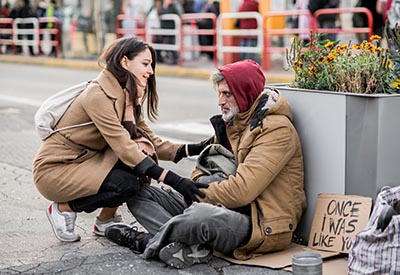
While any solution to homelessness and poverty will not be simple, DuMontier does believe common ground can often be found breaking bread with neighbors.
“I would challenge myself and other people to get to know your neighbors,” he said. “Get to know the people that you interact with, whether they’re your co-workers, or whether you live near them, or whether you pass them walking in the park.”
Sitting down over a meal is one of the keys to learning more about someone, he said.
Grace Evangelical Lutheran Church, across the street from St. John’s, offers a community meal Wednesday nights at 6 p.m. His family, including his wife and two daughters, attend to have conversations with people who stop in for fellowship or because they are hungry.
“It’s easy to pretend to know how everyone’s doing, good or bad, oversimplifying things, but the truth, he believes is found in learning “the depth of somebody else’s story.”
“People need housing, and they need food. But more than that, I think they need dignity, and they need community, and they need to be seen, and just even have an outlet where they can tell their story and somebody can listen to it.”
DuMontier said he thinks we aren’t as far apart as it may seem; he hears from people in the community that they don’t want their children to cross to the other side of the Greenway out of fear if they see someone who is unhoused.
“It’s an invitation to all of us to maybe get a little bit outside of our comfort zones with how we invite and connect with people. I think one of the most profound ways to connect with people is around food.
“What would happen if just a few more people in our city, would invite someone to share a meal together? That’s where the reconciliation, that’s where the breakthroughs come through.”
The community around you isn’t necessarily something you get to choose. You are often matched up together as neighbors, as the unhoused, as the faith community, people who live on the Tree Streets, etc.
“Some of that journey has started for me and for our church, of sitting on the porches of neighbors who live around the church, having cups of coffee with people, and just seeing how we all faithfully weave together.
“We have many gifted people in our community with great hearts,” DuMontier said. “We have amazing churches, and what would happen if all those pieces came together, and what continues to speak to me, in my faith, in the Christian faith, with this issue is, we don’t come before God, and we don’t follow Christ because we have it all together. It’s all about our brokenness, and when we come together in our brokenness, that’s how we are made whole.
“I want us to be honest in vetting the ministries that we bring to our church, and if it’s a fit for our church and the community, excellent.”
Related stories
- Waynesboro allocates $100K from vitality fund to address housing, food insecurity
- SAMHSA’s push toward involuntary treatment for mental health ‘deeply concerning’
- Staunton | Downtown day shelter for unhoused opening at First Presbyterian Church
- Staunton | Habitat built her home; she’s still fighting to break out of poverty
Support AFP


 Share
Share

Crystal Graham