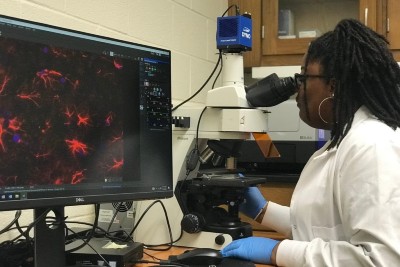
Taylor McFadden was originally interested in animal reproductive physiology. That is, at least, until she met Tim Jarome four years ago.
Eager to build his lab as a new faculty member, Jarome – who specializes in the brain, specifically the limbic system – took a chance on McFadden.
“The conversation I had during my graduate interviews at Virginia Tech changed the course of my research and my career,” McFadden said.
Now, that chance has paid off.
McFadden, a Washington, D.C., native, was recently awarded a National Institute of Mental Health supplement grant to research the differences in how a protein system impacts fear conditioning differences in females and males.
The grant covers the remainder of McFadden’s Ph.D. program, including a stipend, tuition, and travel funds, until 2023 and provides the opportunity to focus on scientific training and professional development.
This is the first diversity supplement grant awarded to the College of Agriculture and Life Sciences’ Department of Animal and Poultry Sciences in the 10-year history of the supplement grant and one of eight awarded to Virginia Tech during that time frame.
“When I told my family that I was awarded the diversity supplement grant, they thought I won an Oscar,” McFadden said. “This grant is something that I could share with my family because I am doing this for all of us.”
The grant also provided validation for McFadden, whose undergraduate training is in animal and equine science.
“As a young researcher, and as it’s mentioned in the diversity supplement, I am not from a neuroscience background,” McFadden said. “This grant gave me the reassurance that I’m good at what I do.”
The National Institute of Mental Health supplement grants are requested by principal investigators who serve as mentors to the candidates. The Diversity Supplement Program includes individuals at a variety of career stages in academia that come from groups that are underrepresented in science. The grant is based upon the candidate, their background, and their likelihood of long-term success in the field.
A first-generation college student, McFadden received the George Washington Carver Assistantship that funded her post-graduate studies until she received the supplement grant.
The work with Jarome, an assistant professor in the Department of Animal and Poultry Sciences, is on why one sex is predisposed to experience anxiety or post-traumatic stress disorders. Jarome’s parent grant from the National Institute of Mental Health began in late 2020.
“PTSD and anxiety disorders are very common and the likelihood of someone experiencing one of those disorders at some point in their life is very high,” said Jarome, a Fralin Life Sciences Institute affiliate faculty member. “Ultimately with our work, we can help understand why this is the case and we can develop a sex-specific treatment.”
One of the challenges in the lab is mimicking PTSD, Jarome and McFadden said.
In the Jarome Lab, the researchers use rodents and give them a single experience, called fear conditioning. Over time, they learn to fear a particular chamber and the researchers can see the chemical reactions in the amygdala limbic structure, a region of the brain that controls emotion and other functions.
“We look at how it’s changing in this brain region and we saw sex differences initially, so now we go back and we use a lot of different genetic tools, such as CRISPR, and other methodology to manipulate this process in the brains of these animals to see if we can erase the memory,” Jarome said.
McFadden’s supplement grant takes a deeper dive into the research, with particular focus on if these mechanisms change within neuronal cells or non-neuronal cells and how those may differ between males and females.
“Some of the early data that we’ve collected found that there’s probably more than one cell type this mechanism is changing in and is different between sexes,” Jarome said. “For Taylor’s work, we expanded on our CRISPR work and targeted individual cell types so we can manipulate this process in individual cell types in the brains of males and females.”
In time, the researchers hope that therapeutic tools can be developed that could be delivered directly to the brain to remove a memory that leads to PTSD in people or to help control anxiety that people with PTSD may experience.


 Share
Share

AFP