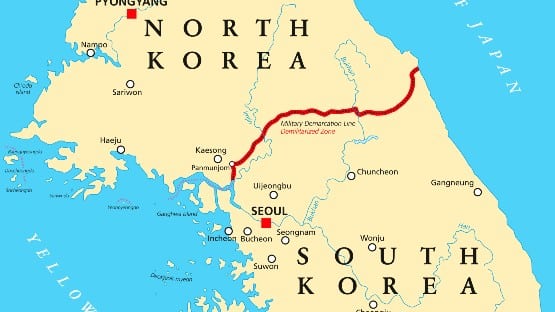
The U.S.-Republic of Korea (ROK) alliance began in 1953, at the end of the Korean War. Now 70 years later, President Biden and Korea’s Yoon Suk Yeol met to cement and expand the alliance, issuing a Washington Declaration that contains strong expressions of mutual support and severe warnings to Pyongyang in the event of a nuclear attack by North Korea.
Both domestic political and alliance considerations drive the Declaration. But two questions must be asked: Are such warnings necessary? Do they add to security on the Korean peninsula?
Nuclear alliance
On the strategic side, this summit sought to reaffirm US extended deterrence in the event of a North Korean nuclear attack. With Yoon at his side, Biden warned that a North Korean attack would “result in the end of whatever regime” authorized it.
Yoon added: “Our two countries have agreed to immediate bilateral presidential consultations in the event of North Korea’s nuclear attack and promised to respond swiftly, overwhelmingly and decisively using the full force of the alliance, including the United States’ nuclear weapons.”
The US will regularly deploy nuclear-armed submarines to Korean waters as a demonstration of its commitment. The two countries also agreed to strengthen consultations on nuclear strategy, in particular through “the establishment of a new Nuclear Consultative Group (NCG) to strengthen extended deterrence, discuss nuclear and strategic planning, and manage the threat to the nonproliferation regime posed by the Democratic People’s Republic of Korea (DPRK).”
Back to my question: Are such statements and actions necessary to deter North Korea? There is no evidence that the North questions the willingness and ability of the US to respond devastatingly to a North Korean attack, nuclear or conventional. Nor, despite North Korea’s increasing capability to deliver a nuclear weapon to targets in the US, is there reason to think it would do so except in response to being attacked first.
Yet, according to numerous reports, some South Koreans are having their doubts about US reliability—enough doubts that around 77 percent of those polled want an independent South Korean nuclear capability. Before visiting Washington, President Yoon himself had raised the possibility of South Korea having its own nukes, which it surely can produce, and fairly quickly.
The political backdrop
Biden’s statement was intended to put to rest a South Korean nuclear option or reintroduction of US nuclear weapons to South Korea. (Recall that President George W. Bush ordered their removal in 1991.) That was a win for Biden, especially since the Declaration recommits the ROK to the Nuclear Nonproliferation Treaty and to reliance on the US in any scenario that involves use of a nuclear weapon against North Korea. What Yoon got in return was also a win: Biden’s commitment on extended deterrence and close consultations on nuclear weapons.
The domestic political motivations for the Washington Statement are clear. Biden probably wanted to quiet accusations in Congress that he is ignoring the North Korean threat. The lavish reception for Yoon and the ensuing declaration may now make North Korea policy less of a target of right-wing criticism.
For Yoon, facing historically low approval ratings at home and anger over his trade policies, tightening the alliance with the US may quiet conservative critics who argue that North Korea’s frequent ballistic missile tests require an independent nuclear capability. Continued US control over nuclear weapons on Korean soil doesn’t look as reliable to them as it once did.
Other Koreans worry about Yoon’s close alignment with the US for different reasons: alienation of China, the ROK’s top trading partner and major customer for semiconductor exports that Biden wants to restrict; strengthened US defense ties with Japan, despite unresolved issues with South Korea that date to World War II; and pressure that forced Yoon to agree to military aid to Ukraine despite Russia’s considerable popularity among the Korean public.
Threats instead of diplomacy
Further stoking the fire with talk of nuclear war, the creation of new joint US-ROK planning and coordination groups on nuclear weapons, and another US nuclear-weapon deployment to South Korea may only magnify tensions on the peninsula.
Kim Yo Jong, Kim Jong Un’s sister, cited the Washington Declaration’s threat of total destruction in saying it demonstrated the “most hostile and aggressive will of action” against the North, posing “more serious danger” for regional peace.
North Korean military leaders surely noticed reports that the US submarines slated to be deployed to South Korea will be Ohio-class vessels armed with Trident II (D5) ballistic missiles with nuclear warheads.
We can expect still more North Korean missile tests in coming weeks, and quite possibly their long-expected seventh nuclear test. Only in the final sentence of the Declaration do Biden and Yoon address a nonnuclear option: diplomacy. “In parallel, both Presidents remain steadfast in their pursuit of dialogue and diplomacy with the DPRK, without preconditions, as a means to advance the shared goal of achieving the complete denuclearization of the Korean Peninsula.”
As I have said many times, the nuclear standoff in Korea requires dedicated, creative diplomacy, not further militarization, if we are to avoid war by accident or miscalculation. Let’s not forget: More than 75 million people live in the two Koreas, not to mention more than 28,000 US troops currently stationed there. If there is a nuclear threat, all three countries—not just one—are contributing to it.
Mel Gurtov, syndicated by PeaceVoice, is Professor Emeritus of Political Science at Portland State University and blogs at In the Human Interest.


 Share
Share