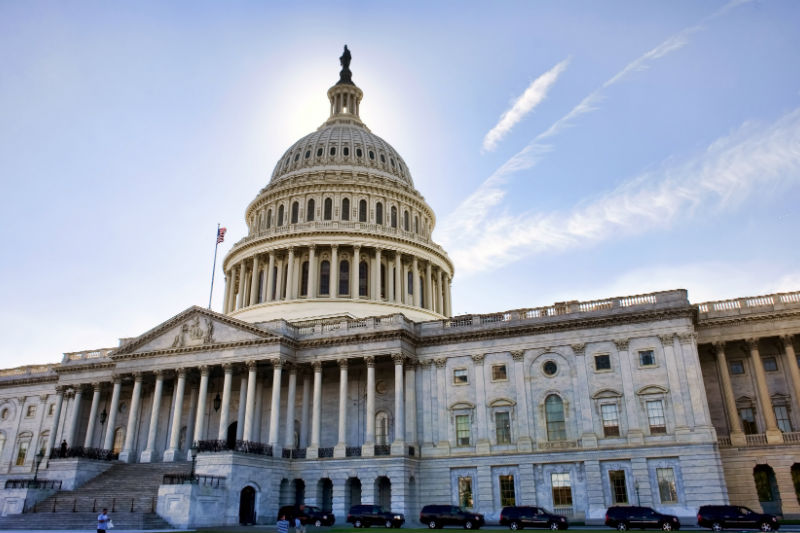
Bipartisan legislation cosponsored by U.S. Sens. Mark Warner and Tim Kaine to award four African-American women scientists the Congressional Gold Medal for their work at NASA Langley was signed into law by President Trump.
The award distinguishes Katherine Johnson, Dr. Christine Darden, Dorothy Vaughan, and Mary Jackson, posthumously awarding the medal to the latter two. It serves to commend these women for their contributions to NASA’s success during the Space Race and highlight their broader impact on society — paving the way for women, especially women of color, in science, technology, engineering, and mathematics.
“We are thrilled that these four trailblazers are being recognized with this honor,” the senators said. “Their engineering and calculations were essential to our nation’s success in the Space Race, but for too long, they didn’t receive the acknowledgment they deserve.”
The Congressional Gold Medal is the highest civilian award in the U.S. It is awarded to those who have performed an achievement that has had an impact on American history and culture that is likely to be recognized in the recipient’s field for years to come.
The Hidden Figures Congressional Gold Medal Act will honor:
- Katherine Johnson, who calculated trajectories for multiple NASA space missions including the first human spaceflight by an American, Alan Shepard’s Freedom 7 mission. She also calculated trajectories for John Glenn’s Friendship 7 mission to orbit the earth. During her time at NASA, she became the first woman recognized as an author of a report from the Flight Research Division.
- Dorothy Vaughan, who led the West Area Computing unit for nine years as the first African American supervisor at National Advisory Committee for Aeronautics (NACA), which later became NASA. She later became an expert programmer in FORTRAN as a part of NASA’s Analysis and Computation Division.
- Mary Jackson, who petitioned the City of Hampton to allow her to take graduate-level courses in math and physics at night at the all-white Hampton High School in order to become an engineer at NASA. She was the first female African-American engineer at the agency. Later in her career, she worked to improve the prospects of NASA’s female mathematicians, engineers, and scientists as Langley’s Federal Women’s Program Manager.
- Christine Darden, who became an engineer at NASA 16 years after Mary Jackson. She worked to revolutionize aeronautic design, wrote over 50 articles on aeronautics design, and became the first African-American person of any gender to be promoted into the Senior Executive Service at Langley.
The lives and careers of Katherine Johnson, Dorothy Vaughan, Mary Jackson, and Christine Darden were featured in the book Hidden Figures: The American Dream and the Untold Story of the Black Women Mathematicians Who Helped Win the Space Race, by Margot Lee Shetterly.
That book was adapted into the 2016 film Hidden Figures, which the Senators showed at a Capitol Hill screening for hundreds of Virginia students in 2017. In addition, Sens. Warner & Kaine honored Johnson, Vaughan, and Jackson by acknowledging their achievements in an official statement that was enshrined in the Congressional Record.
Support AFP



 Share
Share

Chris Graham