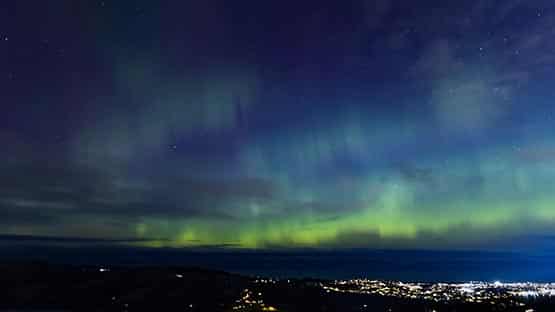
An aurora alert in Virginia rarely stays on the forecast page for long.
Somebody screenshots it. Somebody texts a neighbor. Somebody wonders whether the field north of Staunton beats the backyard in Charlottesville, where the porch light and the trees have already made their opinions known.
By evening, the question is not only whether the Northern Lights are possible.
It is whether the local sky will let anybody see them.
A January story on Virginia’s chance to see the Northern Lights had the familiar setup: darker places, a view to the north, and enough patience to stand around after the first look disappoints.
That is the thing about a faint aurora. It does not roll over the ridge like a storm. It hangs low, easy to doubt, sometimes more visible to a camera than to the person holding it. A little fog along the mountain or one stubborn porch light can make the forecast feel overly generous.
What the map gives you
NOAA keeps a short-range aurora map for tonight and tomorrow night over North America, and that is usually where the excitement begins.
For Virginia readers, though, the map is better read as a maybe than a promise.
Forecasters also talk about Kp, the number tied to geomagnetic activity. Nobody standing beside a fence line at midnight needs to turn that into a new hobby. The practical version is simple enough: when that number climbs, the aurora has a better shot at reaching farther south.
Then, Virginia adds its own complications.
Around here, the aurora often rides low in the northern sky. A camera may find color in what first looks like ordinary darkness. Outside Crozet, an open field gives the horizon some breathing room; in a brighter stretch of Harrisonburg, the same forecast has more to fight through.
One forecast, many Virginia nights.
The clouds get a vote
Cloud cover is where a short drive can start to matter.
Staunton and Charlottesville may be close enough for the same headline, but not always for the same sky. A 20 percent cloud forecast in one place and 60 percent in the other stops feeling like routine weather data when the thing you hope to see is faint and low.
That is where a percentage difference calculator can be useful. It gives the gap between two cloud-cover readings a cleaner shape before someone turns “it looks a little better over there” into a late drive.
Forecast apps make the night look organized. A gravel pull-off under the Blue Ridge usually tells a messier story.
The Shenandoah Valley has darker places than Richmond or Washington. The mountains, though, enjoy making their own rules. A ridge can hold cloud while the next valley gets a short, clean break.
Unfair, yes.
Also very Virginia.
Where the night gets messy
The best aurora map still leaves only half the story told.
No scandal there. The thing people are trying to see is faint, low, and far away. It has to pass through whatever the local night gives it: cloud, haze, light, trees, hills, the whole stubborn mess.
A probability calculator is useful here because the night depends on more than one thing happening at once. Maybe the aurora forecast looks decent, but the cloud forecast is poor. Maybe the sky is clear, but the aurora is weak. The useful question is the combined chance: what are the odds that the aurora, the darkness, and the clear northern view all line up together?
Cloud over the Valley can ruin a loud forecast without breaking a sweat.
A clean northern horizon, even on a quieter night, at least gives the aurora somewhere to show up.
After that, there is still the old-fashioned part: standing outside, letting your eyes adjust, and deciding whether the pale smear over the trees is actually something.
The one good window
The best part of the night sometimes hides inside a bad-looking forecast.
Around Waynesboro, an evening can start with a sky that looks shut for business. Near midnight, a dark gap slides through. Before long, the cloud deck comes back and the road looks ordinary again.
A few miles away, the clouds may never do anything so generous. They thin, thicken, tease the moon a little, and keep the northern horizon just out of reach.
Same rough average. Very different patience test.
With a variance calculator, those hourly cloud readings stop looking like one bland average. The spread tells you whether the night is twitchy or stuck in place: a sky lurching from gray to open is maddening, but it leaves a door ajar; a steady sheet of cloud is simpler, and crueler.
For a Virginia aurora night, one brief clearing can change the whole drive home.
Reading the Virginia sky
The NOAA map tells one part of the story. Local cloud cover tells another.
The Valley, the east side of the Blue Ridge, higher ground, and the Richmond area can look nothing alike after dark. Anyone who has watched summer storms split around the mountains already knows the pattern.
The view from the ground matters just as much.
A dark yard is not always enough. Trees, hills, buildings, and road lights can take away a weak aurora before it gets much of a chance.
In our earlier coverage of a possible New Year’s aurora for the Shenandoah Valley, the excitement came from a rare alignment of conditions. That remains the trick.
Some nights, the biggest number on the screen is not what settles the matter.
By then, the screen has done all it can. The rest belongs to the thin break above the tree line.
This content is provided for informational purposes only and is not a substitute for professional advice. AFP editorial staff were not involved in the creation of this content.

 Share
Share