Your windshield is the second most important safety component in your vehicle. The cheapest replacement option might be the most expensive decision you make.
There’s a reason windshield replacement ads flood Google with prices that seem too good to be true. A $149 replacement. A $99 “special.” Mobile service in thirty minutes. The offers are everywhere — on Groupon, on Craigslist, on the vans parked outside gas stations with handwritten signs.
What those prices don’t include is what should concern every driver: the quality of the glass going into their car, the adhesive holding it in place, the preparation work that determines whether the windshield stays bonded in a collision, and the calibration that keeps their vehicle’s safety systems functional after the swap.
The windshield replacement industry has a transparency problem. And it’s one that directly affects whether your car protects you the way it was engineered to — or whether it just looks like it does.
Your windshield is not just glass
Most drivers think of the windshield as a window. It isn’t. It’s a structural component that accounts for up to 30 percent of a vehicle’s cabin rigidity during a rollover. It serves as the mounting surface for the passenger-side airbag — when that airbag deploys, it pushes against the windshield, and the glass must hold firm to redirect the airbag toward the passenger. If the windshield pops out instead, the airbag inflates into open air and the passenger hits the dashboard.
Federal Motor Vehicle Safety Standard 212 requires the windshield to remain attached during a frontal crash at specified impact forces. FMVSS 208 governs how the windshield supports airbag deployment. These aren’t suggestions. They’re the engineering standards your vehicle was built to meet — and they depend entirely on the quality of the glass, the adhesive, and the installation.
A cheap windshield replacement can compromise every one of those factors. Here’s how.
The glass problem: OEM vs. aftermarket vs. whatever’s cheapest
When a windshield is manufactured for a specific vehicle, it’s made to exact specifications: a precise curvature that matches the roof line, a specific thickness that meets crash-test requirements, an optical quality that allows cameras and sensors to see through it clearly, and in many cases, an acoustic interlayer that reduces road noise.
OEM glass — Original Equipment Manufacturer glass — comes from the same factory that supplied the windshield when the vehicle was new. It matches every specification. OEE glass — Original Equipment Equivalent — is made by companies that also produce OEM glass for automakers but sell it through aftermarket channels. Both meet the same production standards.
Then there’s the broad aftermarket category, where quality varies enormously. The cheapest aftermarket windshields may differ slightly in curvature, thickness, or optical clarity. On a 2005 sedan without any driver-assist technology, those differences might be cosmetically annoying but not dangerous. On a 2024 SUV with a forward-facing camera for automatic emergency braking, lane-keeping assist, and adaptive cruise control, those differences can be genuinely hazardous.
The camera mounted behind your windshield was calibrated at the factory to see through glass with specific optical properties. When the replacement glass has a different refractive index, the camera’s view of the road is subtly distorted. It’s like putting a slightly warped lens on a precision instrument. The camera still functions — it just functions on data that isn’t quite right. At sixty miles per hour, “not quite right” translates to feet of error in object detection and distance measurement.
Shops offering the lowest prices are almost certainly not installing OEM glass. Many aren’t installing OEE either. They’re using the cheapest aftermarket glass available from their distributor, and the customer has no way to verify the difference after installation.
The adhesive shortcut that can kill you
Glass quality gets the most attention, but the adhesive is arguably more critical. The urethane adhesive that bonds a windshield to the vehicle frame is what keeps the glass attached during a crash. It’s what prevents the windshield from popping out when the airbag deploys. And it has a specification that most consumers have never heard of: Safe Drive-Away Time, or SDAT.
SDAT is the minimum time the adhesive must cure before the vehicle can safely be driven. During this window, the bond hasn’t reached full strength. If the vehicle is driven too soon — hitting a pothole, encountering wind load at highway speed, or, worst case, being involved in a collision — the windshield can separate from the frame.
Professional-grade fast-cure urethane reaches SDAT in approximately one hour under normal conditions. Standard urethane formulations require four to eight hours. Temperature, humidity, and altitude all affect cure time.
Here’s where the shortcut happens: some budget shops use adhesives with shorter cure times not because they’re better products, but because they’re cheaper products that let the shop turn vehicles faster. Others apply the adhesive too thinly, creating gaps in the bead that become leak points and structural weak spots. And some skip the primer step entirely — applying urethane directly to bare metal or unprimed glass, where it bonds poorly and degrades faster.
The primer step takes five minutes and costs almost nothing in materials. Skipping it saves the shop a few minutes per installation. It costs the customer a windshield bond that may fail in two years instead of lasting the life of the vehicle. But no customer can tell by looking at a finished installation whether the frame was primed.
The pinch weld problem nobody mentions
Before the new glass goes in, the old adhesive on the vehicle frame needs to be prepared. The standard procedure is to trim the old adhesive to a uniform one-to-two-millimeter bed — leaving a thin layer that serves as a bonding base for the new urethane. The frame is then inspected for rust or corrosion, and any affected areas are treated before the primer goes on.
In humid climates like Houston’s, corrosion under the old windshield seal is common. It’s often invisible until the old glass comes off. A thorough shop catches it, treats it, and primes over clean metal. A rush shop skips the inspection, applies adhesive over rust, and the bond begins failing from day one.
The result doesn’t show up immediately. It shows up as a slow leak six months later. Or a whistle of wind noise at highway speed. Or, in the scenario no one wants to think about, a windshield that separates from the frame during a collision because the adhesive was bonded to corroded metal that couldn’t hold it.
The ADAS calibration gap
This is the newest and fastest-growing problem in windshield replacement, and it’s one the industry is still catching up to.
If your vehicle was manufactured after 2016, there’s a strong probability it has a forward-facing camera mounted behind the windshield. This camera powers your Advanced Driver Assistance Systems — automatic emergency braking, lane departure warning, lane-keeping assist, adaptive cruise control, traffic sign recognition. These systems don’t just make driving convenient. They actively intervene to prevent collisions.
After every windshield replacement, these cameras require recalibration. The new glass sits in a position that may differ by fractions of a millimeter from the original — enough to skew the camera’s view of the road. Calibration uses diagnostic equipment and manufacturer-specific software to realign the camera against known reference targets. It’s a separate procedure from the glass installation, requires specialized equipment, and adds time and cost to the job.
Many budget shops don’t offer calibration at all. Some don’t mention it. Some tell customers it’s “optional” or that the camera will “self-adjust” during driving. None of that is true. A camera that isn’t recalibrated after replacement operates on incorrect data. It may brake for objects that aren’t there, or fail to brake for objects that are. It may steer the vehicle toward a lane boundary instead of away from it.
At highway speeds, a one-degree camera misalignment projects roughly 1.75 feet of error for every hundred feet of distance. At typical following distance, that’s enough for the AEB system to misjudge a braking event by several feet. The difference between a near-miss and a rear-end collision.
The cost of proper ADAS calibration is a fraction of the cost of the collision it prevents. But it’s a cost that doesn’t show up in a $149 windshield replacement quote, because it was never included.
What your insurance company won’t tell you
Here’s the part that surprises most drivers: insurance companies don’t typically specify which glass goes into your vehicle. Your policy covers “windshield replacement,” and the claims process generally lets the shop choose the glass. Many insurers have preferred vendor networks that prioritize cost — directing claims to shops that use the cheapest glass and fastest installation methods.
This doesn’t mean your insurer is acting maliciously. It means the incentive structure rewards speed and low cost, not installation quality. The shop that turns a replacement in forty-five minutes using aftermarket glass and no calibration can process more claims per day than the shop that takes three hours to do an OEM installation with full calibration.
As the vehicle owner, you have the right to choose your shop. You are not required to use your insurance company’s preferred vendor. You can select a shop that uses OEM or OEE glass, follows manufacturer adhesive specifications, and performs ADAS calibration — and your insurance company is generally required to cover it within the terms of your policy.
The key questions to ask before approving any windshield replacement:
- What glass are you installing — OEM, OEE, or aftermarket? If the shop can’t answer specifically, that’s your answer.
- What adhesive do you use, and what is the safe drive-away time? If they say you can drive immediately or within fifteen minutes, the adhesive is not professional-grade.
- Do you prime the frame and the glass before applying adhesive? If they don’t know what you’re asking, find another shop.
- Do you perform ADAS calibration, and is it done in-house or outsourced? If your vehicle has a forward-facing camera, calibration is not optional. A shop that doesn’t offer it is not equipped for modern vehicles.
- Do you inspect the pinch weld for corrosion? If the answer is “we don’t usually need to,” the answer is no.
What a proper installation actually looks like
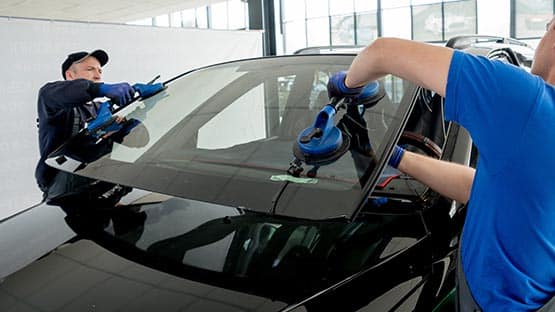
Professional windshield replacement follows a precise, seven-step sequence: pre-installation frame inspection, safe removal of the old glass without damaging ADAS brackets, pinch weld preparation and corrosion treatment, priming of both frame and glass surfaces, adhesive application with the correct bead profile, precision glass alignment, and ADAS recalibration.
The total process takes two to three hours including adhesive cure time. For vehicles requiring static ADAS calibration — which needs a controlled indoor environment with precise target placement — it may take longer. This is the standard. Anything significantly faster is cutting corners somewhere.
Shops like A Plus Auto Glass in Houston follow this protocol on every installation. They use OEM and OEE glass exclusively, apply manufacturer-spec urethane adhesive with verified safe drive-away times, and perform ADAS calibration in-house using make-specific diagnostic equipment. The difference isn’t visible when you pick up your car. The difference shows up when the car has to protect you.
The real cost of cheap
A budget windshield replacement might save a hundred dollars upfront. It might also mean aftermarket glass that distorts your ADAS camera’s view, adhesive that hasn’t reached bond strength when you drive away, a frame that was bonded over hidden corrosion, and a safety system that’s technically active but operating on skewed data.
The real cost of cheap isn’t the price on the invoice. It’s the performance gap between a windshield installed to federal safety standards and one installed to get the van to the next appointment as fast as possible.
Houston drivers have more options than they might realize. Windshield repair in Houston, TX doesn’t have to be a race to the bottom. Shops that prioritize installation quality over volume exist — you just have to know what questions to ask to find them.
Your windshield is the second most important safety system in your vehicle, after the seatbelt. It deserves the same scrutiny you’d give to brake work or tire replacement. Maybe more — because when a windshield fails, the failure happens at exactly the moment you need it most.
This content is provided for informational purposes only and is not a substitute for professional advice. AFP editorial staff were not involved in the creation of this content.

 Share
Share