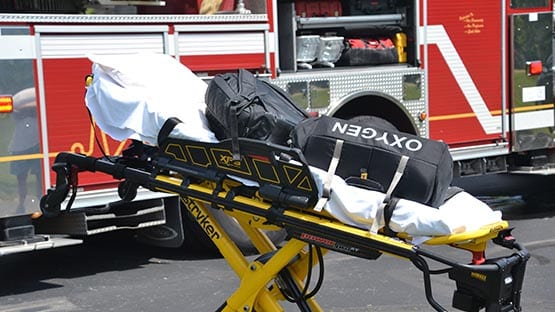
Ask anyone who runs a rescue squad or a small ambulance company where the money goes, and the answer is rarely the one people expect. The vehicle is the obvious cost. The less visible ones are the equipment crews use every shift, the toll that lifting takes on the people doing it, and a station that has to stay warm, lit and charged around the clock.
Those pressures look much the same whether the service is a volunteer squad in the Shenandoah Valley or an independent patient-transport firm in England. Here is where the strain shows up, and where services are finding room to manage it.
Every call ends with a lift
Most calls are not dramatic. They are a fall at home, a patient who needs to get to the hospital, or a discharge back to a house with a narrow staircase. Older homes across Staunton, Waynesboro and the rest of the Valley were not built with a stretcher in mind, and the same is true of terraced houses and walk-up flats in Britain.
That makes moving patients one of the most physically demanding parts of the job. A two-person carry down a tight stairwell puts the crew’s backs and shoulders under load at awkward angles, often late in a long shift. An injured crew member is off the roster, and for a volunteer squad that can be hard to cover.
This is one reason many services replacing older carry chairs look at stair descent equipment for EMS crews that uses tracks and brakes, so two people can guide a seated patient down step by step rather than lift the full weight. Buying recertified units from established makers is one way squads fit that kind of upgrade into a budget that also has to cover fuel, training and insurance.
The station never switches off
The second cost is the building. A station runs day and night. Bay heaters keep vehicles and drugs at a safe temperature in winter. Monitors, suction units, radios and powered stretchers sit on chargers between calls. Ambulances are often plugged in to keep batteries topped up. Add lighting, laundry and a kitchen for crews on long shifts, and the electricity meter rarely rests.
For years that was a background cost. In Britain, it has not been for some time.
What small businesses in Britain now pay for power
The UK government’s Department for Energy Security and Net Zero (DESNZ) publishes what non-domestic customers pay for electricity, broken down by how much they use. Most independent ambulance stations, community transport depots and small medical providers fall into the two smallest bands.
The very smallest users paid an average of 16.71p per kWh in 2019, including the Climate Change Levy. In the first half of 2026 they paid 36.69p, an increase of about 120%. In the next band up, the average went from 14.89p to 28.67p per kWh, an increase of about 93% (DESNZ Quarterly Energy Prices).
In plain terms, every 1,000 kWh a very small business used cost about £167 in 2019 and about £367 in 2026. For a station using 20,000 kWh a year, a figure we use here only as an example, that part of the bill would have gone from about £3,340 to about £7,340.
Why the contract matters as much as the meter
In Britain, businesses choose their own energy supplier and agree a contract for a fixed term. That cuts both ways. A provider that lets its contract lapse can be moved onto an out-of-contract or rollover rate, which is usually higher than a fixed deal, while one that checks the market before its end date has room to do better.
For an operator coming up to renewal, the first useful step is to see what current business energy rates look like for a site of its size and usage, so any quote from the existing supplier can be judged against the market rather than against last year’s bill.
Many stations also use gas for heating and hot water, and a growing number run more than one site. In that case it pays to look at the whole picture. A business energy comparison that covers electricity and gas together, with the end date and notice period of each contract, shows whether the sites can be brought onto the same renewal date and whether the gas deal is quietly costing more than the electricity one.
What Virginia squads can take from it
The picture in Virginia is different in one important way. Most small businesses and rescue squads in the Commonwealth buy their power from a regulated utility or an electric cooperative rather than choosing a supplier, so there is less to gain from shopping around and more from cutting use.
The British figures still carry a lesson. Energy costs that once looked fixed can double within a few years, and a station that knows where its power goes is better placed when they rise. LED bay lighting, timers on bay heaters, and charging equipment on a schedule rather than leaving everything plugged in at full draw all chip away at a bill that never stops running.
Where the savings add up
Neither of these costs makes headlines. A safer way down the stairs and a better energy contract will not change how a service is seen by the public. But they are decisions made once that pay back on every shift: fewer crew injuries, fewer people off the roster, and a station bill that does not climb faster than the service’s income.
For services funded by donations, county contributions or tight contract margins, that is often where the real room in the budget is found.
How we worked this out: electricity prices are from DESNZ Quarterly Energy Prices, table 3.4.2, average prices paid by non-domestic consumers in the very small and small consumption bands, including the Climate Change Levy and excluding VAT, for 2019 and the first half of 2026. Percentage changes and the cost per 1,000 kWh are our own calculations from those published figures. The 20,000 kWh station is an illustration, not a measured figure.”
This content is provided for informational purposes only and is not a substitute for professional advice. AFP editorial staff were not involved in the creation of this content.
Support AFP



 Share