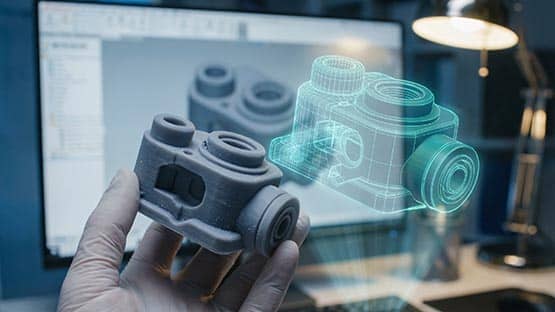
Every successful product starts with an idea.
Sometimes that idea emerges from years of industry experience. Sometimes it comes from a problem someone encounters in daily life. Regardless of where inspiration originates, entrepreneurs face a common challenge: turning a concept into something real.
Historically, that process was expensive, time-consuming, and often out of reach for small businesses. Developing a product typically requires significant upfront investment, access to manufacturing resources, and a willingness to take substantial financial risks before knowing whether an idea will succeed.
Today, technology is changing that equation.
Advances in digital design, rapid prototyping, and modern manufacturing are making it easier for entrepreneurs to test ideas, improve products, and bring innovations to market. As a result, more individuals and small businesses are gaining access to tools that were once available primarily to large corporations.
Why product development has traditionally been difficult
Creating a new product involves far more than having a good idea.
Before a product reaches customers, it must go through multiple stages of development. Designers create concepts. Engineers evaluate functionality. Prototypes are tested. Materials are selected. Manufacturing processes are refined.
At every stage, uncertainty exists.
Will the product work as intended? Will customers find it useful? Can it be produced cost-effectively? Will modifications be necessary?
For entrepreneurs with limited resources, answering these questions has often required difficult decisions. Many were forced to commit significant time and money before fully understanding whether a product was commercially viable.
The result was a development process that frequently favored larger organizations with greater financial flexibility.
The rise of rapid prototyping
Rapid prototyping has helped change that dynamic.
Instead of moving directly from concept to production, businesses can now create physical versions of products much earlier in the development process. These prototypes allow teams to evaluate functionality, identify design issues, and gather feedback before making larger investments.
The benefits are substantial.
Potential problems can be discovered sooner. Improvements can be implemented more quickly. Product teams can make decisions based on real-world testing rather than assumptions.
Many startups and small businesses now rely on services such as Protolabs 3d printing to transform digital concepts into physical prototypes that can be tested and refined before entering production.
This ability to validate ideas earlier helps reduce both financial risk and development time.
Why testing early matters
One of the most expensive mistakes a business can make is discovering a major design flaw late in the development process.
Changes become more costly as products move closer to production. Materials may already be ordered. Manufacturing plans may already be established. Marketing strategies may already be underway.
Rapid prototyping helps businesses avoid these situations.
By creating physical models earlier, entrepreneurs can evaluate performance, identify weaknesses, and gather practical feedback while changes remain relatively inexpensive.
This approach encourages experimentation.
Rather than attempting to perfect a product on the first attempt, businesses can refine designs through multiple iterations. Each prototype becomes a learning opportunity that contributes to a stronger final product.
Small businesses are benefiting the most
Large corporations have long invested heavily in product development resources.
What is changing today is the accessibility of those capabilities.
Small businesses can now access sophisticated design tools, digital manufacturing technologies, and prototyping services without building large in-house operations. This allows entrepreneurs to focus resources on innovation rather than infrastructure.
The impact is particularly significant for businesses developing specialized products.
Whether creating consumer goods, educational products, recreational equipment, medical devices, or industrial solutions, entrepreneurs can evaluate ideas more efficiently than in previous generations.
This creates opportunities for innovation that might never have reached the market under traditional development models.
Innovation beyond major cities
Technology is also helping expand entrepreneurial opportunities beyond traditional business hubs.
In the past, access to product development resources often depended on geographic location. Businesses located near manufacturing centers or major technology regions frequently had advantages that others did not.
Today, digital design tools and modern manufacturing services are helping reduce those barriers.
Entrepreneurs in smaller communities can collaborate remotely, develop prototypes, and refine products without relocating operations. This broader access to innovation resources supports local business development and creates opportunities for economic growth in regions that may have previously faced limitations.
Communities benefit when more innovators can participate in product development.
The educational impact
Rapid prototyping is also influencing education.
Universities, technical schools, and workforce development programs increasingly incorporate digital design and manufacturing technologies into their curricula. Students gain hands-on experience developing solutions, testing ideas, and improving products through iterative design.
These experiences help prepare future entrepreneurs, engineers, and business leaders.
Rather than learning exclusively through theory, students can engage directly with the processes used throughout modern product development.
This practical exposure supports workforce readiness while encouraging creativity and problem-solving.
Looking ahead
The future of product development is likely to become even more accessible.
Artificial intelligence is beginning to assist with design optimization. Simulation tools allow businesses to evaluate products digitally before physical testing. Manufacturing technologies continue to become faster, more affordable, and more widely available.
Together, these innovations are helping reduce barriers that have traditionally limited entrepreneurship.
The ability to transform an idea into a tangible product is no longer reserved for organizations with massive budgets or specialized facilities.
Increasingly, success depends on the quality of the idea and the willingness to test, learn, and improve.
Conclusion
Entrepreneurship has always required creativity, persistence, and a willingness to take risks.
What has changed is the availability of tools that help manage those risks.
Rapid prototyping allows entrepreneurs to validate ideas earlier, improve products more efficiently, and make better decisions before committing substantial resources. For small businesses, startups, and independent innovators, these capabilities can significantly improve the path from concept to market.
As technology continues to evolve, the ability to experiment, learn, and refine products quickly may become one of the most valuable advantages available to the next generation of entrepreneurs.
This content is provided for informational purposes only and is not a substitute for professional advice. AFP editorial staff were not involved in the creation of this content.




 Share
Share