Solid email this morning from Alan, regular reader, on the Tech-UVA game, the kind of good that got me to think through what we know, to this point, in Year 1 of Ryan Odom, about our new-look UVA Basketball program.
The key points from Alan:
- We were bullied, even taking into account the whistle swallowing.
- If we’re not gonna run a scheme like the Pack Line, better brainstorm fast how we’re going to get stops in league play.
Podcast
First, to the bullying:
The lead question from the usual suspects in the assembled media for Odom postgame was about Tech’s supposed supernatural ability on the offensive glass.
Reality check: the Hokies rank 140th nationally, basically, just on the right side of middle of the pack, in offensive rebound rate, per KenPom.
Which is to say, they’re not, usually, the bullies, but rather, the bullied.
And yet, they still owned the offensive boards yesterday, with 20 offensive rebounds, and a 35.1 percent offensive rebound rate.
There were two reasons Virginia lost yesterday – Tech’s work on the offensive glass; and the 41-15 disparity in free-throw attempts.
That second one, my view there, that’s Odom letting the refs bully his team, which had more shots at the rim, more makes in the paint, forced Tech into shooting 15 midrange jumpers, and yet, they got to the line 26 more times.
Coach, dude, you’ve gotta step up for your guys better than that.
ICYMI
Virginia has two losses this season – offensive boards and free throws were the glaring issues in both.
Butler, in its 80-73 win at The Greenbrier in November, had 14 offensive rebounds and a 29-15 advantage in free-throw attempts.
In Virginia’s other Top 100 NET games:
- Northwestern (83-78 W): 6 ORs/17.2% OR rate, Virginia 36-24 advantage in FTAs
- Texas (88-69 W): 13 ORs/32.5% OR rate, Virginia 29-25 advantage in FTAs
- Dayton (86-73 W): 9 ORs/20.5% OR rate, Virginia 27-22 advantage in FTAs
- Maryland (80-72 W): 17 ORs/48.6% OR rate, Maryland 22-21 advantage in FTAs
Notes: The Texas game was garbage time for most of the second half; Maryland made that one more interesting than it should have been because of its work on the boards and getting to the line.
In sum: Tech and Butler got Ws, and Maryland got damn close, by playing bully ball.
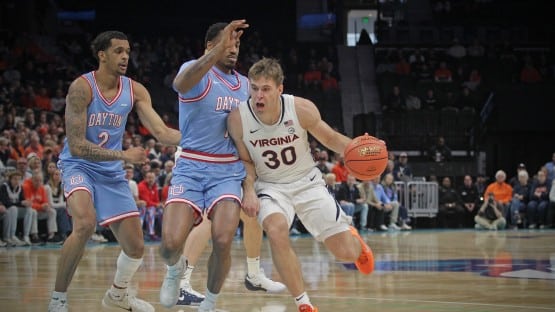
And Dayton, remember, made that one interesting late by forcing an ungodly 21 UVA turnovers.
They didn’t hit the boards, but the struggles that Virginia’s guards endured just trying to get the ball up the court felt like bullying.
So, teams that can play bully ball can have success, or near-success, against this Virginia team.
That’s the surface level.
Deeper dive: isn’t the Odom Scheme supposed to be about playing bully ball?
I’m still trying to figure out, admittedly, a lot about the Odom Scheme, on both ends of the floor.
The defense is based on full-court man, which is intended to try to get the opponent to wasting precious seconds off the 30-second shot clock just getting the ball up the floor.
The numbers bear out that this part of the operation works – per KenPom, Virginia opponents average 18.8 seconds per offensive possession, which ranks 359th nationally, or if you look at it from Virginia’s perspective, seventh nationally, on the defensive end.
For perspective on that:
- Last year’s team forced opponents to use an average of 18.6 seconds per possession, ranking 350th nationally.
- The number for Tony Bennett’s last team, in 2023-2024, 19.3, ranked 362nd.
- Bennett’s last ACC regular-season title team, in 2022-2023, forced an average of 18.8 seconds from its opponents, ranking 360th.
So, the Odom Scheme makes opponents work as hard as Bennett’s scheme did.
Key difference: the opponents are being rewarded at a lot higher rate than we’re used to.
This year’s ‘Hoos are allowing 1.010 points per possession on the defensive end.
Now, yes, last year’s group – technically, the final one of the Bennett era – surrendered a ghastly 1.055; there’s a ton of reasons as to why Ron Sanchez wasn’t retained, but that would be near the top of the list.
Bennett-coached UVA teams never allowed more than the 0.980 PPP that his second team, in 2010-2011, did; seven of his teams allowed less than .900 PPP.
What’s vexing to me as to why the Odom Scheme isn’t producing better results is, two key underlying metrics actually look quite good:
- Virginia is holding opponents to 30.9 percent shooting from three, which ranks 73rd, so, top 20 percent.
- UVA is holding opponents to 43.2 percent shooting on twos, which ranks eighth.
The season-long numbers on defensive rebounding (186th), free-throw attempts/field-goal attempts (193rd) and defensive turnover rate (197th) are the culprits here.
The Odom Scheme’s approach to defensive rebounding – he has guys leaking out for potential transition offense – would seem to be, not a bug, but a feature, though, looking back at past Odom teams:
- His 2023-2024 VCU team ranked 91st nationally in defensive rebound rate.
- His two teams at Utah State both ranked in the Top 30 nationally.
- And he had two Top 50 teams at UMBC.
The hard man defense is also not a bug, but a feature – overplaying the ball on the perimeter, and having seven-footers cleaning things up at the rim, is going to lead to more foul calls.
The tradeoff there is supposed to be, more turnovers – and we’re not getting those.
Odom’s 2024-2025 VCU team ranked 31st nationally in defensive turnover rate.
Forced turnovers and offensive rebounds – Virginia currently ranks eighth nationally there – are supposed to translate into extra possessions.
Odom’s 2024-2025 VCU team, for instance, averaged 4.6 more effective field-goal attempts (field-goal attempts and free-throw attempts) per game than its opponents.
This year’s ‘Hoos are averaging 3.6 more EFGAs than their opponents per game.
Your first glance at the Tech box score would get you to say, hey, UVA had seven more shot attempts from the field, but then, there’s the glaring 26-shot difference at the line.
Do the math on that, dividing the 26 extra free-throw tries by two, you get a net minus-six on EFGAs for our guys.
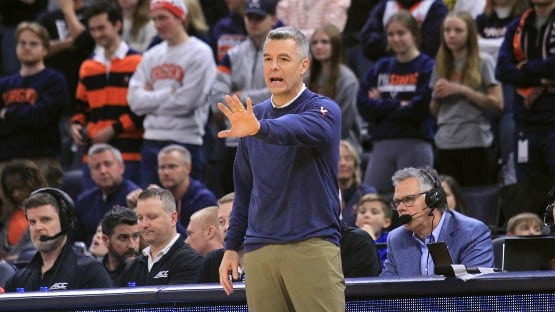
What we were used to, with Tony Bennett, was, control.
Bennett’s approach was to focus on efficiency on both ends – get stops on D, clean up the boards, run good offense, then get back on D.
A Bennett-coached game is scripted, in every aspect – every possession was going to be in the halfcourt, there were going to be fewer of them at that, and if you were going to beat Tony Bennett, you were going to beat him at his game, not yours.
Ryan Odom’s approach is about mastering a series of uncontrollables – he’s willing to gamble on the defensive boards, and have his guards gambling with their man pressure, to try to create turnovers, and transition opportunities; there is no such thing as a bad shot, and in fact, he’s going to be quicker to give you the hook if you pass up a chance to score; he also hits the offensive glass hard, to create second-chance shots.
Both have their pluses and minuses – the minus to Bennett Ball in this day and age being, it takes time to learn his system, and time is of the essence in the NIL/transfer portal era.
The obvious minus to the Odom Scheme is starting to show itself with the two Ls that we’ve seen early this season.
A scheme based on outworking the other side doesn’t work if the other side outworks you.
To win at bully ball, in other words, you need to be the bullies.
Video
Support AFP



 Share
Share

Chris Graham