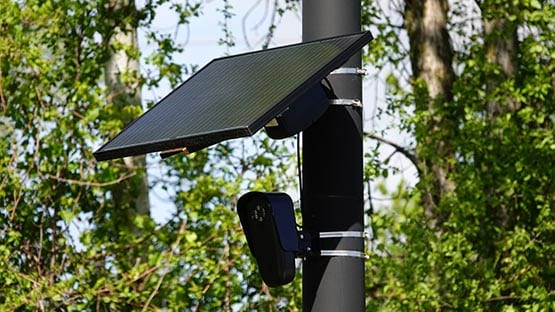
Some Virginia law enforcement agencies are not using automated license plate reader cameras in accordance with a statute enacted last July, according to a new report.
The Virginia State Crime Commission report titled “Law Enforcement use of Automatic License Plate Recognition (ALPR) Update” found that despite legislation to set uniform practices for agencies in the state, “enforcement agencies are not using ALPR in accordance with the new statute.”
More troubling, almost one third of law enforcement agencies did not respond to the questions provided by the Crime Commission.
“Measures will be taken this year to address these issues,” the report stated.
Del. Charniele Herring, chair of the Crime Commission, plans to send letters to law enforcement agencies whose survey responses indicate that their current practices are not consistent with the new statutory requirements for ALPR use.
Herring will also send letters to non-responding law enforcement agencies to advise them of the new ALPR statute and request that they respond to the next Crime Commission ALPR use survey which is planned for later this year.
ICYMI
The Crime Commission also plans to provide presentations on ALPR at the upcoming conferences of the Virginia Association of Chiefs of Police, Virginia Association of Campus Law Enforcement Administrators and Virginia Sheriffs’ Association.
Prior to the July 1, 2025, legislation, Virginia had no statewide statutory or regulatory framework governing law enforcement use of ALPR, with Flock Safety being the most predominant vendor in the state.
ALPR use in Virginia
ALPR data must be purged after 21 days, unless such data is needed for an ongoing investigation, prosecution or civil action.
According to the Virginia statute, law enforcement agencies in Virginia may only use ALPR for:
- Criminal violations under the Virginia Code or any county, city or town ordinance
- Active investigations into a missing or endangered person or a person associated with human trafficking
- Notifications related to a missing or endangered person, a person with an outstanding warrant, a person associated with human trafficking, a stolen vehicle or a stolen license plate.
Finally, law enforcement agencies may only share ALPR data:
- with other Virginia law enforcement agencies, Commonwealth’s Attorneys, a criminal defendant or their counsel or their ALPR vendor;
- pursuant to a court order or court-issued subpoena duces tecum
- to alert the public to an emergency situation, a missing or endangered person, a person associated with human trafficking or a person with an outstanding warrant.
The Crime Commission will also continue monitoring and reporting on law enforcement ALPR use, according to the report.
The cities of Staunton and Charlottesville have recently ceased the use of Flock Safety cameras.
Related stories
- Not so fast: Flock camera remains in Staunton, ‘no idea’ when it will come down
- Staunton police: Flock Safety license-plate reader cameras taken down
- Staunton Police Chief: Flock Safety cameras no longer accessible to officers
- Staunton to cancel Flock Safety camera contract, citing issues with ideology of CEO
- Norfolk | Lawsuit questions legality of 176 Flock Safety cameras in city
- Aaron Barmer: Flock camera removal is victory for all people in Staunton
- Flock cameras, while under fire, helped find the Brown University killer
Support AFP



 Share
Share

Crystal Graham