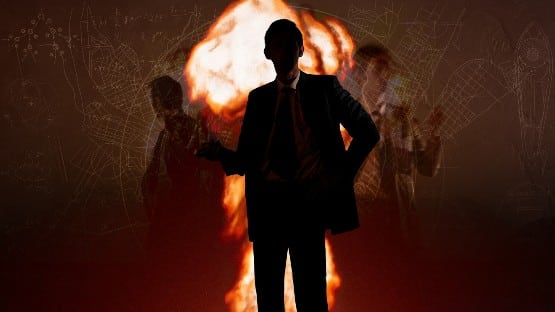
The provocative film Oppenheimer weaves together stories of America’s past that also reflect our present. The narrative threads include:
- the rise and fall of J. Robert Oppenheimer, the “Father of the Atomic Bomb” who led its creation at Los Alamos;
- the collaboration among a constellation of scientists—many Jewish at a time of antisemitism more virulent than today’s—who raced to beat the Nazis in building the first bomb;
- the military and political decision to test “the gadget” two months after Germany’s surrender, then to unleash it on Japan—already defeated in the eyes of many—three months after war ended in Europe;
- the post-war creation of a hydrogen bomb more powerful than Hiroshima’s uranium one;
- the humiliation of Oppenheimer by removing his security clearance, due to expire the following day, making him persona non grata less than a decade after he was revered as an American hero.
In the middle of McCarthyism, Oppenheimer had three “flaws”: having friends and a brother who had been Communists; supporting international transparency to prevent nuclear proliferation; and resisting creation of the fusion bomb—nicknamed “The Super”—with its potential to annihilate mankind.
How super was “The Super?” Hiroshima measured 15 kilo (thousand) tons of dynamite; the H-bomb tested on Bikini Atoll measured 15 mega (million) tons of dynamite. That’s 1000 times greater. With time, the U.S. stockpile grew to over 30,000 warheads and the U.S.S.R’s to 40,000, enough to turn everything on earth into rubble—with enough in reserve to make that rubble rattle.
In the gamesmanship of nuclear strategies, more is more. Oppenheimer was guilty of “premature” anti-proliferation. The year after he died the U.S., U.S.S.R., and other nations concluded a Nuclear Non-Proliferation Treaty.
Why did it take more than twenty years to accomplish the obvious?
In a curious coincidence, Oppenheimer opened as the Army was destroying its last chemical weapons after stockpiling mustard gas and Sarin nerve agent.
Why did it take over seventy years to accomplish the obvious?
Partial answers to these questions include, among others: fear of unseen and unknown enemies; an abiding faith that might makes right; the presumption that we must always maintain the upper hand because we’re America, so we deserve to be Number One always in all ways. Is it any wonder that eliminating AR-15-style weapons of mass destruction from schools, temples, churches, clubs, and streets is not so obvious to many Americans?
In another curious coincidence, Oppenheimer opened as the U.S. agreed to send cluster munitions to Ukraine. To date, 123 nations have signed The Convention on Cluster Munitions, which prohibits using, developing, producing, acquiring, stockpiling, or transferring cluster bombs. The U.S. is not a signatory, nor is Ukraine, nor Russia, which is already using them. Good intentions appear to justify any means. That includes the use of weapons widely known to injure civilians, especially children attracted by the shape, size, and color of tiny bomblets from cluster bombs that fail to explode.
The paradox of these “curious coincidences” startles me, and the silence about the past repeating itself is deafening. I left Oppenheimer wishing my country had learned the history I saw represented in the film. Instead, I perceive the continuing pattern of hubris: chemical weapons in World War One, then nuclear weapons in World War Two, now cluster bombs prohibited by most nations. How do Americans continue seeing ourselves as the moral leaders we yearn to be?
When J. Robert Oppenheimer departed Los Alamos, he told colleagues honoring him: “If atomic bombs are to be added as new weapons to the arsenals of a warring world, or to the arsenals of nations preparing for war, then the time will come when mankind will curse the names of Los Alamos and Hiroshima.”
On August 6th, the 78th anniversary of Hiroshima, I will be thinking about Oppenheimer and the exceptional fact that only my nation has used a nuclear bomb against other human beings. Then we did so a second time only 72 hours later.
Russell Vandenbroucke’s play Atomic Bombers, focusing on the scientists who made the bomb, was performed on public radio to commemorate Hiroshima’s 50th anniversary. Recently retired as Professor of Theatre, he was the Founding Director of the Peace, Justice & Conflict Transformation Program at University of Louisville and is syndicated by PeaceVoice.


 Share
Share