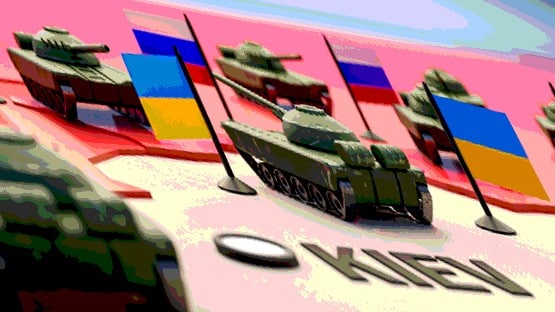
Although the unfolding humanitarian catastrophe in Gaza has captured the world’s horrified attention, the war in Ukraine has had even more terrible consequences.
Grinding on for nearly two years, Russia’s massive military invasion of that country has taken hundreds of thousands of lives, created millions of refugees, wrecked Ukraine’s civilian infrastructure and economy, and consumed enormous financial resources from nations around the world.
And yet, despite the Ukraine War’s vast human and economic costs, there is no sign that it is abating. Russia and Ukraine are now bogged down in very bloody military stalemate, with about a fifth of Ukraine’s land occupied and annexed by Russia.
Meanwhile, polls show that an overwhelming majority of Ukrainians remain determined to continue the struggle to free all of Ukraine from Russian captivity. Indeed, an opinion survey in the fall of 2023 found that 80 percent of Ukrainians polled believed that under no circumstances should Ukraine give up any of its territory.
Similarly, in Russia, polls have found that a majority of the public appears content with the Putin regime’s military conquest of Ukraine and is opposed to any peace settlement that would relinquish Russian control of conquered Ukrainian land. Of course, the accuracy of Russian polls on the Ukraine War remains deeply suspect, for professing opposition to the war could easily lead to arrest, as it did for 20,000 Russians in 2022.
Perhaps for this reason, numerous Russians polled refused to answer the question of where they stood on the war. One participant responded: “Thank you for the opportunity not to testify against myself.” In any case, in increasingly authoritarian Russia, public sentiment against war seems unlikely to alter the Putin administration’s determination to triumph on the battlefield.
Admittedly, in the United States, the major supplier of military and economic aid to beleaguered Ukraine, some developments point to declining enthusiasm for that role. The Republican Party has revived its 1930s policy (once termed “isolationism”) of appeasing military aggression by rightwing dictatorships, while leftists with an anti-American slant see a Russian victory as a useful way of somehow destroying “U.S. imperialism.” Nonetheless, unless Donald Trump and his MAGA followers sweep into power in 2024, it seems unlikely that the U.S. government or its NATO partners will entirely abandon Ukraine to a future under the jackboot of Russian military occupation.
Given these obstacles, is there a way to secure a just settlement of the Ukraine War?
There is, but it will take some creative action by the United Nations, the global organization that has been authorized to enforce international security.
Since the beginning of the Russian invasion of Ukraine on February 24, 2022, the overwhelming majority of the world’s nations have repeatedly used their participation in the UN General Assembly to condemn the Russian invasion and to call for a just peace in Ukraine. For example, on the eve of the one-year anniversary of the war, the General Assembly, by a vote of 141 nations to 7 (with 32 abstentions), demanded that Russia “immediately, completely, and unconditionally” withdraw its military forces from Ukraine and called for a “cessation in hostilities” and a “comprehensive, just and lasting peace” based on the principles enshrined in the UN Charter. The UN Charter, of course, constitutes international law and bans “the threat or use of force against the territorial integrity or political independence of any State.”
Even so, it is the UN Security Council that is tasked with enforcing international security, and Russia has used its veto in that UN entity to block UN action to end the Ukraine War.
The paralysis of the UN Security Council, however, need not continue. As Louise Blais, Canada’s ambassador to the United Nations from 2017 to 2021, has recently pointed out, Article 27 (3) of the UN Charter states that a party to a dispute before the Security Council shall abstain from voting in connection with the dispute. But, when it came to the Security Council’s votes on the Ukraine War, as Blais noted, “none of the 10 elected Security Council members had the courage, vision or backing to put forward a resolution” demanding abstention. According to Blais, the unwillingness of the four other veto-wielding members (Britain China, France, and the United States) to avoid a crippling Russian veto and, thereby, empower the Security Council to act, reflected their “zero interest in supporting such a move for fear it would limit their own power in the future.”
But there is ample precedent for limiting the veto in this fashion. The United Nations has a history of veto-wielding nations abstaining from Security Council voting when they are parties to a dispute. As Blais observes, between 1946 and 1952, Security Council members “regularly adhered to the obligatory abstention rule.” Only in later years did the five permanent Security Council members curtail the application of this practice.
In short, based on both international law and precedent, the UN Security Council has the authority to impose a settlement of the disastrous Ukraine War. What kinds of international action this would require would need to be determined by the world organization, just as the final terms of a peace agreement would ultimately need to be accepted by the contending parties. But, given the overwhelming support in the UN General Assembly for the withdrawal of Russian military forces from Ukraine and for a lasting peace agreement, such a peace settlement is likely to be a just one.
At the least, this would be a far better method of dealing with international conflict than the current full-scale war currently raging in Ukraine. And it could serve as a model for resolving other intractable disputes, such as the brutal Israel-Palestine conflict, as well.
Dr. Lawrence Wittner, syndicated by PeaceVoice, is Professor of History emeritus at SUNY/Albany and the author of Confronting the Bomb (Stanford University Press).

 Share
Share