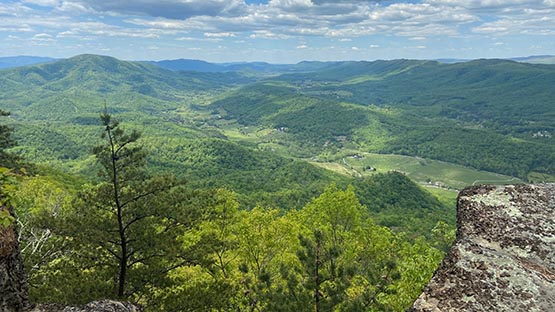
There’s nowhere in the world I’d rather be during spring than the Appalachians, I think I really believe that, as temperate and wonderful as Florida may be.
Some days, of course, it’s still frigid, and I’m reminded that spring is merely the bastard child of winter and summer, which means it sometimes falls back into exemplifying the ugly characteristics of the former. But other days the temperatures rise into the 70s or 80s, and the first thing I have a mind to do is flock to some body of water, somewhere, because it’s been five or six months since I’ve washed myself clean in these ancient rivers and streams.
We visited Florida in March, as we do every year, and I began each day by jumping into the gulf; it was lovely, and I resolved to submerge myself more often when I returned to Virginia, because if I could find a way to dip my body into water once per day, it felt like life would somehow seem more whole, that I’d be able to sleep better at night, and that maybe I’d be closer to God, in some vague and possibly meaningless way.
So, when the temperatures rose to record-setting levels in April, I loaded my 5-year-old son, Conley, and our dachshund-blue heeler mix, Dottie, into my stick-shift Hyundai Accent and putzed out to Falls Hollow Trail in George Washington National Forest.
I’d skim-read online that there were some waterfalls and a minor swimming hole about a mile-and-a-half into the hike, and there were pictures of gorgeous mountain streams, so I figured it was the perfect setting for an unseasonably warm spring day.
The parking lot was little more than a patch of gravel in front of a gate, and there were no other cars, which was a good sign, considering the end goal whenever I go hiking is to be as far away from modernity as possible, people included.
It shatters the mood to hear traffic, or any other human-based noise that reminds me that I live in a society. If I’m not able to convince myself, while walking alone on a trail, that I’ve been transported to a preindustrial era, back before the creep of humanity pulverized the Appalachians and extinguished so many of its native living things, then I might as well turn around and go home.
The sounds of traffic disappeared about a quarter-mile into the hike. We passed a couple of small muddy creeks that Conley wanted to jump into, but I promised him there would be clearer and more robust water up ahead, that we just needed to go in a little further.
We made our way up a steady incline through the woods, over pine needles and dirt and matted leaves, and several times I stopped and stood there, absorbing the silence, which wasn’t really silence, of course, but the absence of civilizational drone: i.e. whooshing vehicles, car alarms, ambulance sirens, barking dogs, a neighbor’s TV blaring Fox News through an open window.
What’s left when this background cacophony is stripped away is a silence so profound that it takes us by surprise.
What this silence actually consists of is this: wind blowing through half-bloomed trees, birds squawking in call-and-response, small mammals rustling through leafy detritus, the buh-bump buh-bump of heartbeats in our ears.
Annie Dillard, that great Virginia author, once wrote: “At a certain point, you say to the woods…now I am ready. Now I will stop and be wholly attentive. You empty yourself and wait, listening.”
It’d been awhile since I listened to this poignant silence; the winter had been cold and hard, as it nearly always is in the Not-So-Deep South, and the smell of warm pine needles and the sight of blue-black butterflies chasing one another like school children and the sun streaking through the canopy and little purple and red and yellow flowers popping up from the soil were welcomed reminders that the world was still in orbit, that we were now tilting in the direction of the right and the good and the true.
Anyway, we were in search of water; it was out there somewhere, the internet had guaranteed it, but we kept slogging up, up, up, through the pines, with little evidence to suggest we were getting anywhere near it.
Conley was perched on my shoulders and leaning to one side, throwing me off my balance and inflaming my already sketchy lower back, while simultaneously whacking a pine cone against my shoulder.
“You’re sweaty, Papa,” he said, to which I responded: “Well, you are a big boy now, and it is 80 degrees today.” He paused for a moment, said “oh,” then went back to pummeling my shoulder with the pine cone.
My lower back tightened with every step, and it sent a cascade of tension into the meat under my shoulder blade, my neck, and even into my skull, causing a dull headache to form at the base of my brainstem.
About 45 minutes into the hike, we took a right-fork that, after about 10 minutes, felt instinctively wrong, so we turned around and humped it back to the main trail. I once again saw butterflies chasing one another, but this time I perceived them as brawling boxers instead of whimsical schoolchildren.
The heat was morphing into something approaching a burden, and I was ready to call it quits.
I told Conley that we might have to settle for those muddy creeks at the start of the trail, that I didn’t want to wander further into the woods, possibly in the complete wrong direction, in search of water that might take us too long to reach.
It was 5:30, and the sun, as I informed him, would be setting soon, especially here in the deep, dark holler. He was having none of it: with the unfounded-yet-infectious confidence of a child who doesn’t understand enough of the world to know better, he convinced me that we must keep going, that water was just around the corner and we’d find it, if we just had a little faith.
I believed him based solely on the cuteness of his face. We crept deeper into the pines, pulled forward by the blind assurance of the small human perched atop my sweaty shoulders, thwacking me with a pine cone on ever-reddening skin.
What is it about water that draws us to it? Is it because we’re mostly made of the stuff, or maybe because our distant single-celled ancestors crawled out of it all those millenia ago, setting us on the dubious path to our current predicament?
Humans, wherever they are, mostly want to be near it; they pay exorbitant amounts of money to buy anything “waterfront,” they fly to tropical locales to vacation near the bluest hues, they pack the hot, wet cement of city pools in the summertime.
All of these high-trafficked bodies of water are fine, I love them myself, but there’s something more spiritually robust about stumbling upon a small waterfall in the silent throat of the mountains.
There’s a baptismal quality to it, the water so cold and (purportedly) pure that you enter it as one thing and come out as another; you brace yourself and take a deep breath and all at once you’re immersed, your skin tight and your blood rushing through your vessels, and in that brief flicker you aren’t worrying about all the wrongheaded things you’ve done in life, or all the wrongheaded things yet to come, but instead letting the cold shock your nervous system and shrink your world to the size of a pretty little flowerhead.
You stay under only for a moment because it is, after all, cold, then you pull your soaked body upward and stand there, waist-deep and hair dripping, sure that life has now changed for the better – and this time, for good.
Conley and I heard the water before we saw it, rushing in the middle distance through a forest in mid-bloom. We stood still for a moment to confirm that it was, in fact, water, and not just the wind playing tricks on our ears. We cut through an overgrown side path, a decision that would lead to a tick bite on the back of my knee, moving toward the sound of the tumbling water like two magnets drawn to their opposite.
About 50 feet into the forest, there it was: a waterfall, with a belly-high swimming hole and a quaint little shore area, cocooned on both sides by sloping forest. It was a personal temporary Eden, and I felt lucky to have found it after being so diaphoretic and ready to abandon the journey just a few minutes earlier.
We splashed around for awhile, and it was glorious, truly: Dottie, the dog, got the zoomies, frolicking in the shallow water then leaping onto the shore and shaking so enthusiastically that she nearly threw herself over. Conley sat on a moss-covered rock and placed his hand in the clear water rushing over it. Eventually, I baptised myself, letting the coldness seize my bones. I lurched upward and broke the surface tension like an ancient lagoon creature, howling and shaking and full of joy, spooking the hell out of Dottie and making Conley wail with laughter.
I loped out of the water and wrapped myself, and then Conley, in a couple of towels, and the two of us sat there, listening to the absence of traffic and car horns and sirens, internalizing the pregnant bliss of nothingness.
We were only at the swimming hole for about 15 minutes, but that’s all we needed to feel like we’d touched something greater than ourselves, something that has been alive for far longer than we can fathom, something that, as far as we know, won’t ever die.
On the way back to the trailhead, I sang “Perfect Day” by Lou Reed to Conley as I carried him on my shoulders, changing some of the words in the verses because I couldn’t remember them verbatim (“watched the butterflies in the park?”).
He was silent behind my head as I finished the chorus. It was the first time he’d ever heard that song, and I thought for a second that maybe he hadn’t liked it, that his mind had wandered elsewhere – to Toy Story, to baseball, to whatever strange lands a 5-year-old’s mind wanders.
But then he said: “Sing it again.”
So, I did, and it was.



 Share
Share