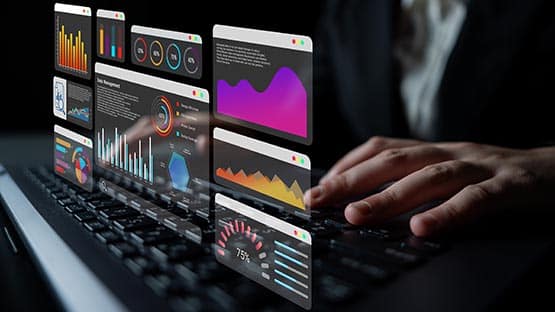
Data informs decision-making. Whether you’re interpreting customer data to understand where you sell best, product usage data to identify future developments, or public web data to keep ahead of your competitors, it is the data itself that gives you the information to make better decisions.
In this article, we will directly identify four broad uses of public web data that organizations like yours use to inform their decision-making: competitor intelligence and product pricing, market research and expansion strategy, B2B lead generation and talent acquisition, and artificial intelligence and predictive modelling. Understanding these four uses will give you some helpful pointers about how to supercharge your business into making better decisions
Collecting data from your competitors’ websites keeps you ahead of the game
The best place to start is with the most common usage of public web data: your competitors and their pricing. Your digital marketing team should be harnessing the power of information to ensure that your product is always competing with your market rivals.
To do this, they should be setting up a series of daily automations that scrape data from the websites of your competitors, and include all pricing data in this gathering procedure, too. By doing it daily, you have the most up-to-date overview of the market and can react quickly when a leading competitor drops their prices for a limited-time promotion.
However, web scraping can lead to being locked out of your rival’s website. This is because the automations can sometimes trigger a soft block based on too many access attempts in a short timeframe, or even because your competitor has easily identified your head office’s IP address via their own data analysis, and blocked your devices from accessing their website.
This situation can, thankfully, be easily bypassed. If your marketing team deploys their automations via a proxy server, your head office won’t be the one locked out, and most providers allow you to change where you connect at the click of a button, giving you guaranteed uptime for the automations. The best proxy provider is truly the one service that gives you a wide range of locations to connect through, especially if it can provide a location in every country where your company operates.
Data is essential to your marketing department
Your marketing and sales teams will also be using public web data to inform their market research and expansion strategies, too. Often, businesses use publicly available data to analyze product availability, stock levels at a range of leading retailers, and historical pricing trends so that they can identify gaps in the market.
Aggregated customer reviews are also scraped to build an overall picture of consumer sentiment about your brand as well as your competitors. Social media comments can also be tracked as part of this, as the objective for your marketing team is to understand what customers want and where your products could be further improved.
Finally, by analyzing geolocation data of your existing customers, and marrying that up with publicly available sociodemographic databases, your business leaders can identify the most profitable regions and furthermore which demographics to target with your next product or launch strategy.
These are great examples of matching two different sets of data to meet one business goal: where are the products sold, what is the sociodemographic profile of that area, and at what price are the items most often bought? With these three factors, you can expand your market into a similar-looking city or region and at the exact price for the perfect product, based on your data analysis.
Sales and human resources use data to identify and track potential leads
Another purpose of public web data is to help sales teams identify lead-generation targets for B2B-related products and services. Companies can either harvest or purchase firmographic data, that is, data detailing key information such as company size, funding sources, and even technology stacks. This data is then used to build lead lists targeting ideal business prospects identified from the information available for each firm.
This same type of data collection can also be applied to individuals. This means that, often, human resources departments scan professional networking sites like LinkedIn, either manually or using a dedicated recruitment tool, in order to locate specialized talent. They can do this proactively, before a job opening is even available, in order to track hiring sprees as well as analyse labor market trends over a longer period of time.
By having such a list compiled, the hiring team can be notified of ideal candidates who may be available based on this range of criteria, which can quickly address potential gaps in the business to minimize the effects of a departing team member.
Technology and financial firms use data for predictive modeling
A final use of public web data to better inform decision-making processes is at the enterprise level. Gigantic tech or SaaS companies are able to train their own in-house AI systems by scraping public datasets and feeding them into the system to produce current and accurate results for any queries that may be leveled at the AI by employees at all levels of the business.
This data harvesting allows extremely large businesses to run in-house systems that support their employees’ decision-making, but it relies on the AI being periodically updated with new datasets to ensure the data remains relevant and future-proof. This way, any forecasting that needs AI input in analyzing market trends or consumer behaviours will at least be based on up-to-date information.
In the financial or insurance industries, forecasting is also heavily reliant on public web data of a different kind. Using both public records and macroeconomic indicators, banks and insurance firms can run predictive modeling on this kind of data, which is readily available online, in order to forecast trends in spending or saving, as well as in the income and expenditure of both businesses and individuals.
For both these particular uses, the forecasts are run to evaluate the risk in any decision-making. Whether it’s in the case of a massive tech company or a nationwide banking partner, they will both build models based on public data to analyze the risk of their next step.
Data informs decision-making across all areas of a business
Everything comes back to decision-making. Without data, companies and individuals would be making blind decisions based on gut feeling and not on sheer evidence. Making good decisions is based on your understanding of available data: what has worked in the past, how you can meet your customers’ requirements, what might happen based on previous patterns.
Understanding the bigger picture is crucial to make sure that a company can make better decisions, and this is wholly down to the relevance of the data and the accuracy of any predictive modeling setups. For data to be kept relevant and accurate, public web data must be scraped or collected. Now that you have a better understanding of how other businesses use such datasets, you can identify the gaps in your own company and where you can improve your own decision-making going forward.
This content is provided for informational purposes only and is not a substitute for professional advice. AFP editorial staff were not involved in the creation of this content.


 Share
Share