Groundwater extraction is causing major U.S. cities to sink, according to new research from Virginia Tech.
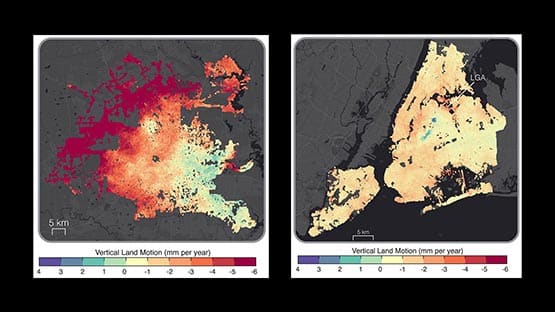
The researchers looked at 28 of the most populous cities and found that at least 20 percent of the urban area is sinking. In 25 of 28 cities, at least 65 percent is sinking.
Combined, the cities are home to 34 million people, or approximately 12 percent of the total U.S. population.
The urban areas are sinking two to 10 millimeters per year.
When land shifts, even a small amount, the structural integrity of building, roads, bridges and dams can be impacted, said Leonard Ohenhen, a former VT graduate student and the lead author of a study published in Nature Cities.
“A lot of small changes will build up over time, magnifying weak spots within urban systems and heighten flood risks,” said Ohenhen.
New York, Chicago, Houston, Dallas, Forth Worth, Columbus, Seattle and Denver are sinking more than two millimeters per year, according to the researchers.
Several cities in Texas exhibited some of the highest measured rates of subsidence at about five millimeters per year — and as much as 10 millimeters per year in certain areas of Houston.
East Potomac Park in Washington, D.C. has subsidence greater than five mm per year.
Cities with high subsidence variability include New York, Las Vegas and Washington, D.C.
“The latent nature of this risk means that infrastructure can be silently compromised over time with damage only becoming evident when it is severe or potentially catastrophic,” said Manoochehr Shirzaei, an associate professor at Virginia Tech’s Earth Observation and Innovation Lab. “This risk is often exacerbated in rapidly expanding urban centers.”
Rapid subsidence also found along the East Coast
In the last year, Shirzaei’s team has also provided looked at the flood risks along the East Coast and found Virginia Beach and Norfolk to be facing rapid subsidence potentially increasing the risk to roads, runways, building foundations, rail lines and pipelines.
The map also showed a large area of the East Coast is sinking at least two mm per year.
“We measured subsidence rates of 2 mm per year affecting more than two million people and 800,000 properties on the East Coast,” said Shirzaei. “We know to some extent that the land is sinking. Through this study, we highlight that sinking of the land is not an intangible threat. It affects you and I and everyone, it may be gradual, but the impacts are real.”
The problem isn’t just the land is sinking, its that the land intersects with population and infrastructure hubs.
“For example, significant areas of critical infrastructure in New York, including JFK and LaGuardia airports and its runways, along with the railway systems, are affected by subsidence rates exceeding two mm per year,” said Ohenhen. “The effects of these right now and into the future are potential damage to infrastructure and increased flood risks.”

 Share
Share

Crystal Graham