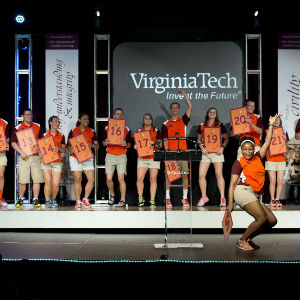
Coca-Cola Foundation will support first generation college students at Virginia Tech

A $100,000 grant from the Coca-Cola Foundation will provide six scholarships to first-year students who are the first in their immediate families to attend college.

A $100,000 grant from the Coca-Cola Foundation will provide six scholarships to first-year students who are the first in their immediate families to attend college.

A Virginia Tech team led by Nancy Brossoie, senior research associate at the Center for Gerontology, has been awarded a $945,000 grant to provide substance-misuse treatment training to students in undergraduate and graduate health professions in Southwest Virginia.

As the freshwater shrimp in his ponds continued to grow and multiply, Charles Carter knew he had a good product to sell.

Two Virginia Tech electrical and computer engineering faculty members are the lead investigators on a $1.37 million, international research project that may lead to higher performance for wireless networks in densely populated venues including arenas, theaters, and transportation hubs.

Scientists from the Virginia Tech Carilion Research Institute and clinicians from Carilion Clinic have discovered how to sensitize drug-resistant human glioblastoma cells to chemotherapy.

Virginia Tech’s proposed School of Neuroscience promises to be a unique program in the nation, one that will study not only disorders of the brain, such as Alzheimer’s disease and traumatic brain injury, but also the mind itself, including decision-making, behavior, and creativity.

Eleven counties, cities and towns across Virginia have received technical assistance grants ranging from $5,000 to $15,000 to map, evaluate and plan for conserving their natural resources.

A $1.7 million grant awarded to two Virginia Commonwealth University researchers may lead to improved diagnosis and treatment of overactive bladder – a condition that affects nearly 20 percent of adults and that is characterized by symptoms such as urinary urgency, frequency and incontinence.

Environment can make all the difference in behavior – even at the cellular level. Scientists at the Virginia Tech Carilion Research Institute have discovered even a small shift in environmental factors can change how a cell in the immune system matures.

Findings now online and slated for the Nov. 5 issue of Molecular Cell by a team of researchers with the Virginia Bioinformatics Institute at Virginia Tech and international collaborators show that the same is true of cells — timing is indeed everything.
We don’t take press releases or official statements as the final word. Digging in to get the whole story takes time and resources.