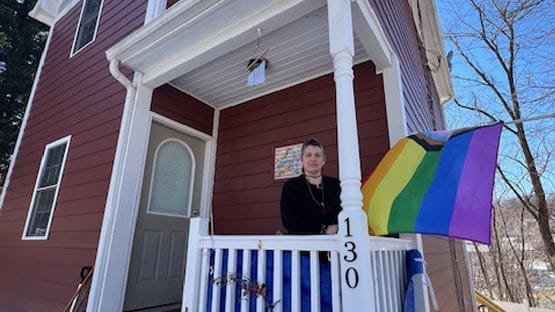
When you live in poverty all your life, it’s hard to envision a future that’s any different. Staunton resident Nikki “Nitch” Lynlee thought that through home ownership, she might be able to break the cycle, build wealth and pass on some equity to her own children one day.
Her partnership with Habitat for Humanity in 2007 seemed like the answer to develop financial independence.
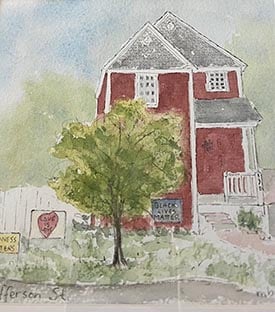
Despite limited means, Lynlee was able to purchase a three-story, 976-square-foot red home in Staunton’s West End sandwiched between the Newtown historic district.
Lynlee worked with the Staunton-Augusta County-Waynesboro Habitat for Humanity affiliate, and together, with support from Virginia Housing, she thought her dream of a different life was finally coming true.
However, all these years later, she feels the promise of generational wealth is still beyond her reach.
Lynlee once felt her relationship with the nonprofit organization was more than what was printed on a piece of paper; she truly bought into the idea that Habitat was her partner in the home.
“One of the things we were told when I became a partner was it’s not just about providing a house, a roof over your head, although that’s wonderful,” she said. “It was about helping partners develop wealth.”
After the purchase, her life changed in ways that she could never have anticipated, unfortunately not for the better.
Lynlee faced health challenges that prevented her from working, and she pursued disability benefits. While she waited for approval, her only income was child support. It was a struggle to make ends meet and be able to put food on the table for her family; and she sometimes relied on community support when money was tight to help with things like heating and cooling.
It wasn’t easy, but somehow Lynlee managed to keep a roof over her head all these years.
No room for change
Five years ago, Lynlee’s life changed again.
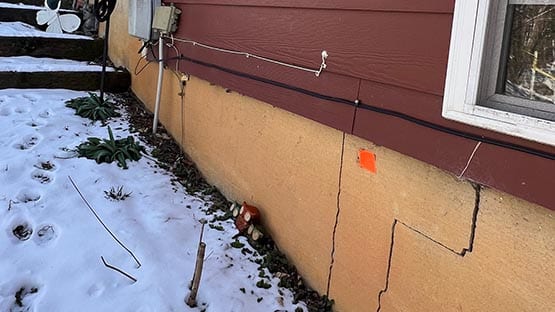
She entered into a platonic partnership with an older man and wanted to move in with him and rent her home to save up to make repairs that she had neglected over the years due to the cost. She felt it would be a win for everyone involved – she could finally address the cracking foundation and save to fix her HVAC system; and above all else, she’d still own her home which seemed to fit Habitat’s narrative.
After some research, she found she could likely rent her home for $1,400 per month, which would allow her to save money for the first time in her life.
“But Habitat would not enter into any negotiations with me about redefining what our partnership looked like, so I couldn’t do that.”
Frustration mounted as she felt hamstrung with an agreement that no longer met her needs and with red tape that she felt limited her options to break out of poverty once and for all.
Her partner had two surgeries last year, and he moved in with her temporarily because she could care for him. In her home, his bed was set up on the main floor just beyond the living room of the home, in a makeshift space likely meant to be a dining room. It made for tight quarters, but the pair soon began to brainstorm how they could live together once and for all.
Lynlee made another plea to Habitat for help.
She asked for assistance in reaching out to neighbors to see if they could purchase adjoining property to expand the footprint of her existing home, allowing her and her partner to age in place together.
Unfortunately, she hit another brick wall. Even if they could find a way to help her, she was landlocked; her neighbors did not want to sell.
“I’m a crier,” Lynlee told AFP. “I was like, do you know understand what this means?”
Poverty: A never-ending cycle

Emotionally, the setbacks took their toll as she grappled with the idea that she may have to live separately from her partner who is her best friend.
Selling her home would end her contract with Habitat for Humanity and give her the freedom to walk away, but anyone who has tried to break out of poverty or lived in it for any period of time, knows that when you have something, anything, you will do everything in your power not to lose it.
If she sold her home now, she would not get the full value of the appreciation; a portion would go back to Habitat to fulfill her contract. While she would likely still come out ahead of where she started nearly two decades ago, it certainly wouldn’t allow her to escape poverty completely, and it wouldn’t be enough to buy a home again if her life circumstances changed again.
She could refinance the home, and pay off the loan, but with interest rates what they are today, she doesn’t consider this the right time to pursue that avenue.
With those scenarios off the table, she again started to think about the idea of renting her home. While the organization had said no before, a change in leadership meant she had the opportunity to pitch the idea again. The fine print in her contract, however, requires her to live in the home as her primary residence.
“I can’t really do anything without Habitat’s permission, and they have first right of refusal, so I mean, they’ve just got me every which way from Sunday.
“I just want Habitat to partner with me in this and evolve, the contract and their participation, our collaboration as partners, as my situation has evolved. I mean, my kids are grown, they are out of the house now. My needs in 2025 are much, much different than when we originally signed the contract.”
Habitat ED: ‘I truly would love for there to be a resolution’

SAW Habitat for Humanity Executive Director Brad Bryant is still getting his feet wet at the helm of the nonprofit, having started the job on June 2. While it’s a new title, he previously served on the Board of Directors for Habitat, so he had a pretty good idea of how things work within the organization.
He met with Lynlee shortly after he learned about her situation and said he made a couple phone calls on her behalf to neighbors. He found that they weren’t willing to sell, so that meant that expanding the home still wasn’t an option.
ICYMI
- Local Habitat to host meet-and-greet as organization works to rebuild leadership team
- ‘I’m all in’: Habitat for Humanity names Brad Bryant to executive director role
- Experts: Nonprofit boards have opportunity to learn from United Way, Habitat for Humanity
- New executive director at Habitat for Humanity looks at 2025 with fresh set of eyes
- Staunton: Habitat for Humanity ‘survives’ tumultuous year with exit of executive director
The language in the Habitat International contract states that renting her house is “distinctly and unequivocally not allowed.”
“There will not be an instance in which she can rent her house,” Bryant told AFP.
While he said there isn’t any wiggle room on renting the home out, there are other areas where Habitat has the ability to offer assistance.
For example, Habitat gives its homeowners much more grace on late payments than a traditional bank would. Even when payments are not made, they try to find a solution, whereas with a bank, after 90 days, you could lose your home.
Bryant isn’t surprised that Lynlee’s situation is different now than when she purchased her home. Most people who buy through Habitat stay in their homes about 17 years.
“At 17 years, they find that they’ve changed their position. They do have equity in the house. There has been appreciation of their house, and they can cash out, and now they actually become in the market for the house they want, right? They have a down payment; they have stability,” Bryant said.
While he is financially secure now, Bryant said he hasn’t forgotten what it feels like to struggle. As a child, his dad made only $30,000 per year and was the sole provider for their family of seven. His dad died when he was only 17, which made things even harder for them.
That understanding is part of what led him to reach out to Lynlee and put in time and effort to try to come up with something that could be helpful in her situation. Over time, he hopes to get to know the other 30+ clients of Habitat to learn more about what the organization has done right and wrong and to get a better understanding of each of their needs.
“I truly care about these situations,” he said. “I’m always going to want good for you, and that’s just my nature.
“I truly would love for there to be a resolution,” he said. “I am bound by what paperwork is back there. I am bound by what rules are in place.”
‘I cannot give up … my nest egg’
Lynlee’s partner had another surgery in late July, and since there was no ability to expand her home, he purchased a home on his own. It wasn’t the outcome that Lynlee had hoped for.
Her relationship isn’t the status quo, and she feels Habitat has struggled to adapt to her queer platonic relationship.
“What’s mine is mine, and what’s his is his. I have worked, and he’s worked to provide for himself. He’s been single his whole life. I’ve worked to provide for myself. I cannot give up what I have as my nest egg.
“I don’t have a 401K. I don’t have investments. I don’t have stocks and bonds. I don’t even have a savings account. I live paycheck to next day like most people in poverty.”
When her home loan is paid in full, and she owns it free and clear, she said she might be willing to consider putting it on the market.
Seven years from now, her partner will be 84 years old.
Shades of grey
While her legal agreement with Habitat may be a black-and-white issue to some, Lynlee isn’t willing to accept that. Her mindset is that there is always a grey area somewhere in between.
Through advocacy, it is her hope that even if it doesn’t help her in this situation, it could benefit the next person who pursues a home through Habitat for Humanity or a similar program. She hopes that sharing her story in some way may lead to positive change.
“If I am true to my principles and to my own morals and being the best advocate I can be, if that means that I’m the person that has to risk the most with my own story, then I’m willing to do it, because the story is more important than my comfort.”
She’d like to see future home buyers who partner with Habitat have more flexibility as they age and their situations change.
Lynlee plans to pursue alternatives that may allow her to pay off the $45,000 she still owes on the house so she can finally break free from the contract she signed nearly 18 years ago.
“It’s really not about me now,” she told AFP on Tuesday. “I’ll be more than fine because of others who care about me. I didn’t always have that, and many others still don’t.”
Support AFP


 Share
Share

Chris Graham