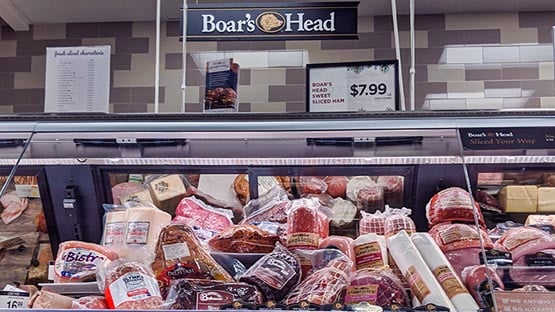
A Virginia Boar’s Head plant is set to reopen after it was indefinitely closed following a deadly Listeria outbreak in 19 states approximately one year ago.
Six days ago, the company website showed 24 available jobs at the Jarratt plant ranging from plant manager to spice maker or pickle maker.
Company officials told The Detroit News that the location is scheduled to reopen in coming months.
On July 18, 2025, U.S. Department of Agriculture officials lifted its forced suspension at the Jarratt plant that came in response to the outbreak.
“The facility is in full compliance of the guidelines and protocols set for the safe handling and production of food and the serious issues that led to suspension have been fully rectified,” the USDA’s Food Safety and Inspection Service told TDN.
Breaking down the deadly outbreak linked to liverwurst
In total, 10 people died and 61 people were infected in the multistate outbreak of Listeriosis linked to the production of liverwurst at a Jarratt plant.
The 10 deaths spanned multiple states including Virginia: one in Illinois, one in New Jersey, two in New York, one in Virginia, one in Florida, one in Tennessee, one in New Mexico and two in South Carolina.
In Virginia, there were four cases and one death linked to the outbreak. Three lawsuits were filed related to cases in the Commonwealth: one on behalf of a Newport News man who died; and two others, one from a woman in Williamsburg and one from a man in Smithfield who were hospitalized due to Listeria from the liverwurst product.
Approximately seven million pounds of liverwurst and deli meat products were recalled after a liverwurst sample texted positive in July 2024.
The plant announced its closure on Sept. 13, 2024, and said in response to the deadly outbreak, it would permanently discontinue production of liverwurst.
USDA: Outbreak due to ‘inadequate sanitation process’
A report by the Food Safety and Inspection Service within the U.S. Department of Agriculture found that the Jarratt outbreak was due to “inadequate sanitation process” including the presence of product residue on equipment and condensation in production areas.
Inspectors also observed facility and structural-related issues including cracks, holes and broken flooring and rust, condensation and peeling caulk.
FSIS released 44 pages of inspection reports showing overspray on walls, blood in puddles on the floor, rancid odors, flies, gnats, cobwebs and mold on walls.
One example of condensation documented in the report read that in an effort to take corrective action, an employee wiped the area but the leaks returned within 10 seconds. The inspector wrote that the issue was near fans that looked to be blowing the liquid onto uncovered deli meats.
The liverwurst cook tank room, where it is believed the deadly strain of Listeria originated, was inspected shortly before the outbreak, and condensation was noted as an issue.
A Seattle lawyer who has sued companies over food poisoning outbreaks told the AP that the conditions described in the reports were the worst he has seen in three decades.
The Listeria outbreak was the largest since 2011. In recent years, there have been Listeria outbreaks associated with queso fresco, peaches, ice cream, leafy greens, mushrooms, deli meat and cheese. There are approximately 260 deaths in the United States each year attributed to Listeria.
Lesson learned? Well … reports seem to point to no
In the announcement of the Jarratt plant closure, Boar’s Head said it fully understood “the gravity of this situation and the profound impact it has had on affected families.”
FSIS conducted thorough inspections at other Boar’s Head plants including establishments in Arkansas, Indian, Michigan and Virginia.
In the aftermath, the USDA announced several steps it would take to regulate processing facilities including broader Listeria species testing, better training for food safety inspectors and more follow-up with systemic issues during food safety assessments.
Boar’s Head promised “comprehensive measures” would be put in place “to prevent such an incident from ever happening again.”
“This is a dark moment in our company’s history, but we intend to use this as an opportunity to enhance food safety programs not just for our company, but for the entire industry.”
Boar’s Head said it would implement enhanced food safety and quality measures.
“We remain steadfast in our commitment to our customers and to the safety and quality of our products. You have our promise that we will work tirelessly to regain your trust and ensure that all Boar’s Head products consistently meet the high standards that you deserve and expect.
“We are determined to learn from this experience and emerge stronger.”
Unfortunately, similar problems were found at other Boar’s Head plants this year, according to a Freedom of Information Act request obtained by the Associated Press.
The Petersburg location, approximately 30 miles from the Jarratt plant, had issues with handwashing, residue on meat hooks and conveyor belts, beaded condensation in hallways, foul odors, chipping paint and dark discoloration on ceilings, to name a few.
Related stories
- Crystal Graham: Family ties to the town of Jarratt, its history, its namesake, run deep
- USDA: ‘Inadequate sanitation’ culprit of deadly Listeria outbreak at Boar’s Head plant
- Boar’s Head Listeria outbreak linked to 10 deaths, 59 hospitalizations in 19 states
- Boar’s Head plant linked to fatal Listeria outbreak will close permanently
- Lawsuit seeks $10M for Williamsburg woman sickened in Boar’s Head Listeria outbreak
- Retailer list released in deadly Listeria outbreak includes 300-plus locations in Virginia
- Virginia family files first wrongful death lawsuit in Boar’s Head Listeria outbreak
- Tough questions ahead for Boar’s Head, USDA after deadly Listeria outbreak
- Expert on Boar’s Head recall: Businesses ‘generally work hard’ to serve safe food
- Boar’s Head plant responsible for deadly Listeria outbreak had blood, flies, black mold
- Nine dead, 57 sick due to Listeria outbreak linked to Virginia company
- New death reported in Virginia in listeria outbreak linked to deli meats
- Virginia company expands recall; linked to Listeria outbreak strain that killed two
- Possible source of Listeria outbreak that killed two traced to Virginia company
- Two dead, 28 sick due to Listeria outbreak in multiple states including Virginia
Support AFP


 Share
Share

Crystal Graham