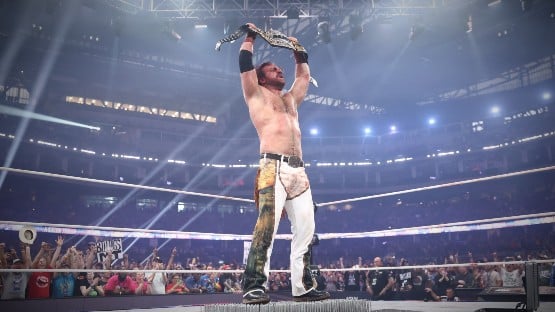
A new AEW king, “Hangman” Adam Page, was crowned at Globe Life Field at “All In: Texas,” ending the nine-month world title reign of terror of Jon Moxley.
Over the course of those 273 days, Moxley became a deeply divisive figure.
His victory over Bryan Danielson at “WrestleDream” was sudden, abruptly ending the title run of “The American Dragon” and his career as a full-time pro-wrestler in one fell swoop.
Fans still had whiplash, but the trajectory of Moxley’s reign didn’t improve. A brief feud with an impassioned Orange Cassidy careened Mox into a haphazard four-way match at “Worlds End” that left fans unimpressed.
From there, Moxley became entangled with “The Rated R Superstar,” Adam Copeland, and his cadre of adjutants. Altogether, the feud seemed antithetical to Moxley’s dogma.
From their inception, The Death Riders postulated that they were a necessary evil—ridding AEW of the complacency that afflicted it. Moxley was challenging the rising stars to inherit the promotion. Instead, he spent the better part of three months feuding with a 51-year-old has-been.
By the time Swerve Strickland was repelled at “Dynasty,” fans were apathetic. The audience had become desensitized to Marina Shafir, Claudio Castagnoli, PAC and Wheeler Yuta, and the stable’s penchant for interference.
Once The Young Bucks and Gabe Kidd became affixed to Mox, the collection became a caricature of itself. Moxley’s allies felt less like acolytes and more like weapons that could be deployed at a moment’s notice. And it became difficult to invest ourselves in Moxley’s title defenses, until The Death Riders.
However, amidst The Death Riders saga, a cultural shift began to take place within All Elite Wrestling.
“Switchblade” Jay White and Will Ospreay entered the Owen Hart Foundation Tournament, in hopes of deposing Jon Moxley. MJF began courting The Hurt Syndicate, hoping to create an infrastructure that could rival Moxley’s Death Riders.
Inadvertently or not, The Death Riders had produced enough pressure to turn coal into diamonds.
ICYMI
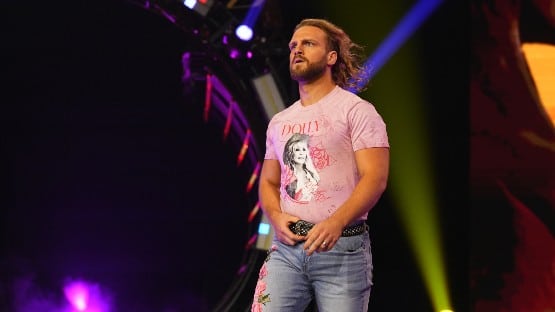
At the center of that movement was “Hangman” Adam Page.
From AEW’s inception, “Hangman” Page was destined to inherit the promotion from its founders: Kenny Omega, Cody Rhodes and The Young Bucks. Page’s journey to the summit was mired in failure, losing to Chris Jericho at “All Out” (2019) to crown the inaugural AEW World Champion. Then, Page failed to defeat Kenny Omega at “Full Gear” (2020) in the finale of the 2020 Eliminator Tournament, losing an opportunity to face Jon Moxley.
When “Hangman” finally defeated Omega at “Full Gear” (2021), it seemed like the prince who was promised had finally fulfilled his destiny. However, not all was as it seemed. After a tremendous feud with Bryan Danielson, Page felt rudderless in the ensuing three month—leading to a lackluster title defense against Adam Cole at “Revolution” (2022).
By early May, “Hangman’s” less-than-stellar reign had done irrevocable damage to his perception—while CM Punk’s stock was soaring. So, Tony Khan devised a change.
At “Double or Nothing” (2022), “Hangman” lost his AEW World Championship to Punk. The feud proved to be an inflection point in the promotion’s history. For Page’s transgressions, the former champion was forced to pay an untenable toll. Thus, a new saga began for the “Hangman.” One marked by tragedy.
His first obstacle in that journey was none other than Jon Moxley, culminating in a violent Texas Deathmatch at “Revolution” (2023). The match ended with Page hanging Moxley from the ropes with a steel chain.
“Hangman’s” victory over Mox should have been the beginning of a renaissance. Instead, he was roped back into a supporting role with his old friends, The Elite.
Afterwards, his critically acclaimed feud with Swerve Strickland began, sending the “Hangman” down a darker road. In the aftermath of their initial trilogy of matches, Strickland ascended to the summit—capturing the championship that Page revered.
“Hangman” became singularly focused on crushing Strickland, forgoing “Hangman’s Tale” for the more foreboding theme, “Black Hat.” The song beckoned an executioner; not the anxious millennial cowboy that the company rested its faith in.
“Hangman” finally exacted some measure of revenge at “All Out” (2024), burning Strickland’s childhood home down (kayfabe, of course) and then violently dismantling him in an unsanctioned light’s out match.
Several months later, he took part in that aforementioned fourway match at “Worlds End;” rekindling their rivalry. However, Page didn’t have the wherewithal to defeat Mox amidst the chaos.
Page had reached the depths of despair. Now, it was time for him to crawl back into the light, and his feud with MJF facilitated that transformation.
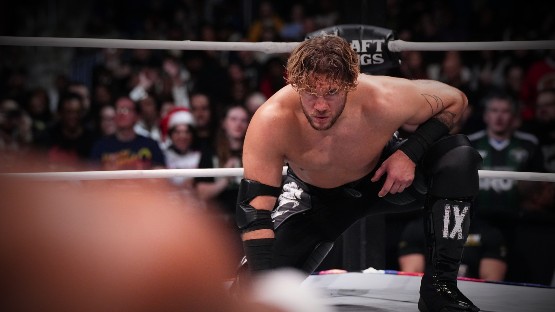
Page’s victory over Will Ospreay at “Double or Nothing” (2025), thrust him into a familiar role as the promotion’s savior. However, in order to close that dreaded chapter in his career, Page needed to recapture the championship that he lost when this saga began. The “Hangman” needed to slay the king.
We may never know what Tony Khan’s initial plans were, when Jon Moxley killed Bryan Danielson at “WrestleDream” and won the AEW World Championship. Regardless, this outcome felt preordained. Violence had always been the order of Page and Moxley’s rivalry. It’s their currency.
What better way for this reign of terror to end, than in a Texas Deathmatch at “All In: Texas?”
It’s always been easy to root for “Hangman” Adam Page. Whether he’s condemning CM Punk, burning down a man’s home, or cutting a promo in the heart of CMLL in fluent Spanish, “Hangman” always wears his emotions on his sleeves.
He’s honest to a fault and unapologetically human. Those are the qualities that have made Page so endearing. In the weeks leading up to this match, Page became a unifying force—not only amongst his allies, but for the fans who vehemently reject Moxley.
Only in Texas Death can the villain receive all of the punishment he’s owed. And, only in Texas Death can the fans find catharsis.
Over the course of his title reign, Moxley lost most of his charm. His anti-pop approach prevented his challengers from experiencing many of the emotional highs that babyfaces are accustomed to, in title matches.
Instead, the gratification was delayed, until this moment.
For example, Mox has resisted his urge to blade for the majority of his title reign. In the rare instances where he has bled, it’s been earned the “hard way.” That is, by accident or pure force.
ICYMI
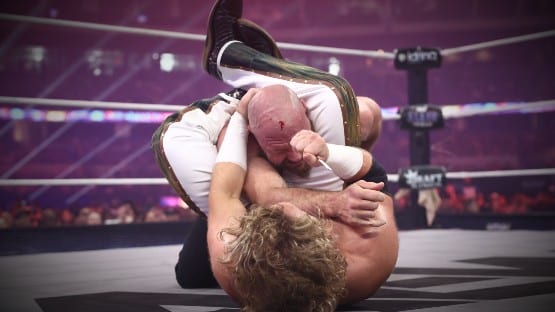
Here, he let the flood gates open.
In the first act, “Hangman” takes Moxley to hell and back. With his back against the wall, the champion’s only recourse being the tools in his toolbox—his subordinates.
Here, the Texas Death stipulation shines—providing a plausible explanation for a gamut of run-ins. Will Ospreay tried to nullify Gabe Kidd, Claudio Castagnoli and Wheeler Yuta before they could swarm Page, but The Death Riders quickly engulfed “The Aerial Assassin.”
However, reinforcements arrived in the form of Bryan Danielson and Darby Allin—both of whom were central to The Death Riders’ early exploits.
Page regains control, forcing Marina Shafir to help Mox answer a ten-count. Here, the cracks in the champion’s guise begin to reveal who he truly is. Jon Moxley is a coward.
Matt & Nick Jackson were Moxley’s final trump card. Page’s equalizer proved his unlikeliest ally: Swerve Strickland.
After disposing of The Young Bucks, Strickland handed Page a steel chain. The gesture typified the culmination of the “Hangman’s” saga. The steel chain symbolized Page’s agency and with it, he could finally defeat Jon Moxley.
The walls surrounding Jon Moxley began to close in. Finally, the champion was afraid and no one could save him.
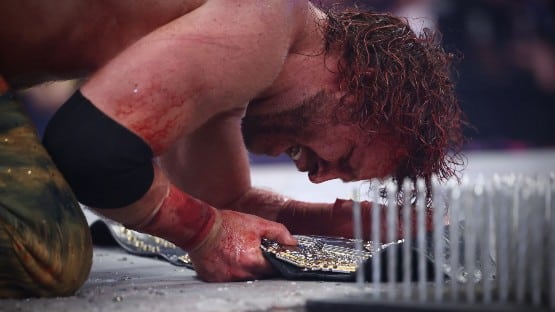
Moxley desperately tried clawing his way out of “Hangman’s” clutches, but quickly found himself hanging over the ropes from Page’s steel chain. Moxley convulsed.
No one fears death itself more than The Death Rider.
The “Hangman” saga began when he lost the AEW World Championship. So, it’s only fitting that it ends with him recapturing what he lost.
“Hangman” Adam Page paid the untenable toll. Finally, tragedy has turned into triumph.
Support AFP



 Share
Share