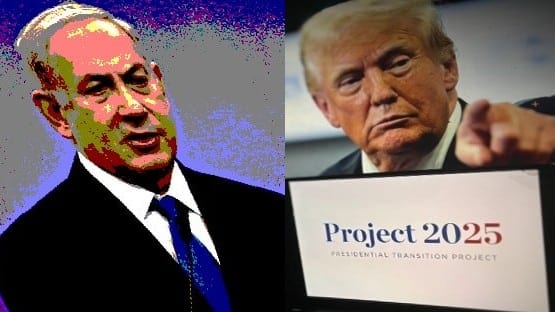
In the lead-up to Israel’s devastating attack on Iran’s nuclear facilities and its military leadership, Donald Trump posed as a peacemaker and concerned bystander.
Trump said that he much preferred a nuclear deal with Iran to war but hinted that he might not be able to keep Israeli Prime Minister Benjamin Netanyahu from ordering a strike.
Then Trump shifted June 12 when asked about an Israeli strike: “I don’t want to say imminent, but it looks like it’s something that could very well happen,” he told reporters at the White House. No sooner did the attacks come than Trump warned Iran, not Israel: accept U.S. terms for a nuclear deal or face “even more brutal attacks.”
The meaning of this sequence of comments seems clear to me: Trump, the Good Cop, saw value in using Netanyahu, the Bad Cop, to force Iran, the victim, to plead for a deal.
In the last few weeks it seemed that conditions were ripe for revival of a nuclear deal with Iran—one similar to the deal Trump discarded in his first administration. Iran was experiencing serious economic problems; Trump was determined to secure normalization of relations between Saudi Arabia and Israel; the threat to Israel from Hamas, Hezbollah and Syria had been greatly reduced; and the International Atomic Energy Agency‘s reports suggested that Iran was moving ahead on its uranium enrichment program.
An IAEA resolution reinforced those reports, declaring that Iran was in breach of its nuclear obligations, citing “undeclared nuclear material and activities” and failure to provide credible explanations. “Unless and until Iran assists the agency in resolving the outstanding safeguards issues, the agency will not be in a position to provide assurance that Iran’s nuclear program is exclusively peaceful,” the IAEA director general said.
But in much the same way as in the Russia-Ukraine peace talks, Trump failed to close the deal he said he wanted. He talked peace but did nothing to prevent a war. He did not use the leverage the U.S. has with Israel to avoid a regional conflict and great loss of life.
Secretary of State Marco Rubio was quick to dismiss the notion that the U.S. was involved in Israel’s attack yesterday. Well, not directly involved, but most certainly a party.
Just a week ago, Trump claimed he stopped Netanyahu from ordering an attack on Iran. Trump also repeated his desire that Netanyahu end the war in Gaza. He could have warned Netanyahu again this time, and backed the warning by saying that the U.S. would not help defend Israel from an Iranian retaliation—that unlike last October, when the U.S. provided defenses against Iran’s missile and drone attack, Israel this time would be on its own.
But Trump kept up the pose as a powerless outsider, hoping for a nuclear deal but using Netanyahu to strengthen the U.S. bargaining position with Iran. As Ali Vaez, director of the Iran program at the International Crisis Group, says: “I think the military pressure is aimed at achieving what economic pressure has not achieved, which is for Iran to give up its enrichment program.”
Once again Netanyahu has outflanked Trump and undercut what remains of the peace forces in Israel. Faced with domestic and international pressure finally to halt military operations in Gaza, Netanyahu responded in his usual way: more war.
He has pulled the same stunt time and again—in the West Bank, in Lebanon, in Syria, and now again in Iran: ratchet up tensions, divert Israelis’ attention from his failure to gain the release of hostages, and win the affection of the far right. Netanyahu claims to act in Israel’s self-defense: If I don’t attack Iran, Iran will get the bomb and obliterate us.
His actual view, strongly supported by his far-right cabinet ministers, is that now is the perfect time to “finish the job” and eliminate Israel’s Iran problem. Netanyahu has always opposed U.S. talks with Iran and has yearned for a green light from Washington. Two facts he refuses to consider are that Israel has a nuclear weapon arsenal more than sufficient to deter Iran, and that U.S. negotiations with Iran (as President Obama showed in 2015) to prevent its enrichment of uranium to nuclear-bomb level contribute to Israel’s security.
A further reason for questioning Netanyahu’s announced motives for striking Iran now is that the Israeli attacks seem to have been directed mainly at decapitating its military leadership rather than at totally destroying its nuclear weapon capability. The list of key Iranian military figures who were killed suggests that Israel wanted to undermine regime stability and accomplish what the U.S. has never been able to accomplish: regime change.
But to do that really depends on how Iran’s public as well as its leaders react. If the past is any guide, the leadership will appeal to national pride in counterattacking Israel and denouncing its American supporters. And with that will probably come Iran’s withdrawal from the nuclear talks and rapid movement toward producing deliverable nuclear bombs.
Once again, the U.S. is positioning ships and planes to defend Israel on the pretext of only defending American forces in the Middle East. With Israel determined to carry out multiple attacks on Iran, all-out war looms as a distinct possibility.
The only hope for ending further Israel-Iran exchanges of fire is diplomatic intervention by Saudi Arabia and the other Arab states. In their own self-interest, they should act immediately.
Mel Gurtov, syndicated by PeaceVoice, is Professor Emeritus of Political Science at Portland State University.



 Share
Share