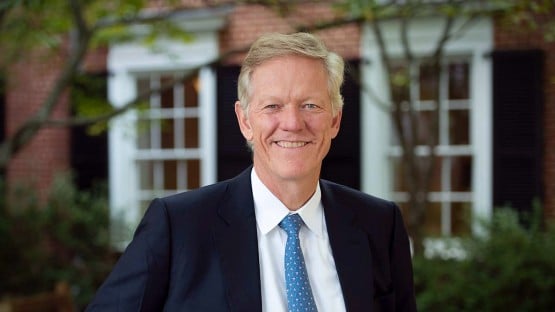
Scott Beardsley became the 10th president at the University of Virginia in January. He is, by all accounts, a man of accomplishment: a former McKinsey senior partner, a successful Darden dean, a skilled fundraiser, and a persuasive public figure. The UVA Board of Visitors chose him through a process that was rushed, opaque, and structurally compromised by conflicts of interest. That process deserves its own reckoning — and it has begun to receive one.
But there is a second question that has largely been avoided, and it is time to ask it plainly: Does Scott Beardsley’s doctoral credential — the University of Pennsylvania’s Executive Ed.D. — qualify him to lead one of America’s great public research universities? My answer is no, and the reasons are not about elitism. They are about governance and what it means to lead a community of scholars.
About the author
- James Finkelstein, Professor Emeritus of Public Policy at George Mason University, is an authority on the university presidency.
The Doctor of Education was born at Harvard, which established its Graduate School of Education in 1920 and conferred the first Ed.D. the following year. Dean Henry Holmes had a reasonable idea: education was a distinct profession, like medicine or law, and its senior practitioners deserved a doctorate focused on applying knowledge rather than generating it. Where the Ph.D. asks “what is true?,” the Ed.D. was designed to ask “what works?” Harvard eventually lost confidence in how the experiment had played out. In 2013, it quietly discontinued the Ed.D., replacing it with a redesigned doctorate in education leadership — an implicit acknowledgment that, after ninety years, the degree label had never fully resolved its identity problem.
That history matters because it clarifies what the Ed.D. is — and is not — meant to represent. The Ed.D. can be an appropriate credential for training school superintendents and other senior practitioners who need advanced analytical tools for real-world leadership. It is not equivalent to a research doctorate, and those who have worked hardest to reform and defend it have generally been the first to say so.
Here is the irony that matters most for UVA. UVA’s School of Education and Human Development offers its own executive Ed.D. in Administration and Supervision — a four-year, part-time program that meets one Friday and Saturday per month, with two years of coursework followed by two years of independent dissertation research. The program is designed for working K-12 school leaders: principals, assistant principals, division superintendents. UVA keeps cohorts small and builds the program around sustained mentorship, on the explicit premise that doctoral development cannot be compressed without losing something essential. If UVA requires four years to confer an Ed.D. on a school principal, one might reasonably ask what it should require of a university president.
That is UVA’s standard for what an Ed.D. requires. Scott Beardsley’s Penn Executive Ed.D. was completed in 22 months. The curriculum tells its own story.
Penn awards 19 course units for the Executive Ed.D. — but the program’s own materials disclose that all admitted students transfer the equivalent of a full year of graduate coursework from a prior degree. In Beardsley’s case, that prior degree is an MBA from the Sloan School of Management at MIT. Credit awarded for business school coursework completed years earlier, toward a different degree, in a different field, is now counted toward a doctorate in higher education management.
After that transfer, what remains is a compressed sequence of modules, most carrying fractional unit values — 0.33, 0.5, 0.67 — reflecting intensive weekend sessions rather than semester-length courses. The entire research methods foundation, quantitative and qualitative combined, amounts to roughly one full course equivalent. At a research university, methods training alone includes a series of semester-long courses, because the capacity to design, execute, and defend original scholarly inquiry is not a skill acquired in a module. It is the foundation on which doctoral work rests. Compressing it is not an efficiency. It is a statement about what the degree is designed to produce.
Penn is candid about this. The program explicitly aims to produce leaders who use “scholarly inquiry as a management tool.” That is a coherent and honest description of a professional doctorate. It is not a description of the research training and scholarly discipline that define the faculty at a Research 1 flagship university.
Set that beside the years-long scholarly apprenticeship that defines the faculty he now leads. Most UVA faculty spent five to eight years becoming scholars — enduring the slow grind of archival work, rejected grant applications, false starts, and the discipline of peer review. They produced a single, original, independently examined contribution to knowledge and defended it publicly before experts who owed them nothing.
That process is not credentialism. It is transformation. It changes how you read evidence, tolerate uncertainty, and evaluate competing claims when the answer is not obvious and incentives are misaligned. The question worth asking is not whether Beardsley is a capable administrator. It is whether two years of monthly weekends produce the same change in professional judgment — and whether it matters who leads a community for whom that experience was the defining feature of their careers.
I have read Beardsley’s dissertation. In my professional judgment — informed by decades of work in and alongside colleges of education at major research universities and documented in detail with my colleague Judith Wilde in a separate analysis — it does not meet the standard I would apply at any institution with which I have been closely associated. The Ed.D. reform movement deliberately relaxed the dissertation standard in favor of applied, sometimes collaborative work. That can be legitimate for a professional degree. It is not a legitimate basis for claiming equivalence with the research doctorate held by most faculty at a top research university — or, for that matter, with the four-year Ed.D. that UVA itself requires.
ICYMI: Scott Beardsley
- Vanishing act: How UVA’s presidential search missed what took us an hour to find
- Prof shades new UVA president: Not qualified for elite university presidency
- Analysis: It won’t cost nearly as much for UVA to name a new president as you thought
This is not an argument that presidents must be great scholars. It is an argument that research universities are built around scholarly norms, and that leadership credibility depends in part on having lived within those norms. We generally expect the managing partner of a law firm to be a lawyer and the head of an academic medical center to be a physician. These are not arbitrary guild rules. They reflect professional socialization, judgment, and the credibility that makes leadership possible within a professional community. Universities are professional communities, too.
When faculty do not recognize their president as a scholarly peer — when they sense that the person making decisions about tenure, research investment, and academic priorities has not traveled the same academic path they have—something important erodes. Not in open conflict, but quietly: a withdrawal of faculty investment in shared governance, and a growing conviction that the administration neither understands nor particularly values the academic enterprise it nominally leads. That dynamic has a name: managerialism. And it damages the research mission in ways that take years to diagnose and longer to reverse.
Roughly 90 percent of university presidents come from academic backgrounds, a proportion that has held steady for decades. That is not an accident. It reflects an institutional logic that governing boards override at their peril.
Credentials are not destiny, and I say that without irony. But the Board of Visitors made a consequential choice that UVA’s faculty, students, and the citizens of Virginia who fund this institution, deserve to understand clearly. UVA’s own Ed.D. program requires four years because the institution knows that serious doctoral development cannot be done in two. The version Scott Beardsley holds was completed in half that time.
A great public university is not a managed enterprise. It is an intellectual community. Scott Beardsley leads one. The UVA Board of Visitors should be clear-eyed about what their choice signals.
Support AFP



 Share
Share