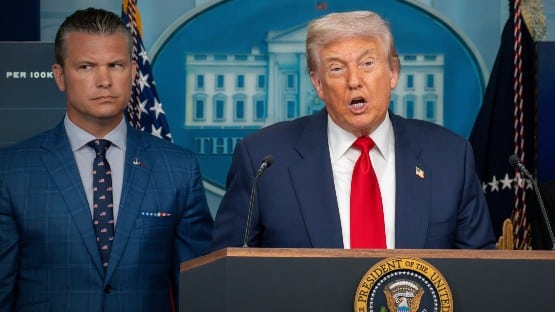
Defense Secretary Pete Hegseth wobbled on Tuesday as he tried to launch his TV defense that he shouldn’t, in fact, be brought up on war-crimes charges, mumbling something about “fog of war,” and blaming reporters in “air-conditioned offices” nitpicking him, as he lectured at reporters from, you guessed it, an air-conditioned office.
“I did not personally see survivors, but I stand, because the thing was on fire, it was exploded, and fire and smoke, you can’t see anything. You got digital. This is called the fog of war. This is what you and the press don’t understand,” Hegseth told reporters covering a made-for-TV Trump Cabinet meeting, trying to explain away the summary executions of two men on a boat in international waters who had designated by the administration as narco-terrorists, which sounds impressive, but isn’t a real, legal term.
ICYMI
The first of the pair of Sept. 2 missile strikes blasted the boat, in international waters off the coast of Venezuela, to kingdom come, but two of the men on the boat survived and were clinging to life.
Under U.S. and international law, they would, at this stage of whatever the nature of the proceeding initiated by the Trump administration was, be afforded protections as either prisoners of war – though we’re not at war with Venezuela – or criminal suspects.
It’s unclear how much time passed between the first strike and the second strike – maybe an hour or two, it now seems, per a timeline provided today by Hegseth – but a second strike was carried out, killing the two either POWs or criminal suspects.
Hegseth, appearing on “Fox & Friends” on Sept. 3, boasted that he had watched the operation “live,” which he is now trying to walk back.
“As you can imagine, at the Department of War, we got a lot of things to do, so I didn’t stick around for the hour and two hours, whatever, where all the sensitive site exploitation digitally occurs,” Hegseth said today, using the made-up name for the Department of Defense that will not help him when he goes in front of the military tribunal.
“I moved on to my next meeting. Couple hours later, I learned that that commander had made the, which he had the complete authority to do, and by the way, Admiral Bradley made the correct decision to ultimately sink the boat and eliminate the threat. He sunk the boat, sunk the boat, and eliminated the threat. And it was the right call,” Hegseth said.
Admiral Bradley is Mitch Bradley, the commander of the U.S. Special Forces and 1991 Naval Academy grad, who you can imagine is himself lawyering up, given what he’s about to face, which is, yes, his own military tribunal.
Because “fog of war” won’t work as a defense to killing the survivors of a military or police action.
There’s a reason those six congressional Democrats put out a video a couple of weeks ago advising military members that they are obliged to resist carrying out illegal orders.
A second missile strike taking out the survivors of a dubious first missile strike against guys said to be running drugs on a boat 1,500 miles off the U.S. mainland is about as illegal as you can get.
“I can say this: I want those boats taken out. And if we have to, we’ll attack on land also, just like we attack on sea,” said Donald Trump, in between bouts of nodding off, after spending most of the night mean-tweeting at the world, at least giving us the courtesy of telling us ahead of time about his fresh plans to violate U.S. and international law.
“I hear Colombia, the country of Colombia, is making cocaine, they have cocaine manufacturing plants, OK? And they sell us their cocaine. We appreciate that very much. Anybody that’s doing that and selling it into our country is subject to attack,” Trump said.
And anybody who participates in such an attack – and violation of another nation’s sovereignty – will find themselves subject to our update to Nuremberg.
Support AFP


 Share
Share

Chris Graham