Everyone knows the feeling: the same meal, the same company, even the same table settings somehow feel like an occasion at a restaurant and like a Tuesday at home. The difference is not the chef. It is a lighting formula that hospitality designers have refined for decades, documented in design specifications, and applied so consistently that diners never notice it — they only feel it. The formula is also why restaurant photos of food and faces beat home photos taken on the same phone. Every part of it can be copied at home, most of it for the price of bulbs and a dimmer, and the whole conversion fits in a single weekend.
The formula hiding in plain sight
Walk into any well-reviewed restaurant after dark and four decisions are already made around you. The light is warm — 2200K to 2700K, the color range of candle flame, because it flatters skin and food and signals that work hours are over. The light is low — dining areas often run at a tenth of the brightness of a home kitchen, which shrinks the perceived world down to the table and the faces around it. The light is placed at face level — candles, low pendants, small table lamps — because overhead light alone drops shadows into eye sockets and under chins, and hospitality designers treat that as a cardinal sin. And there is exactly one fixture worth looking at, usually over the bar or the center of the room, giving the eye a destination. Warmth, dimness, face-level placement, one focal point: that is the entire secret, and none of it requires a restaurant budget.
The numbers restaurants actually use
The infographic below compresses hospitality lighting specifications into the version worth saving. The brightness gap is the number most people find shocking: the average American dining room is lit like a workspace, at five to ten times the level of the restaurants its owners love.
The Restaurant Lighting Formula
Four decisions hospitality designers make in every dining room — and homes usually make none of:
1. WARM COLOR: 2200K candle, 2700K max. The color of flame — never above 2700K after dark
2. LOW BRIGHTNESS: Home dining Restaurant, dim to 20–40% of full output at dinner
3. LIGHT AT FACE LEVEL: Candles or low lamps between faces —overhead light alone shadows every expression
4. ONE FOCAL FIXTURE: One fixture worth looking at, dimmed warm —the eye’s destination in the room.
Warmth + dimness + face-level light + a single focal point: the whole formula, at any budget.
Translating each technique to a home
Every hospitality move has a residential equivalent, and the price gap between the professional version and the home version is smaller than any other category of design imitation:
| Restaurant technique | Home translation | Cost |
| 2200–2700K lamps throughout the dining room | Replace every visible bulb with 2700K (or 2200K filament) from one batch | $20–$60 |
| Dimming presets by hour of evening | One LED-compatible dimmer on the dining fixture, set 20–40% at dinner | $25–$60 |
| Candles on every table | Two or three real or quality LED candles at the centerpiece | $15–$50 |
| A statement fixture over the room’s center | A chandelier sized to the table — half to two-thirds of its width, hung 30–36 in (76–91 cm) above it | $200–$1,200 |
| Perimeter glow from sconces and wall wash | One or two plug-in sconces or a corner lamp on the room’s edge | $60–$180 |
| Zero cold light visible from the dining area | Switch kitchen task lights off, or separate their circuit from ambient | $0–$60 |
Read top to bottom, the table is also a priority order: the bulb swap and the dimmer deliver most of the feeling for under $120, the candles add the face-level layer, and everything after that is refinement.
The fixture restaurants never skip
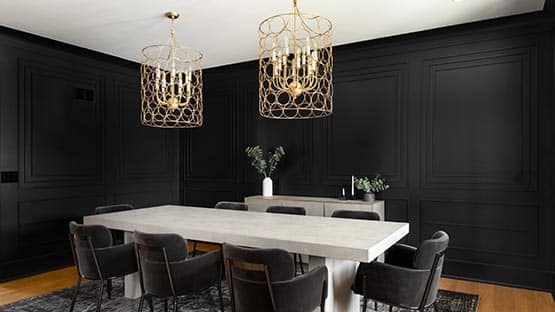
Of all the line items, the focal fixture is the one restaurants treat as non-negotiable, because it does two jobs at once: it centers the room visually, and — dimmed low — it produces the flattering downglow that makes food photography from restaurant tables so much better than from home ones. The residential equivalent is the dining chandelier, and the selection logic hospitality designers use translates directly: visual interest at low output (glass, crystal, and open frames stay beautiful when dimmed; solid shades just go dark), warm-toned finishes that agree with 2700K light, and scale generous enough to read as intentional. This is the one purchase in the formula where a general home store falls short, since the pieces that hold up to the dimmed-warm test cluster at specialty sellers; an evening spent in a shop devoted entirely to ceiling fixtures — filtering by dining spaces and table size — covers in one session what hospitality designers spend procurement budgets on.
What not to copy
The formula has boundaries worth respecting. Restaurants light their kitchens like operating rooms — 4000K and bright — and homes should too while cooking; the trick is separating that light from the dining sight line, not eliminating it. Restaurant-level dimness also assumes diners never read homework or pay bills at the table, so the home version needs the full brightness range on tap: 100% for tasks, 20–40% for dinner, which is exactly what the dimmer provides. And skip the colored LED accents that casual chains use — hue belongs to bars, not dining tables, and it wrecks food color at home just as it does in the chains.
The one-weekend version
The full conversion fits in a weekend and a modest budget. Saturday morning: buy 2700K bulbs for every fixture visible from the dining table, one dimmer, and candles. Saturday afternoon: install the dimmer (or have an electrician do it for $75–$150), relamp everything, and test the room at 30% after sunset. Sunday: decide whether the current overhead fixture survives the dimmed-warm test — if it goes dark and shapeless at 30%, it is the one upgrade left, and the only one that costs real money. Most homes discover the first day’s $120 already carried them 80% of the distance.
Dinner at home, restaurant rules
Restaurants do not feel better because they spend more on light; they feel better because they decide about it, while homes accept whatever the builder installed. Four decisions — warm, dim, face-level, one focal point — separate the two, and every one of them is available at hardware-store prices except the fixture, which is a once-a-decade purchase. Make the four decisions once, and the ordinary weeknight table inherits the thing people actually go out for: a room that tells everyone at it that this hour matters.
This content is provided for informational purposes only and is not a substitute for professional advice. AFP editorial staff were not involved in the creation of this content.




 Share
Share