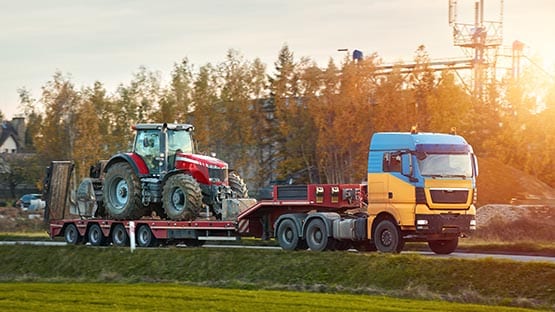
That used tractor on a dealer’s lot in Ohio looks like a steal on your phone. Then you think about getting it down I-81 to a farm outside Staunton. A big four-wheel-drive or a combine won’t go in an enclosed van, and hardly anybody in Augusta or Rockingham County owns a trailer rated to haul one. So you buy the machine, and now it has to come home somehow.
This is where a flatbed service comes in, and it’s also where a lot of deals quietly go sideways. The used market is busy right now for a reason.
With new machines selling slowly, more farmers are shopping the used market far from home: RFD-TV reports, citing the Association of Equipment Manufacturers data, that U.S. tractor sales finished 2025 nearly 10% below 2024, while combine sales fell more than 35%.
That puts plenty of people on the phone booking a flatbed service for the first time. Most trouble comes from questions nobody asked.
Measure it yourself first
Don’t go by the brochure. Measure the real length, width, and height at the widest and tallest points. If the combine still has its head on, measure it that way, then ask whether it’ll ship with or without it. Those are two very different loads. Duals on a tractor might have to come off or get narrowed. Weight counts too, and the spec sheet usually lists a dry number. Add fuel and ballast (and the loader bucket you forgot about). Carriers price and permit from what you tell them. Shave six inches off the height and that low bridge isn’t going to care it was an honest mistake.
Ask what trailer is coming
“Flatbed service” covers a lot. A step deck gives you more room under bridges. For a tall or very heavy machine, a double drop might be the only thing that works, or a removable gooseneck, which lets a machine drive straight on over the front. Ask the flatbed service which trailer they plan to send. If the answer sounds like a guess, keep calling around.
Permits, and who’s paying for them
Anything oversize can need a permit in each state it passes through, and every permit has its own rules on roads and hours. Plenty of states won’t let oversize loads move on weekends or holidays. If the route runs through Pennsylvania, some rural roads there get posted during the spring thaw, which can push a load onto a longer path. Find out whether the flatbed service handles all that, and whether those fees are already in the quote.
Chains, tarps, and the unloading question
Chains and binders need to be rated for the weight. If there’s a cab with glass up front, ask about a tarp, especially if it looks like rain somewhere along I-81. Then think about the other end. Most farms don’t have a dock, and a tractor or combine usually comes off on ramps. So the flatbed service needs to send a trailer with ramps, or a deck that sits low enough to make that work. Better to sort that out on the phone than in your driveway while the driver watches the clock.
Insurance and who picks up the phone
Ask how much cargo coverage the flatbed service carries, and compare it to what you paid. Somebody saying they’re “fully insured” doesn’t tell you much. Then ask how you’ll track the load, and who calls if it’s running late.
None of this takes long. Maybe ten extra minutes on the phone, which is a lot cheaper than finding out the hard way.
This content is provided for informational purposes only and is not a substitute for professional advice. AFP editorial staff were not involved in the creation of this content.



 Share