A plant that switches from palletized sacks to bulk bags doesn’t just change a line item on a purchase order. It rearranges the floor, rewrites the labor plan, and generates a different waste stream. Operators treat the package as a procurement detail, then discover months in that it was a facility decision.
The assumptions behind that decision are where the money leaks. Most of them don’t hold up under a careful look.
“The package is just how the material shows up”
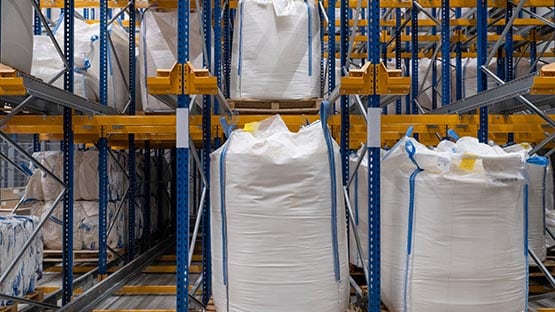
Packaging gets filed under logistics, but it sets the physical shape of the receiving dock, the staging footprint, the discharge station, and the dust capture around it. A plant layout engineered for pallet jacks and hand-add sacks will not absorb a super sack program on its own. Someone has to find overhead clearance for the unloader frame, a hoist rated for the full load, and a staging lane for bags that cannot be shelved.
Picking the right source for those materials matters as much as picking the right bag. A broker like Diversified Ceramic Services can specify what shows up on the truck and in what format, which is the earliest point at which layout, labor, and waste are being decided.
“Dust is a housekeeping problem”
Discharge of fine powders from a bulk bag releases airborne material, whether operators notice it or not. Treating that as something the night crew sweeps up ignores what the dust actually is: an ignition hazard, a product-loss hazard, and a compliance exposure. A thin accumulated layer across a surprising fraction of a room’s surface area is enough to put a facility inside a recognized explosion risk.
The practical consequence is that the discharge station is a system, not a frame. It needs a dust collector sized for the material, a bag-sealing mechanism that cuts emissions during the cut-and-dump, and anti-static construction appropriate to the powder’s ignition energy. Design that in before the first bag arrives, not after an insurance inspector flags it.
“An FIBC is an FIBC”
The bag types are not interchangeable. As outlined in technical guidance on electrostatic hazards, selecting the appropriate FIBC depends on the material’s ignition characteristics, the surrounding atmosphere, and the bag’s ability to control static discharge.
The wrong one around a combustible powder is a direct safety failure, not a paperwork one. Type A and Type B bags handle non-flammable materials with no flammable solvents nearby. Type C bags must be grounded during fill and discharge. Type D bags dissipate charge through engineered yarns and can operate around powders with very low minimum ignition energies without a ground connection.
Choosing between them is a function of the powder, the surrounding atmosphere, and the plant’s grounding discipline, in that order. Specifying by habit, or by whatever the last supplier shipped, is how the wrong bag ends up at the wrong station.
“The empty bag is someone else’s problem”
Each discharged bag becomes waste the same shift it empties, and the volume adds up fast in a plant running several tons a day. Polypropylene is technically recyclable, but recovery rates for it remain low in practice. That means most empty FIBCs end up landfilled unless a plant sets up a real diversion program.
Setting one up is straightforward, but it requires decisions upstream. Bags that contained hazardous or regulated materials usually can’t go into a standard recycling stream. Liners, labels, and non-PP components need to come off.
A baler and a staging area have to exist somewhere on the floor plan. All of that is cheaper to design than to retrofit.
Where the decision actually gets made
The super sack decision is a layout decision, a labor decision, a safety decision, and a waste decision pretending to be a packaging decision. Treating it as the last of those is how plants end up with the bag they wanted and the operation they didn’t.
The useful move is to walk the format through the plant before signing the contract. Where does the bag land, who rigs it, and what catches the dust? Where does the empty go, and who pays to move it? If any of those questions returns a shrug, the savings on the spec sheet are not the savings the plant will see.
This content is provided for informational purposes only and is not a substitute for professional advice. AFP editorial staff were not involved in the creation of this content.


 Share