California gets treated as a single climate in conversations about outdoor materials, which produces fence specifications that work reasonably well in some parts of the state and underperform significantly in others. The coastal strip from San Diego through the Bay Area has a climate character that’s fundamentally different from the Inland Empire, the Central Valley, or the high desert communities east of Los Angeles, and material behavior across those environments diverges enough that what holds up well in one location can degrade noticeably faster in another even when the installation quality and maintenance practices are identical.
What coastal conditions do to metal
Salt air is the most aggressive environmental factor affecting metal pool fencing along the California coast, and its effects aren’t limited to properties with direct ocean frontage. The marine layer that blankets coastal communities for significant portions of the year carries salt particulate inland far enough that properties several miles from the water experience meaningful salt air exposure over the lifespan of an outdoor installation. That exposure affects aluminum and steel differently, but neither is immune to the accelerated oxidation that salt air produces when maintenance doesn’t actively interrupt the process.
Powder-coated aluminum is the standard specification for pool fencing across most of California, and the coating quality matters significantly more in coastal environments than it does inland. A powder coat applied at adequate thickness to a properly pretreated aluminum substrate provides reasonable protection against salt air oxidation for a meaningful period of time, but that protection depends on the coating remaining intact. Scratches, chips, and abrasion points that expose the base metal become corrosion initiation sites in coastal environments within a timeframe that would be inconsequential in a drier inland setting.
Stainless steel hardware on aluminum fencing is worth specifying specifically in coastal applications rather than accepting the zinc alloy hardware that comes standard on most fence systems. The hardware points, hinges, latches, and fasteners, are the locations where moisture accumulates and where the coating is most likely to be compromised by the mechanical action of the components, and those are precisely the locations where corrosion establishes itself first in salt air environments.
Thermal cycling in inland and desert communities
The Inland Empire, the Coachella Valley, and the communities in the high desert east of the Los Angeles basin experience temperature ranges across a single day that coastal California rarely sees. A summer day in Palm Springs or Victorville can move from a cool morning to afternoon temperatures that drive metal surface temperatures well above ambient air temperature, followed by a significant overnight drop. That thermal cycling produces expansion and contraction in metal fencing that stresses the connections between components, particularly at post bases, gate hardware, and the points where horizontal rails connect to vertical posts.
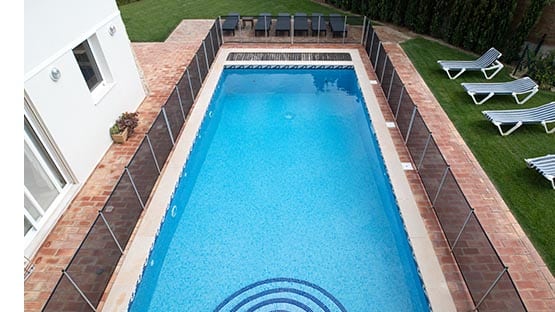
Pool safety fence installation in California communities with significant thermal cycling needs to account for this movement in the way connections are made rather than treating the installation as static once the concrete has cured. Hardware with some capacity to accommodate thermal movement performs better over a multi-year period in these environments than rigidly fixed connections that concentrate stress at a single point each time the cycle runs.
Composite and glass panel systems handle thermal cycling differently than aluminum. Glass has a lower coefficient of thermal expansion than metal and behaves more predictably across temperature extremes, which is part of why frameless glass systems are specified in some high-desert applications despite their higher initial cost.
UV exposure and polymer components
The UV index in Southern California, particularly in communities without the marine layer that moderates coastal radiation exposure, is high enough that polymer components in fence systems degrade measurably faster than they do in lower-UV environments. Plastic post caps, polymer latch components, and any vinyl elements in a fence system are subject to UV-driven brittleness that develops over years rather than immediately and produces failures at stress points when the material can no longer absorb impact without cracking.
Specifying UV-stabilized polymer components rather than standard grade is a straightforward upgrade that most fence suppliers can accommodate, and the cost differential is small relative to the labor cost of replacing components that failed ahead of the expected service life. In the highest UV exposure zones of California, the specification conversation is worth having explicitly rather than assuming the standard components are adequate for the specific environmental conditions of the installation location.
This content is provided for informational purposes only and is not a substitute for professional advice. AFP editorial staff were not involved in the creation of this content.

 Share
Share