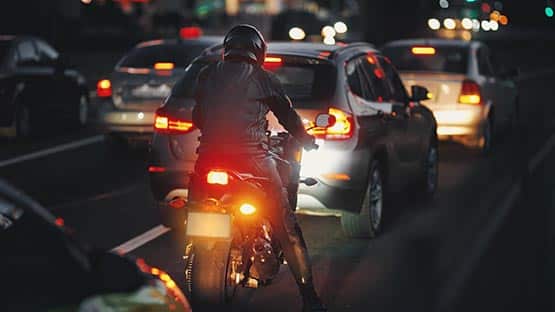
A motorcyclist approaches congested traffic on Highway 59 near Sugar Land and attempts to pass between two lanes of slow-moving vehicles. Suddenly, a driver changes lanes, causing a collision that leaves the rider seriously injured. Texas law specifically prohibits motorcycle lane splitting, but violating that restriction does not automatically determine who is responsible for the accident.
Understanding this distinction is essential because both motorcyclists and passenger vehicle drivers have independent traffic safety obligations. The circumstances surrounding the collision determine whether one or several parties contributed to the resulting injuries.
Texas law explicitly prohibits motorcycle lane splitting
Under Texas Transportation Code Section 545.0605, motorcyclists cannot operate between lanes of traffic moving in the same direction. The law also prohibits passing another motor vehicle while remaining within the same lane.
These restrictions became effective on September 1, 2023, following the enactment of House Bill 4122.
Texas distinguishes prohibited lane splitting from riding two motorcycles side by side within a single lane. Section 545.0605 permits two motorcycles to travel abreast, while prohibiting more than two from occupying the same lane together.
The statute also establishes exceptions for police officers performing official duties.
Motorcycles have the right to an entire traffic lane
Section 545.0605 expressly recognizes that motorcyclists are entitled to full use of a traffic lane. Other motorists generally cannot operate their vehicles in ways that deprive motorcycle riders of that space.
This provision matters when a passenger vehicle attempts to pass a motorcycle without changing lanes completely.
Motorcycles do not have fewer roadway rights simply because they occupy less physical space than cars. Drivers must respect their designated lane and exercise reasonable care when passing or merging.
A collision involving improper lane encroachment therefore presents different legal questions from one involving prohibited motorcycle lane splitting.
Unsafe lane changes create separate driver liability
Under Texas Transportation Code Section 545.060, drivers must remain within a single lane as nearly as practical and cannot move from that lane until determining that the movement is safe.
For example, a driver changing lanes without checking mirrors might collide with an approaching motorcycle. Whether the rider was operating lawfully becomes important, but the driver’s independent obligation to execute a safe maneuver remains relevant.
Individuals consulting Lone Star’s Sugar Land motorcycle accident lawyers after these collisions need to examine vehicle movements, witness statements, and available electronic evidence.
A motorcyclist’s traffic violation does not automatically excuse negligent driving by another motorist. Establishing liability requires determining how each person’s actions contributed to the collision.
Comparative fault determines whether compensation is available
Under Texas Civil Practice and Remedies Code Section 33.001, an injured person cannot recover damages when their percentage of responsibility exceeds 50%.
Section 33.012 generally reduces recoverable damages according to the claimant’s percentage of fault.
Consider a motorcycle accident producing $100,000 in compensable damages. If the rider is found 30% responsible for improper lane splitting, the recovery would generally decrease to $70,000 before other adjustments.
A rider assigned 51% responsibility would ordinarily be barred from recovering damages under the statute.
These percentages depend on the evidence rather than automatically following a particular traffic citation.
Accident reconstruction establishes the sequence of events
Motorcycle collisions frequently occur within seconds, making physical evidence particularly important. Surveillance recordings, dashboard cameras, skid marks, and vehicle damage help establish where the motorcycle was positioned before impact.
Investigators examine whether the rider was traveling between lanes, whether the driver signaled a lane change, and whether either person had sufficient time to avoid the collision.
Augusta Free Press’s discussion of motorcycle accident risks explains why riders are especially vulnerable to serious injuries.
The location of vehicle damage can help establish whether the collision resulted from an unsafe merge, prohibited passing, or another maneuver.
Road conditions affect the liability analysis
Motorcycle stability and stopping distance change when pavement becomes wet or visibility deteriorates. A rider traveling through congested traffic during heavy rain might have less time to respond to sudden vehicle movements.
Augusta Free Press’s article on weather-related motorcycle hazards explains how rain, fog, and slippery surfaces affect motorcycle control.
Poor weather does not automatically excuse traffic violations or negligent driving. Both riders and motorists must adjust their behavior to existing conditions.
Weather reports, roadway photographs, and witness accounts help determine whether those conditions contributed to the accident.
Medical evidence establishes recoverable injuries
Motorcycle crashes frequently result in fractures, traumatic brain injuries, severe abrasions, and prolonged rehabilitation. Medical records establish treatment costs, physical limitations, and the potential need for future care.
However, injury severity does not independently establish who caused the collision. Liability evidence and medical documentation serve separate purposes within a personal injury claim.
Under Texas Civil Practice and Remedies Code Section 16.003, ordinary personal injury negligence lawsuits generally must be filed within two years after the claim accrues, subject to statutory exceptions.
Legal responsibility depends on more than a traffic violation
Texas motorcycle accident investigations require a careful distinction between unlawful riding behavior and the negligence of other motorists. A traffic violation is important evidence, but it does not necessarily establish the full sequence of events or the final allocation of responsibility.
Preserving photographs, witness information, medical records, and available camera footage helps establish what occurred before disputed evidence becomes unavailable.
The decisive question is how each driver’s conduct contributed to the collision. Under Texas law, that determination directly affects whether an injured motorcycle rider receives compensation and how much the rider ultimately recovers.
This article provides general legal information and is not individualized legal advice.
This content is provided for informational purposes only and is not a substitute for professional advice. AFP editorial staff were not involved in the creation of this content.



 Share