A few minutes of homework can save local buyers thousands on their next vehicle.
For most families across Augusta, Georgia, and the wider Central Savannah River Area, or CSRA, a car is the second-largest purchase they will ever make, right behind a home. Yet while almost nobody buys a house without an inspection and a title search, plenty of people still buy a used car on a handshake and a hopeful test drive. The vehicle looks clean, the seller seems honest, the price feels fair, and the keys change hands. Weeks later, a warning light or a mechanic’s phone call reveals a story the seller never told.
That gap between what a car looks like and what a car has actually been through is where buyers lose money. The good news is that the gap is easy to close. Every car built since 1981 carries a unique 17-character Vehicle Identification Number, and that number is a key that unlocks decades of recorded history.
What the sticker price doesn’t tell you
A used car’s asking price reflects its year, mileage and cosmetic condition. What it cannot reflect is the part of the story that lives in databases rather than under the hood: whether the odometer reading is honest, whether the title has been branded salvage or flood, whether there are open safety recalls that were never repaired, and how many owners the car has cycled through.
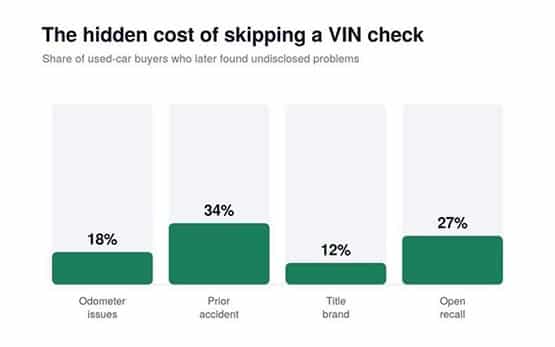
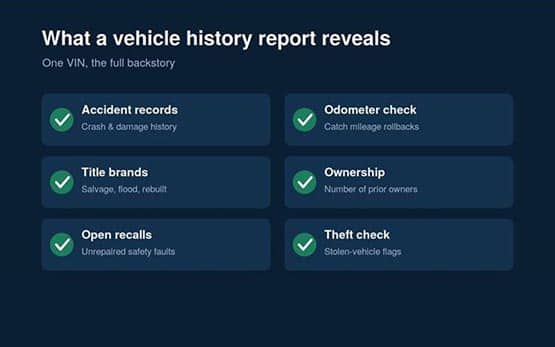
None of these things are visible from the driver’s seat. A car that spent two seasons absorbing salt and humidity, or one rebuilt after a serious collision, can be detailed to look showroom-fresh. The records, however, are harder to disguise. Running the VIN through a vehicle history service such as zilocar.com surfaces accident reports, title brands, odometer readings logged over time, and ownership changes, all tied to that one number.
Why the odometer deserves special attention
Mileage rollback remains one of the most common and most profitable forms of used-car fraud. Federal regulators estimate it costs American consumers more than a billion dollars a year. A car advertised at 80,000 miles that actually has 140,000 is not just overpriced; it is closer to expensive repairs than the buyer realizes. Because history reports record mileage at every inspection, sale and service event, a sudden dip in the numbers is an immediate red flag.
Reading a report like a pro
You don’t need to be a mechanic to make sense of a vehicle history report. The most useful habit is to look for consistency. Do the recorded mileage readings climb steadily over the years? Does the title stay clean across every owner and every state? Are there any accident entries, and if so, how severe were they? For buyers who want to compare what different services include before paying, a neutral overview at bestvehiclehistoryreport.com lays out how the major report providers stack up on coverage and price.
A clean report is not a guarantee that nothing is wrong; no database captures every fender-bender settled in cash. But a report that contradicts the seller’s story, or that reveals damage the listing never mentioned, is reason enough to walk away or renegotiate.
A simple routine before you buy
Treat the VIN check as one fixed step in a short routine. Get the VIN from the seller or the listing, run a history report, and read it before you ever schedule a test drive. If the report is clean and the price still fits your budget, take the car to an independent mechanic for a pre-purchase inspection. The report tells you the car’s past; the mechanic tells you its present. Together they cover most of what can go wrong.
Local sellers are not the enemy here. Many honest owners simply don’t know their car’s full history themselves, especially if they bought it used. Asking for the VIN and running a report protects everyone and keeps the transaction transparent. A trustworthy seller has no reason to object.
How much money is really at stake
Consider the math on a typical local purchase. A used sedan or pickup in this market can easily run between fifteen and thirty thousand dollars. A rolled-back odometer hiding fifty or sixty thousand extra miles can knock several thousand dollars off the car’s true value, and it moves the timeline for a major repair, a transmission, a timing component, a worn suspension, much closer than the buyer expects. An undisclosed accident that damaged the frame can be even more costly, because structural repairs are difficult to do well and easy to do badly. Against numbers like those, the few dollars and few minutes a history report costs barely register.
There is also a resale dimension that buyers tend to forget. The branded title or hidden accident you don’t catch today becomes your problem when you try to sell the car later, because the next buyer, if they’re careful, will run the same check you should have. Buying clean protects not just your driving experience but the money you’ll eventually recover when it’s your turn to sell.
Local deals, national records
One thing that surprises first-time buyers is how far a used car can travel before it reaches a local lot or driveway. A vehicle advertised a few miles from home may have been titled in three different states, sold at auction out of region, and driven through climates and conditions its current appearance gives no hint of. That mobility is exactly why a national history check beats relying on the local title alone. The paper in the seller’s hand reflects the most recent chapter; the report reflects the whole book.
The next time a deal in the classifieds or on a neighborhood marketplace looks too good to pass up, remember that the cheapest part of the whole process is the few minutes it takes to check the history. In a market where used prices remain stubbornly high, that small step is the difference between a smart buy and an expensive lesson.
This content is provided for informational purposes only and is not a substitute for professional advice. AFP editorial staff were not involved in the creation of this content.

 Share
Share