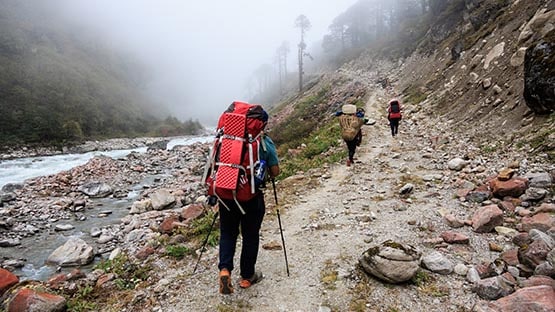
Some of Nepal’s most beautiful and less explored landscapes lie in the remote eastern part of Nepal. A blend of forests, rivers, traditional villages, and Himalayan scenery can be found in the Simbu and Yamphudin valleys.
These valleys are part of the approaches to the Kanchenjunga region, one of the most breathtaking parts of the Himalayas. They are located in the Taplejung District of eastern Nepal. The journey takes trekkers through shifting landscapes and peaceful mountain communities as it passes through the Simbu and Yamphudin valleys.
Contrary to some of Nepal’s busier trekking routes, the Kanchenjunga trek offers a more tranquil experience where they can enjoy the natural surroundings and local way of life.
Where are Simbu and Yamphudin located?
Simbu and Yamphudin are located in the eastern part of Nepal, within Taplejung District of Koshi Province.
Yamphudin
The valley is located at an altitude of 2,080 m (6,824 ft). It is a vital settlement along the trekking route to the Kanchenjunga Conservation Area.
The surrounding terrain is made up of high Himalayan mountains, river valleys, steep hills, and forested slopes.
The terrain gradually shifts from lower forested hills to the higher mountain terrain as trekkers proceed through the region.
Simbu
It is a small mountain village and a starting point on the southern approach of the Kanchenjunga Circuit Trek.
The valley has an average elevation of 1,413 m (4,636 ft). It is surrounded by green hills and forests; Simbu provides a peaceful trekking environment.
Unlike Yamphudin, it is not a major transition point, but its significance lies entirely in how the landscape and human experience shift when you pass through it.
Understanding the landscape around Simbu and Yamphudin
The landscape and vegetation around the two villages change gradually as you move towards the high Himalayas.
Around Yamphudin, the landscape is lush green, terraced farmland covers more parts of the hillside, and forests and rivers surround the villages.
The Simbu Khola runs through the valley, shaping the route towards the higher mountains.
As trekkers move forward, the valley becomes covered with dense forests of rhododendron, pine, and other Himalayan vegetation.
The terrain changes significantly, becoming characterized by waterfalls, challenging rocky trails, and demanding hillsides.
Hence, the two villages and surrounding areas offer you traditional mountain villages, terraced fields, farmland, mountain views, forests, and changing vegetation.
Yamphudin: Major gateway to Kanchenjunga
The valley lies within the Kanchenjunga Conservation Area and serves as a vital link between lower hillside towns and the wild, high mountain valleys on the path to the Kanchenjunga South Base Camp.
The official Kanchenjunga Conservation Area map also identifies Yamphudin as one of the major settlements along the area’s trekking trails.
From Yamphudin, the trail follows through Simbu Khola toward Tortong and Tseram before heading to Ramche and the Oktang village. This area provides views towards the southern face of Kanchenjunga.
Yamphudin is a diverse mountain village and brings together the unique traditions of the Limbu, Rai, Sherpa, and Gurung people, enhancing the trek with a rich cultural experience.
Culture and local life
Life in Yamphudin is directly shaped by the surrounding natural terrain. Many families depend on farming, livestock raising, tourism, and small local businesses.
Locals grow crops on terraced hillsides and gather firewood and wild plants directly from the nearby forests. Local streams and rivers provide essential water for drinking, cooking, and daily chores.
Trekking through this valley gives trekkers an opportunity to experience the daily life of the locals, such as farming, preparing meals, caring for livestock, and maintaining traditional houses.
Festivals and community gatherings
Attending local festivals gives trekkers a unique, firsthand look into the culture, traditions, and beliefs of the communities. Different communities celebrate their own festivals and maintain distinctive clothing.
Visitors will experience the region beyond the scenery and witness the authentic village gatherings, traditional music, and local dances.
Food and local cuisine
Eating local food in the village lets you experience the region’s simple lifestyle through mountain meals. This shows you real cooking habits and ingredients used by the people who live there.
Local households and lodges commonly prepare dal bhat, vegetables, noodles, soups, potatoes, and other simple meals.
Connection with Kanchenjunga
Simbu and Yamphudin are located in eastern Nepal and are part of the broader trekking route to the Kanchenjunga region.
Yamphudin, in particular, is an important settlement on routes towards the Kanchenjunga Conservation Area.
The landscape around these villages is mainly made up of green hills, forest, rivers, and traditional mountain settlements.
As trekkers move higher, forests become thinner, surroundings become more rugged, with alpine meadows, rocky slopes, glaciers, and snow-covered peaks.
The area also provides views of Mount Kanchenjunga and other Himalayan peaks. Simbu and Yamphudin act as a transition between the lower mountain villages and the high Himalayan landscape of the Kanchenjunga region.
Permits and requirements for trekking through Simbu and Yamphudin
Trekking through Simbu and Yamphudin is connected with the wider Kanchenjunga region. The main permit required for trekking in the Kanchenjunga Conservation Area is the Kanchenjunga Conservation Area Project (KCAP) permit and a Restricted Area Permit (RAP).
It is important to know that trekkers need to travel with a licensed trekking guide. This is particularly relevant because the Kanchenjunga region includes remote trails and settlements where facilities can be limited.
You cannot apply for the permit yourself. Your trekking agency will help you arrange the required permit/entry formalities.
Why explore Simbu and Yamphudin?
Simbu and Yamphudin offer a different kind of Himalayan trekking experience. For travelers who prefer quiet surroundings, Simbu and Yamphudin can be an appealing part of the journey.
The quieter environment also makes it easier to notice small details, such as birds in the forest, mountain streams, traditional houses, and local people going about their daily activities.
One of the main reasons to explore this area is also its connection to the Kanchenjunga region. The route gives travelers a sense of moving deeper into the mountains.
Trekking through Simbu and Yamphudin is not only about reaching a particular viewpoint or destination. The trail itself becomes part of the adventure.
Walking through forests, crossing suspension bridges, passing mountain villages, meeting local people, and gradually entering higher landscapes all add to the experience. Each part of the trail offers something different.
This content is provided for informational purposes only and is not a substitute for professional advice. AFP editorial staff were not involved in the creation of this content.


 Share