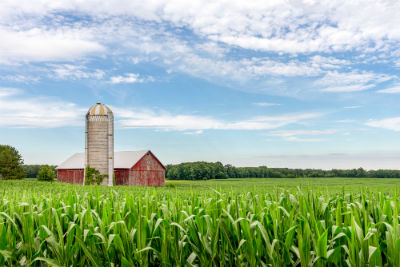
People strongly depend on farming even when living in the city. Agriculture supports our food needs, be it veggies and fruits, dairy, or meat. It provides the raw material for our clothes, home textile, and technical use.
The industrial revolution from the mid-18th till the late 19th century was a crucial milestone for technical progress. It had a colossal impact on agriculture, too.
Top 5 Achievements in Farming
The industrial novelties moved agriculture to the next level, facilitating farming labor with machinery. Furthermore, they also drove other branches related to technical progress. This way, farmers got plant protection products and improved crop species. Later, industrial and scientific findings promoted computer-based and satellite technologies for agribusiness to enjoy.
Let’s focus on the top five inventions that provided greater feasibility to agrarians and people in general.
Precision Farming with Remote Sensing
Precision agriculture is the edgiest advancement. It suggests that crops get exactly the treatment they require, respective of their needs – no more, no less; at each particular spot – instead of the entire field. Such differentiated allocation reduces farmers’ costs. What is more, it contributes to environmental sustainability and soil moisture monitoring in particular.
Remote sensing enables farmers to do what they have never done before:
- monitor fields not being in them in person;
- assess crop state with vegetation indices;
- access accurate weather reports (more accurate than those of regular weather stations);
- operate GPS-navigated machinery;
- delegate some jobs to robots, and more.
Fertilizers
Agronomists started industrial fertilizer applications in the late 1880s. Commercial fertilizers contain nitrogen, phosphorus, and potassium. These are the key vital elements for plant growth. Before chemical fertilizers were synthesized, farmers had to rely solely on natural soil fertility or organic manure. Then, they got the possibility to additionally nourish crops with the nutrients they need. However, fertilizers are no magic pill – they should be used with care, as excessive nitrates are harmful to humans.
Tractors and Combines
In the old times, field activities were performed manually, which was labor- and time-consuming. Heavy operations were done by oxen, horses, or mules. Machinery speeded up the process and eased the efforts. Farmers began to use tractors to pull equipment and cultivate crops. The tractors of the early 20th century were steamed-powered and then switched to fuel.
The first self-propelled combine had much in common with its successors nowadays. Their mechanism of work is as follows:
- blades cut the stalk;
- the thresher extracts the grain from the straw;
- the fan separates the grain from debris;
- the bin atop collects the grain.
Additionally, modern combines have removable heads for various crop types (e.g., soybean, corn, wheat, rice, etc.).
Reaper and Binder
Reaping and binding small grains had been entirely handwork until specific machinery was introduced in the early 19th century. The process implied cutting with sickles or scythes, raking, and tying into sheaves. The first reapers assisted in cutting, yet sheaves were still bound manually. The brand-new approach was suggested by the Marsh brothers in 1857. They added canvases to their reaper that shifted the cut grain to be tied on a special platform by a worker riding on the machine.
The Plow
The tool was invented at the dawn of farming and was used as early as in Ancient Egypt. The plow had an iron tip and a wooden wedge and was moved by oxen. With this device, farmers could till more fields within a shorter time. Apart from that, tilling assisted in incorporating crop residue as well as controlling weeds and pests’ larvae.
In its essence, the plow hasn’t changed much throughout history. The one which was used in medieval Europe didn’t differ greatly from its Mesopotamian predecessor but was improved with a moldboard to turn the soil. The same iron-and-wood analog was used in the USA in the early 19th century.
Despite iron plows eased tilling, they had a significant drawback: the earth stuck to blades and had to be removed by hand. The issue was solved by the blacksmith John Deere who changed iron to steel in 1837.
It’s hard to say how agriculture would have been like without these inventions. The good thing is that progress never stops, and agriculturalists will witness even more facilities in the future.




 Share
Share

AFP