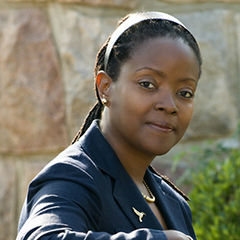
 Beverly Bunch-Lyons vividly recalls her grandmother’s funeral in Raleigh, North Carolina. At age five, it was her first experience with death and the process of burying the dead.
“I remember thinking how much I would miss the person we all lovingly called ‘Mother’ but I was also happy to know that she would no longer suffer,” said Bunch-Lyons, a Virginia Tech associate professor of history based in the National Capital Region.
“While I recognized many of the faces at the funeral, among the unfamiliar were the stoic, hard-faced men in their black suits, white shirts, and black ties who seemed to be telling everyone what to do. Quietly, and with great dignity and poise, they orchestrated my grandmother’s going home ceremony,” said Bunch-Lyons, “and even at such an early age, I was fascinated by them.”
Years later, as Bunch-Lyons was searching for a thesis topic for her master’s degree, the death of another family member prompted her to explore what had peeked her interest early on — the work of people who engage in the business of death in the African-American community.
Although her thesis, completed in 1990, was narrowly focused on her hometown of Raleigh, which at the time had three African-American-owned funeral homes, she began to delve into the history of the business which surged after the Civil War. Concerns about how black bodies were laid to rest by white undertakers fueled the desire among African Americans to have their family members buried by black undertakers whom they believed would bury their dead with care and dignity. A desire to meet this community need, while also earning a comfortable, stable living led would-be entrepreneurs to the undertaking business.
Bunch-Lyon’s research led her to the work of Booker T. Washington who believed that with the exception of caterer, there was no other business in which African-Americans “seem to be more numerously engaged or one in which they have been more uniformly successful.” U.S. census records in 1890 list 231 African-American funeral firms nationwide. Today, there are more than 2,000.
But the African-American funeral business is not without complexity, said Bunch-Lyons, who continues to explore its nuances. She recently authored “‘Ours is a Business of Loyalty’: African American Funeral Home Owners in Southern Cities,” published in the current issue of The Southern Quarterly literary magazine.
Bunch-Lyons relies on personal accounts of funeral home operators in three Southern states (North Carolina, South Carolina, and Virginia) to demonstrate powerful linkages between the personal, political, social, and economic lives of funeral directors and the communities they serve.
Starting a business on a “shoestring” budget was common among African-American entrepreneurs, especially undertakers. Most started modestly, and grew their businesses by saving and investing in additional equipment over time. Working wives contributed their earnings from teaching or other professional jobs. When Nelson Greene Sr. opened his funeral business in 1954 in Alexandria, Virginia, he relied on personal savings and a little help from relatives.
“These were truly family endeavors,” said Bunch-Lyons, “as wives and children often worked in the business, driving cars or attending to other business-related matters.
Despite financial setbacks, Calvin Lightner continued to operate the Raleigh funeral business inherited from his father but also turned to local politics. In 1967 he became a member of the Raleigh City Council. During his tenure he served as chairman of the Law and Finance Committee; chairman of the Transit Study Committee; and member of the board of directors of the city/ county Tax Committee. His most prestigious positions were mayor pro-tem of Raleigh, and eventually mayor of Raleigh.
“I found that turning to politics is a fairly common practice among funeral home owners,” said Bunch-Lyons. “They were able to capitalize on their status as well-respected members of their communities to segue into it. Once involved in local politics, they could encourage black citizens to support black businesses, exercise their right to vote, and become better educated.”
Stories of sanctions, however, discouraged some from entering the political arena. Although whites did not as a rule patronize black-owned funeral business, sanctions could have repercussions if the family who owned the funeral home also owned other businesses in the area.
Like most other kinds of businesses, the funeral business was tied directly to the ebbs and flows of the economy. While the need to bury the dead did not diminish during economic downturns, the ability of clients to pay for services did.
But there is a client-based loyalty that is built into the African-American funeral business and even today most funeral directors do what they can to accommodate their long-time customers, Lorin Palmer, the only female funeral home owner in Columbia and Sumter, South Carolina, told Bunch-Lyons.


 Share
Share

AFP