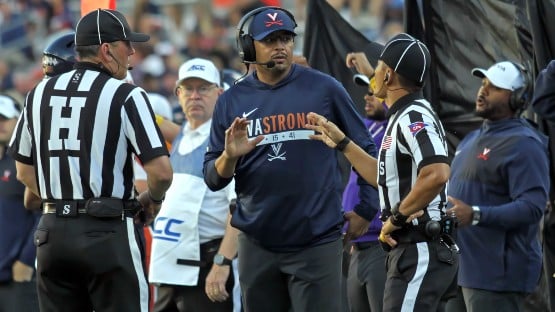
We all saw the incredible amount of quit from our UVA Football program, from the players to the head coach, as last week’s 38-7 loss at Florida State was playing out.
Head coach Tony Elliott even seemed to acknowledge the quit postgame, telling reporters that he “challenged” his guys in the second quarter, as FSU was taking control of the game, “just to control what they can control, and not let the circumstances and the situation, you know, kind of dictate the way that they respond,” then adding, “the reality is, body language influences, you know, the way that you think, and the way that you think influences the way that you go out and talk and act and respond.”
That was Elliott in the heat of the moment, minutes after the game.
ICYMI
- UVA Football: This Virginia team has a whole ‘nuther dimension of quit to it
- UVA Football: Every time Tony Elliott pledges to ‘fix’ things, you take a shot
Three days later, as the coach again faced the media, Elliott took umbrage with a reporter who confronted him with the observation that “Virginia Football prides itself on is being extremely physical, and at a certain point when they got behind, it just seemed like they kind of just weren’t as physical,” ahead of asking the question: “Do you think that’s something that you can kind of instill in them, or is it something that they just need to learn from playing from behind?”
Umbrage, from Elliott, might be understating his reaction to that.
“You know, I’m trying to figure out how to answer that question the right way, right?” the coach started his answer. “Because I think it’s easy to point when you lose a game that the kids didn’t play physical. Like, we missed tackles. But those guys put their hand in the dirt every single play, and they played all the way to the end. So, I’m not going to say I disagree with your point of view. I may see things a little bit differently, right? Like, I didn’t see quit in our team, right? I didn’t see a lack of belief in our team. What I saw was a difficult situation that I got to coach them through better, right?
“You kind of got me on that question, because I don’t think it’s easy to say that, right, after a loss, right, but those kids fought, right, and what I’m not gonna do is, I’m not gonna turn on my team, right, I’m not gonna do that, that’s not who I am.”
I can’t disagree with Elliott on his sentiment there – “I’m not going to turn on my team” – except that, it sure seemed like he quit on them as much as they quit on themselves as the loss was playing out.
There were at least two instances in the second half, during media timeouts, with the TV cameras focused on the Virginia sideline, where we could all see Elliott standing outside the huddle, thousand-yard-staring at nothing in particular, and his body language and facial expressions as the clock ticked down in the fourth quarter were hardly motivating.
The contrast that comes to mind for me was James Franklin, the first-year Virginia Tech coach, sprinting excitedly down the sideline after a big play from his quarterback, Ethan Grunkemeyer, who was trying to rally his team from a double-digit second-half deficit, after having thrown two INTs and fumbling three times.
Which guy do you want wearing the big headset on your sidelines – the one with the hangdog expression when the going has gotten tough, or the one oozing unbridled enthusiasm trying to motivate his guys past the tough sledding?
“To say that we lack physicality and toughness, you know, late in the game, after one game, like, I don’t know if I agree, you know, with that,” Elliott continued his response to the pointed question – and for the record, it’s not “one game” that we’re talking about here; Elliott’s team quit on itself in the second half of the loss to West Virginia two weeks earlier, and it’s that trend, this happening two times in three weeks, that has observers concerned.
“We had a bad day at the office,” Elliott said, “and we’re going to go get better, right, and we’re going to figure out how to be at our best for four quarters.
“But I don’t know how to answer that question, you know, the right way.”
That would be the problem here, Coach; the reason they pay coaches the big bucks is because we expect them to know how to answer those kinds of questions the right way.


 Share
Share

Chris Graham