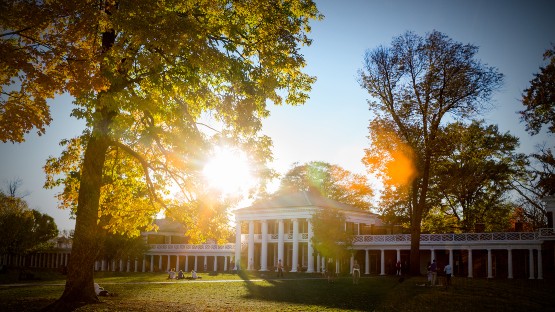
I just returned from a reunion at the University of Virginia. Like many alumni, I was looking for the past; what I found was the future.
The occasion was the bicentennial celebration of the Jefferson Literary and Debating Society, the oldest student organization at Mr. Jefferson’s University.
Founded in 1825, six years after the institution, the society was an extracurricular organization dedicated to the goal embraced by the university: educating white men from wealthy families to become state and national leaders. Founded by and for the elite, the Jefferson Society contributed to the grand task. Its debates, oratorical contests, and discussions helped prepare a U.S. president, numerous governors, senators and legislators.
When I became a member in 1963, the society was in the grip of those who honored the mythos of the old South. With beer and bourbon lubricating our tongues, we celebrated the virtues of gentlemanly honor, chivalry, states’ rights, and segregation. There were no women admitted to the University in those days, and only two Black men were enrolled as undergraduates. Neither sat inside the society’s hall, which often rung with the strains of the “Bonnie Blue Flag.”
Shaken by the assassination of John F. Kennedy and challenged by a campus speech by Martin Luther King Jr., several of us spoke out in favor of civil rights and opportunity for all. We seldom won debates.
What a change 60 years have made in the Jefferson Society. Women, minorities and international students make up a mélange contributing to the university’s intellectual ferment. A woman majoring in statistics now serves as president, and the annual Moomaw Oratorical Contest – captured in 1880 by Woodrow Wilson – was won by a Black female. Current members from India, Egypt, Israel and other countries join debates demonstrating that intellectual vigor is still a cherished organizational value. Students like these make the society a mirror of UVA with women and men from many races, nationalities, cultures, and religions leavening the university with their skills, talents, and views.
It is a sad reality that diversity frightens some people, most prominently Donald Trump and Glenn Youngkin. When men like these encounter a weak board and a rector without courage, venerable institutions can suffer. The University of Virginia is in danger, and so are the Commonwealth’s other educational institutions, like George Mason University, led by a Black man.
President Trump’s determination to reform universities has been championed by the governor of Virginia and his compliant boards, populated primarily by those aspiring to become financial “masters of the universe” like their leaders. The question that the president, governor, and board members must answer is what attacks like the one that forced the recent resignation of UVA President Jim Ryan are designed to accomplish.
ICYMI
- UVA Student Council passes resolution of ‘no confidence’ in University leadership
- Jim Ryan explains decision to step down as UVA president: ‘Real and direct harm’
- UVA President Jim Ryan resigns: Making sense of something that doesn’t make sense
Virginia’s higher-education community is the envy of the nation, with few other states matching its quality or programmatic breadth. Our institutions are a powerful engine for the prosperity of Virginia. Exactly what needs to change?
The students whom I met in the Jefferson Society, at the University of Virginia, and at other Commonwealth institutions I have served are uncommonly serious, deeply committed, and impressively prepared to bring their energy to the state’s and the nation’s economy.
Do our universities match the party scene of the University of Alabama, the football prowess of Ohio State, or the beach culture of the University of Southern California? No, but do we really desire that?
Do we want to return to the 1960s when Virginia’s universities predominantly enrolled white males, with minority groups relegated to jobs making minimal contributions to the economy? Do we want mediocre students content to grind through classes, cheer at football games, and move to states with greater economic opportunities?
Some critics assert that reliance on statistical measures of meritocracy – SAT scores or high-school GPAs – would cure the educational ills they perceive. When I was associate vice president of the College of William & Mary, I pointed out that if we relied solely on such measure for admission decisions, we would recruit a student body made up of Asian-heritage women from Northern Virginia.
To fulfill their missions, universities must be free to select students with skills, talents, and aspirations that will benefit from their particular programs.
After visiting Charlottesville, I realized that the old Jefferson Society has disappeared, but I was heartened by the new society with its vibrant, diverse membership – ambitious, capable, and welcoming of differences that strengthen organizations. If Virginia’s higher-education community pursues similar strategies, it has every prospect of continued success.
After earning a B.A. with high honors at UVA, William Walker served as associate vice president of Virginia Tech and the College of William & Mary for 20 years. Now retired, he lives in Staunton.
Support AFP


 Share
Share