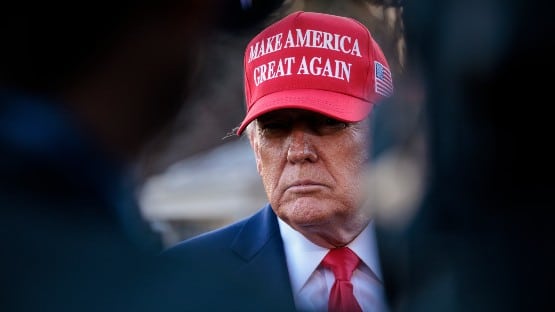
Donald Trump did not invent America’s vulnerabilities, but he has driven them to a breaking point. His contempt for democratic norms, alliances, and international law has transformed the United States from an anchor of a rules-based order into a disruptive force.
The damage extends far beyond decisions like the war on Iran, stretching the credibility of U.S. institutions, Western cohesion, and the balance of power with adversaries sensing opportunity.
Trump’s presidency has not merely shaken the postwar order; it has exposed how far the United States has drifted from a benevolent superpower to an unruly one. His contempt for alliances, law, and norms, and readiness to dramatically disrupt the world’s order includes his war of choice against Iran, which has proven to be disastrous to the global trade in oil and gas. His attempt to seize Greenland alarmingly soured U.S. relations with its closest allies in Europe, and his abduction of Venezuela’s leader raised serious concerns about the U.S. throughout Latin America.
Together, these actions have shattered the image of U.S. responsibility and leadership that has been built since 1945, reflecting a decay in legitimacy, capability, and purpose.
The deepest damage lies in the erosion of U.S. legitimacy as an agent of a rules-based order. For decades, Washington could press allies toward difficult decisions, trusting that it ultimately sought broader stability.
Trump’s impulsive, law-indifferent use of power — of which Iran is one example — is now seen as erratic. U.S. legitimacy has eroded, and even necessary initiatives meet suspicion and resistance.
“America First” protectionism has weakened the trade and financial system that once amplified U.S. power. Tariff wars, sweeping sanctions, and disdain for institutions like the WTO and NATO have accelerated efforts to move away from the dollar and U.S.-centered systems.
An alternative financial architecture is emerging in which Washington can no longer easily weaponize access to capital, technology, or markets.
This is compounded by visible democratic backsliding. Trump’s assaults on the rule of law, delegitimization of elections, and contempt for the press have made US politics a cautionary tale.
When the self-styled leader of the free world cannot guarantee electoral integrity, its advocacy of democracy abroad rings hollow.
A ruptured West
Nowhere are the consequences clearer than in U.S.-European relations. Canadian Prime Minister Carney’s description of a permanent “rupture” reflects a growing belief that the transatlantic relationship may never return to its pre-Trump form.
For many Europeans, Trump’s tenure is not an aberration but proof that American extremism can recur, especially after his re-election. Trust, once broken so deeply, is not easily restored.
Europe is therefore moving toward strategic autonomy. In defense, this means building capabilities no longer dependent on the “whims” of a U.S. president. In energy and technology, it means diversifying suppliers and shielding economies from American sanctions and regulatory pressure.
The more Europe acts independently, the less leverage Washington retains.
A cooler transatlantic relationship risks parallel systems. Europe is already a regulatory superpower in digital markets and data protection. A sustained rupture could push Brussels to align elsewhere or act independently, complicating U.S. standard-setting.
Diverging approaches to sanctions, technology, and climate policy would weaken collective Western responses, benefiting Moscow and Beijing.
Adversaries on the offensive
For Russia and China, Trump’s presidency signals a reckless, declining hegemon. They present themselves as defenders of a “multipolar” order against U.S. unilateralism, portraying American actions as threats to sovereignty and stability — an argument gaining traction across the Global South.
As Washington is distracted and its credibility weakens, Russia probes NATO’s periphery, betting a divided West will hesitate. China draws similar conclusions, increasing pressure around Taiwan and the South China Sea, assuming diminished deterrence and fragile alliances after Iran. An overextended, internally divided America invites calculated risk-taking.
Both powers also exploit the U.S. retreat from development and multilateral engagement. They expand influence through infrastructure, energy, arms, and digital networks where US presence recedes. States affected by U.S. sanctions and policy volatility increasingly see Chinese and Russian offers as more predictable. Even if U.S. dependency follows, such ties become difficult to reverse over time.
Domestically, Trump has handed U.S. adversaries a propaganda tool. Amplifying images of U.S. dysfunction, racial tension, and institutional erosion, they argue that American democracy is failing.
By fueling division, they make coherent foreign policy harder. An America at war with itself cannot project strategy, and its commitments lose credibility.
The long road back
The question is whether the United States can recover — or whether the damage is permanent. Recovery remains possible if patriotic Republican and Democratic leaders confront the depth of the crisis and pursue structural change. The starting point must be bipartisan recommitment to democratic norms: protecting voting rights, depoliticizing law enforcement, respecting judicial independence, and defending a free press.
An America where globalization equates to insecurity will not sustain global leadership. Investment in infrastructure, green technology, innovation, and social protections is essential for both competitiveness and legitimacy. Citizens must feel that engagement abroad benefits them, not only elites.
In foreign policy, a post-Trump consensus must re embed the U.S. in alliances and multilateral institutions — treating allies as partners, not clients, and recognizing that shared rule making strengthens U.S. power. Rejoining and reinforcing regimes on climate, arms control, global health, and nonproliferation would signal renewed responsibility.
Managing China and Russia will be the central test. The U.S. must combine deterrence with disciplined diplomacy, investing in critical technologies, protecting infrastructure, coordinating responses to cyber and economic coercion, and engaging in arms control.
The aim is not unipolarity, but a stable balance where coercion is costly and norms endure.
Finally, the U.S. must rebuild soft power by embracing openness. A renewed commitment to human rights, foreign aid, academic exchange, immigration, and cultural engagement would stand in sharp contrast to recent xenophobia. Such efforts can restore America’s image as effectively as military strength.
The road back will be long, with no guarantee of success. Trump has not only damaged America’s standing but also exposed vulnerabilities that adversaries will exploit. Yet the crisis presents a choice.
If Republicans and Democrats, especially as midterms approach, put country over office — rebuilding democracy, recommitting to alliances, and rejecting unilateral militarism — the U.S. can regain moral footing rather than remain a declining power.
Whether the United States recovers from this self-inflicted wound depends on the choices its leaders have yet to make.
America may not regain unipolar dominance, but it can help shape a more stable and decent order — if it proves to the world, and itself, that it can still govern and lead responsibly.


 Share
Share