Pro wrestling stands at a unique intersection between sports, choreography and scripted television. While I often refer to it as the former, the consensus is that the “sport of kings” is, in fact, the latter.
Suppose pro wrestling is more akin to television than a sporting event. Why, then, has the critical discourse surrounding it become centered on commercial success, rather than the effectiveness of the art?
It’s virtually impossible to succinctly define “art” in a way that is universally agreed upon. In simple terms, it’s the human expression of creativity and imagination. Not all art is worthwhile, though. Not all art feels authentic or comes from a place of vulnerability. Not all art resonates with its intended audience.
At its core, pro wrestling is a synthesis of techniques, many or few, that have evolved over the last century to engage the audience. When folkstyle and Greco-Roman wrestling became a carnival attraction, it yielded something uniquely rooted in subterfuge and provocation.
Therein lies pro wrestling’s greatest fallacy: that financial success directly correlates to quality. Promoters have always valued profit above all else, equating a pro wrestler’s worth to their drawing power.
I don’t want to judge anyone for their taste in pro wrestling. I will, however, judge them for how they critically assess a performer or promotion’s success in the sport. Nielsen ratings, ticket sales, media rights deals, and merchandising only offer quantitative insight into a promotion’s financial success. They aren’t substantive metrics to measure quality.
When Alan Sepinwall reviews an episode of “The Chair Company,” he doesn’t obsessively compare its quarter-hour ratings to an episode of “Stranger Things” to belittle Tim Robinson and Zach Kanin’s script or Andrew DeYoung’s directorial choices. Instead, Sepinwall uses a qualitative approach — analyzing what creative tools are being employed and how they convey the show’s central themes and messages.
Everything in pro wrestling is driven by narrative, from a backstage interview to storylines that unfold over the span of years. Narrative isn’t always conveyed in simple terms, though. In the same way that promos or interviews can function as expository material, so should the matches themselves. That’s because pro wrestling is a universal language.
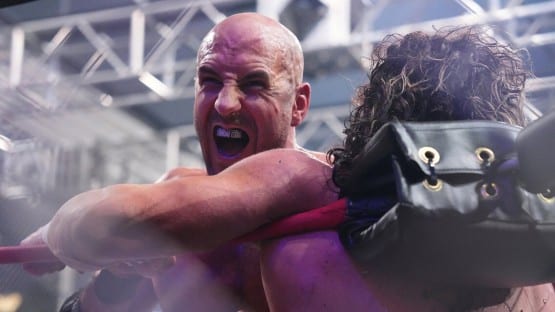
Current AEW star, CMLL World Heavyweight Champion, and former WWE superstar Claudio Castagnoli famously said that he speaks six languages: English, French, Italian, German, Swiss German, and pro wrestling.
“People say I speak five languages, but that’s not true,” Castagnoli said. “I speak six. What I do in the ring is a universal language. No matter what country it’s broadcasted in, people can understand it.”
For that reason, the strength of a professional wrestler should be judged on their body of work in the ring — more so than their charisma or drawing power.
Therein lies an important distinction, though, between aesthetics and substance. While it’s completely acceptable to watch pro wrestling and simply admire the athletic feats being performed, the action in the ring is designed to be expository. Good professional wrestling, whether it’s lucha libre or the WWE’s house-style, tells a succinct story.
On an episode of “The Sessions” with his wife, Renee Paquette, Jon Moxley meditated on the relationship between narratives and professional sports:
Every football game has a story.
‘Hey, what happened in the Bengals game last night?’
‘Well, they got out to a really big lead, the other team chipped away at it, and they lost in the fourth quarter.’
Or it was a defensive struggle in a low-scoring game. Or it was a very high-scoring game.
Every match has a story. Sometimes, people talk about storytelling and psychology, and they don’t know what the fuck they’re talking about. A story can be anything. Wrestling can be anything.
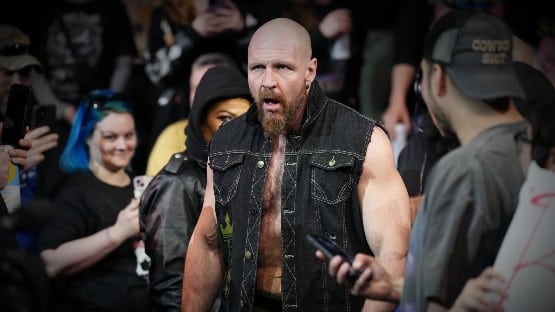
It’s easy to understand why Moxley is a master of his craft. “The Death Rider” doesn’t just accept simplicity; he revels in it. Just like a professional football or basketball game, the “sport of kings” uses wrestling to drive its narrative. The only difference is that, in professional wrestling, the outcomes are predetermined.
It’s difficult for me not to romanticize professional wrestling. When done properly, it simulates my favorite parts of sports and athletics: the spirit of competition, the pursuit of self-improvement, the clash of unique stratagems, the war of attrition.
The difference between professional sports and professional wrestling is that the latter is uniquely theatrical.
Like actors, pro wrestlers are ultimately portraying characters — whether they’re heightened caricatures of themselves or more fantastic personas, like Mark Calaway’s Undertaker. In either scenario, it’s their job to use all of the tools in their arsenal to approximate that character, both in the ring and outside of it.
One such tool is “selling,” a catch-all term to describe a performer’s ability to emote. This encompasses everything from facial expressions and body language to how they physically register pain.
Selling. pic.twitter.com/B742z2jsiG
— Matt D – SC (@MattD_SC) September 17, 2025
Selling is the most valuable tool in a wrestler’s arsenal. With the advent of mixed martial arts, it is now more obvious than ever that pro-wrestling is merely an approximation of combat sports. Selling is the gravity that grounds its absurdist elements. The greatest professional wrestlers, from Dusty Rhodes and Ric Flair to Mistico and L’Ange Blanc, used selling to capture the audience’s imagination. It’s an art that, when mastered, turns the medium into an immersive experience.
It’s also a tool that can’t be quantified, nor does it directly correlate to dollars or tickets sold. It’s merely one element in a pro-wrestler’s composition that can be dissected and compared in a qualitative way.
As with all forms of art, professional wrestling or otherwise, it’s important to separate artistic quality and financial success.
Picture the best cheeseburger you’ve ever had. Where did you get it from? Was it from your favorite bistro? A greasy spoon? From the grill on your patio? In-N-Out?
I bet it didn’t draw as much money as the Big Mac.
Support AFP



 Share
Share