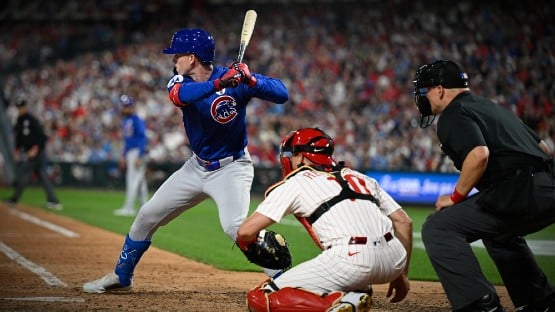
By the sixth inning of the Cubs game against the Athletics on June 4, I had reserved myself to writing about how Chicago’s season had finally reached its nadir, after a long and painful slide over the previous month.
Pete Crow-Armstrong (PCA, for the initiated), the exuberant and divisive centerfielder, had just lost a fly ball in the sky at Wrigley Field, and the thing landed about 20 feet behind him, nearly on the warning track, allowing the hitter, Shane Langeliers, to sprint, knock-kneed, around the bases for a rare inside-the-park home run, giving the A’s a 4-0 lead and causing the crowd at the Friendly Confines to grumble, which isn’t something that happens often.
This isn’t Philadelphia: the fans are mostly there to have fun, not to throw beer cans at their own players, so when the jeers start raining down at Wrigley, you know the season has taken a genuinely grim turn.
It wasn’t PCA’s fault that he couldn’t see the ball, of course; it wasn’t like he dropped an easy pop-up or forgot how many outs there were or failed to make a play due to a lack of hustle; the fans weren’t even booing him, per se, but instead the whole rotten charade that had led up to that embarrassing moment, which at the time felt like the low-point of the Cubs’ perplexing season thus far.
They’d lost 18 of their last 23 games, their last eight at Wrigley, and had suffered a brutal 10-game losing streak in the month of May, and all of this after reeling off not one, but two 10-game winning streaks, going 15 games without losing at home, and storming out to the best record in baseball by May 8.
At that high point in the year, which now feels like eons ago, I was parading around the house and proclaiming to anyone who would listen – which was no one – that this would be the year that the Cubs won another World Series, that a decade after breaking an 108-year-old goat-centric curse, they’d inevitably scale baseball’s Everest once again, and flip the bird to all the lowly peons below.
Then the wheels started falling off, and continued falling off, and finally completely disintegrated in the sixth inning on June 4, as PCA stood there in centerfield staring up at the twilight sky, like it had somehow eaten the thing he was supposed to catch.
The night only got worse in the seventh, as homer-prone pitcher Shota Imanaga allowed two straight dingers to give the A’s a 6-1 lead, causing the collective mood at Wrigley to shift from restless frustration to outright despondency: I’ve watched every Cubs game since the beginning of the 2024 season, and I don’t think I’ve ever heard the fans as quiet as they were after those back-to-back blasts; this was, after all, a team that had looked genuinely unbeatable early in the season, and now here they were, on the verge of being swept by the A’s – a team that doesn’t even have a proper home, for God’s sake – and sinking into the cellar of the NL Central, alongside the Cincinnati Reds.
What the hell had happened? Where had the light gone? Was this just the cruel and fickle nature of baseball, of life, or was there something fundamentally defective about this team, some latent rot that was causing the whole structure to collapse in on itself?
It was unclear, but in the bottom of the inning, before Cubs fans had much of a chance to wallow, Ian Happ – the longest-tenured Chicago athlete, and a guy who’d collected his 1,000th career hit the night before – launched a two-run shot into the bleachers to shrink the deficit to 6-3.
Still, we’d all seen this movie before: brief flickers of hope followed by doldrums and more doldrums. A veteran baseball fan knows to never harbor too much optimism; a little is fine, of course, necessary, even, to sustain an interest in the game, but too much is setting yourself up for avoidable disappointment. Teams entering the ninth inning trailing by three or more runs end up winning only about 2.5 percent of the time, after all. Hope, it seems, can only get you so far.
Yet there are times when the great universal gear clicks into place and takes you exactly where you hoped you’d go. It’s not the most frequented of destinations, in fact it’s rarely visited, but on the occasion you actually get there, my God, is it beautiful – and so bafflingly simple, too: see ball, hit ball, and put it where they’re not. That’s what the Cubs did in the bottom of the ninth, in the flat shadow of their lowest moment: five hits, none of them homers, and on the precipice of defeat, too.
See Dansby Swanson, the struggling shortstop with movie star looks, turn on an 100-mph fastball with two strikes and two outs to score pinch-runner Kevin Alcantara and tie the game, his helmet falling off and flopping in his face as he raced towards the plate like a wild pony.
See PCA – of course, PCA – come to bat with the winning run on third, and instead of launching a homer into the Chicago night, like he did earlier in the game, or flailing at a breaking ball out of the zone, like he so often does, instead lift a sawed-off semi-blooper into right-center field, which outfielder Lawrence Butler raced toward, his hat flying off his head in a mad dash to make a game-saving catch.
He wouldn’t get there, he wouldn’t even come close, really, and as the ball landed in the grass, the twilight emptiness in Pete’s eyes was replaced by an MDMA glow of victory – a victory that, less than an hour earlier, seemed as unreachable as the outer edges of space-time.
From frustration to despondency to jubilation: the Chicago faithful had been put through the ringer, and there they were levitating, despite it all, waving their big white “W’ flags and singing “Go Cubs Go” on a beautiful summer night in the Windy City. And who was right there in the center of the celebration but Anthony Rizzo, that living ghost of the 2016 World Series team, who’d been watching the game from behind home plate with his buddies, occasionally with his shirt off.
The final shot before I turned off the TV was of Rizzo and PCA, who’d just been doused with water and Gatorade during a postgame interview, smiling and chatting in the dugout about – what? The thrill of victory? Dinner plans? The twists and turns of an unpredictable life?
Who knows if this win will make a difference in the interminable slog of a six-month season. If I know baseball, and I think I do, it probably won’t; 29 teams will go home losers by year’s end, and after all, the Cubs got stomped by the San Francisco Giants, 18-3, the very next day, in what may have been the true low point of their season.
But I couldn’t help but allow myself to feel a little bit of joy after that unlikely comeback win: I’d been making some mistakes in my personal life, the details of which need not be expounded on here, and watching the Cubs self-destruct was only causing me to sink further into a shallow sort of self-loathing, so to witness them rising from the pit of defeat like a beleaguered boxer who’d just caught his second wind made me feel like everything might work out in the end after all, however silly it may be to extract greater meaning from sports.
As the Cubs raced out of the dugout and ransacked PCA in the infield, part-time color commentator Cliff Floyd, a former Cub himself, shouted “I needed this!” which I initially found stupid and indulgent, until I realized that if I was in Cliff’s shoes, I probably would’ve said the exact same thing, and really meant it.


 Share
Share