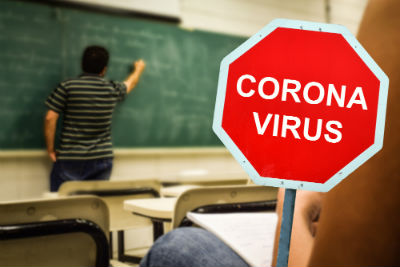
With little warning or training, thousands of teachers moved from the front of a classroom to behind a computer screen, with many instructing students from both places at once. Now, some of these least heralded front-line workers are getting extra support through the Virginia Tech Southwest Center.
“Teachers are essential workers, and they are being crushed by this difficult situation — and it is affecting thousands and thousands of children,” said Heidi Anne Mesmer, a professor in the School of Education. She said teachers are continuing to perform their jobs during the pandemic but without many of the tools with which they are familiar.
“Imagine you’re a race car driver and in the middle of your race — during a pit stop — your crew chief hands you a remote controller. Now you also will be driving a remote-controlled car in a second race held in the infield of the track at the same time as your current in-car race. And you must win both races. That is my classroom in 2020,” middle school teacher Jody Carter said.
Recognizing the needs of teachers like Carter, Penny McCallum, director of the Southwest Center in Abingdon, Virginia, organized a series of free webinars and workshops, working with more than 400 educators from 18 school districts.
“Schools are overwhelmed, and teachers are stressed as they try to teach hybrid, virtual, and remote classes. Never has it been a more important time to connect the expertise of Virginia Tech to the needs of the commonwealth’s K-12 education community,” McCallum said.
Funded and supported by a partnership with the Southwest Virginia Higher Education Center and the Virginia Department of Education, the programs address techniques for virtually teaching a variety of subjects, grade levels, special education, and more. There are also sessions to help parents navigate online learning.
Along with Mesmer, several other Virginia Tech faculty from the School of Education jumped in to help, including Alicia Johnson, Glen Holmes, David Alexander, Betti Kreye, Nancy Bradley, Donna Fogelsong, and Rachelle Kuehl. Stefan Duma, executive director of the Institute for Critical Technology and Applied Science, led a session for coaches addressing athletes’ safety during the pandemic.
Johnson and Holmes stressed that teachers are doing emergency remote teaching rather than distance education. “While distance education takes a great deal of planning, many teachers and students have been forced into this unfamiliar role with little preparation,” Johnson said.
Mesmer agreed. Teachers know what they are being asked to do isn’t a best practice and may feel at first like it can’t be done this way, she said. “I wanted to emphasize shifting the mindset from ‘It can’t be done’ to — like Dorothy and her ruby red slippers — ‘You have the skills all along; you just have to work with what you have.’”
She affirmed what most teachers already know: Worksheets and videos aren’t going to work, especially with younger students. “By going through building a lesson step by step, modeling it myself, I could show how the technology doesn’t have to be overwhelming and can be used to create an engaging learning environment,” she said.
Bradley and Fogelsong encouraged teachers to start with one of the many free resources available. “Don’t overwhelm yourself with all the options,” Bradley said. “Many of the activities that they currently do or use can be integrated into a virtual platform with some creativity.”
Fogelsong said participating in these sessions is beneficial not only to the teachers, but also to Virginia Tech faculty members. “By providing professional development, it allows us to share ideas and expertise that we have gained, but it also helps us engage with practicing teachers in the field to learn from their expertise.”
Programs will continue throughout the school year, and recordings of each program and supplemental materials are also available to teachers and parents.
Story by Diane Deffenbaugh



 Share
Share

Chris Graham