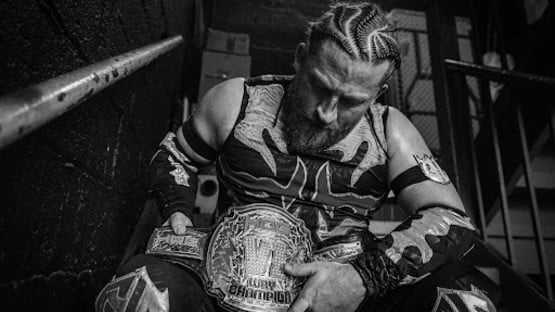
In a sport nearly two centuries old, there are few oddities left in the world of professional wrestling. Gringo Loco is an outlier.
Born and raised in Chicago, Loco, née Charlie Santo, journeyed to Mexico City to pursue an advanced education in lucha libre — immersing himself in one of professional wrestling’s most idiosyncratic styles. Now, after two decades, the 41-year-old’s reputation has finally reflected his standing as a modern maestro, and the only true American-born luchador.
Loco’s journey began at a young age, channel surfing in the mid-nineties.
“I saw the red, white, and blue ropes on the TV, and I thought it was the coolest thing I’d ever seen. It was WWF ‘Superstars’ at the time, and, you know, guys are getting in and getting squashed in like, you know, less than a minute, and I thought it was the coolest thing ever. They just come in and do their finishing maneuvers, kick some ass, and I was like, this is actually sick.”
Loco’s voracious appetite for all things wrestling led him to discover ECW and AAA, which only fueled his fire.
“Yeah, I was just watching it on — I think it was CaliVision. I don’t know how I got the channel. Maybe it was just one of the channels that was available to us, but as soon as I saw that and how different it was from what I was watching on WWF, I couldn’t get enough, man. I was hooked; the pageantry, the colors, the culture, the moves, everything was just so different.”
While professional wrestling was his calling, Loco found it difficult to navigate the financial demands of wrestling school. With little recourse, he found an unorthodox solution.
“We found a gymnastics place, called Skyline Gymnastics; I’ll never forget it. They had open-gym on Wednesdays, and they said, you know, you pay us whatever the fee is, 10, 15 bucks a time, and you can do whatever you want.
“I said, ‘Whatever we want?’
“[The owner] said, ‘Yes.’ And, this was an ex-Olympic champion, so for her to say that was pretty cool.
“So, we carved out a little corner and emulated what we saw on the television. I’m talking Stone Cold Stunners, Rock Bottoms, Pearl River Plunges… You know, the Ahmed Johnson move? Choke slams, all of this stuff. And, we got pretty damn good at it.
“After a couple years doing that, we started kind of venturing outside of the box of finishing maneuvers, and started trying head-scissors and, you know, stuff that we would see on AAA and lucha libre. Lo-and-behold, long story short, we’re training, we’re doing our thing, just like we do every single Wednesday, and some wrestler came in. He was practicing tumbling, and saw what we were doing, and then invited us to his gym, which happened to be a lucha libre gym. The rest is history after that.”
Loco’s hobby prepared him for success in Chicago’s burgeoning independent lucha scene. However, those gymnasiums still didn’t harbor the secrets to lucha libre’s immortal techniques. So, once he finished high school, he saved all his money and sought out a higher education in lucha libre; leaving his home in Chicago and journeying to Mexico City, sight-unseen, with nothing but the phone number of CMLL star Tarzan Boy in his pocket and a dream.
“I had never been [to Mexico]. When I tell you I was terrified of the media, I mean, ‘you’re going to get kidnapped, they’re going to steal your watches…’
“I didn’t leave my hotel room for three full days. I ordered room service from downstairs, because we’re talking a long time ago. There was no Uber Eats. There was no Uber. There was no Google Translate. There was none of that. So I’m just there like, man, I hope that this is the right decision.
“I had a contact of one of the big CMLL names. His name was Tarzan Boy, a.k.a. Toscano. He was a big star down there. So I was just waiting to hear something from him. Finally, he came and got me, and then the rest is history.
“It was a really humble beginning.”
As the longest active wrestling promotion in the world today, CMLL has become synonymous with lucha libre. Conventional wisdom would reason that training under its auspices would have assured Loco a long-lasting career in Mexico. His experience was anything but.
“The money doesn’t last forever and to generate money in Mexico City, I don’t know if you know, but it’s not the easiest thing to do. You know, the money isn’t being made and I’m spending all the money that I saved, so I would go back and forth. I would come back, make some money, go back to my city, blah, blah, blah.
“So, what I learned in that, you know, short amount of time was, I would get opportunities, but they weren’t the big opportunities in Arena Mexico, or in [Arena] Coliseo, where I really wanted to be, because you had to make your name and train and all that.”
Loco explored other opportunities to ply his trade, discovering a smaller promotion in Naucalpan, called IWRG.
“So, I started looking for other avenues and the one door that opened years later was IWRG in Naucalpan. I said, let me show you what I got, and if you like this, you know, the style that I bring, maybe we can talk about doing a storyline or create a trio, or a tag team or something. So, I met a couple guys down there that were pretty passionate about wrestling and innovation, and trying to be new, and that led to the Gringos VIP trio. We won a bunch of belts and stuff, and that was really the most fun I had in Mexico up to that point for sure. That chapter is very close to my heart[…] We had Avisman, who was the king of mat work and the holds. Then you had me, with the high flying and just the ability to do pretty much whatever dive and everything. And, then we had El Hijo de Diablo, who was the talker. He was the vet talker who could rip you apart with any promo, with a couple of words, and we were gold.
“So, yeah, I mean, essentially, that was the door that opened for me for work where I could make some kind of money in Mexico City.”
My introduction to Loco was Phil Schneider’s book, Way of the Blade: 100 of the Greatest Bloody Matches in Wrestling History. Originally a tape trader, Schneider has spent the last three-decades evolving into one of finest scribes in pro-wrestling.
While he continues to write for publications like The Ringer and Yahoo’s Uncrowned, Schneider began on the Death Valley Driver Video Review and its spiritual successor, Segunda Caida. It was there that he and his cohorts began shedding light on Loco’s work in Naucalpan, and that era of IWRG at large.
Much of that lens was focused on the work of lucha legend Black Terry, who was also IWRG’s head trainer. Terry was an integral part of the promotion’s success in the late aughts and early teens, and, by extension, his faction, Los Terribles Cerebros.
The particular match featured in Schneider’s book, between Black Terry, Chico Che, and Dr. Cerebro versus Gringos VIP, from March 7, 2010, is a bloody spectacle. While it’s difficult to find, the match is filmed by Black Terry Jr., whose handhelds resemble the found footage from the “Texas Chainsaw Massacre.”
Wrestling warfare. @PWRevolver 📸 @ohsnapalliemac https://t.co/EpjeA4Isw3
— GringoLoco グリンゴ • ロコ (@GringoLocoOG) January 27, 2024
For fans who are familiar with Loco’s more contemporary work, his work in IWRG is a marked departure, much of which he attributes to Terry.
“I was a more rabid, crazy Gringo, and the guy that kind of brought that out of me was, rest in peace, Black Terry.
“This guy was so intense and so just rabid in the ring. He would look at me before we would go out and he was like, ‘let’s just leave it all out there, man. I want you to actually hit me, and if you don’t actually hit me, I’m going to actually hit you. So you tell me which one you want to do.’
“And this was like seconds before going out through the curtain in front of a sold out Naucalpan show.
“I’m like, alright, let’s just see how this goes. He really did bring that to fruition; this crazy, maniacal Gringo Loco. A heel, essentially, that the States really doesn’t know a lot about except for the Psycho Clown matches, and a couple others here and there, that I could think of off the top of my head. But, he’s in there, and he’s ready to come out, because I thrive as a heel if I’m being honest. But, I came to the states and started doing all this stuff and people started liking it, so I became a babyface.”
While Loco was experiencing a sustained level of relative success in Naucalpan, he knew he was beginning to outgrow his role within the promotion.
“During that IWRG time, I was getting my legs under me and kind of spreading my wings a little bit to where I was like, okay, I need to knock on some doors and see what happens. Let’s go back to CMLL. Let’s have those meetings. Let’s knock on AAA’s door. And if I’m being honest, nothing opened. And I was going to stay another year in IWRG, but what they had for me at the time, they said, ‘we’re probably just going to have you do another loop of the same trios.’ I felt, being honest, I wasn’t interested.
“I had done all the blood matches, all the hair matches, all the mask matches and, you know, they’re fun, but I was looking for something else. I didn’t feel fulfilled anymore, in IWRG, which they were great to me, that was my opportunity, but I was just like… I don’t want to do this.
“So, I came back to the States, and I took some time off. In my heart, I pushed as far as I could in Mexico, and it just didn’t happen.”
During his sabbatical, Loco found new purpose travelling abroad with his family. After a year and a half removed from the sport, he nearly put that chapter of his life in the rearview mirror entirely. That was, until a chance encounter in Tokyo.
“The family’s doing family stuff, we’re doing the tourist stuff, and then I just, I don’t know how this happened, but I just happened to see that New Japan [Pro-Wrestling] has a show.
“Either that same day or the following day, they had two shows and I said, you know what? I’m gonna go check that out because, hell yeah. Wrestling in Japan? That sounds so cool[…] Obviously, the family wasn’t interested in that, so I went by myself. Watching the show, I was like, man, I remember being very passionate about this sport. This is really cool to see again.
“And there was an earthquake in the building that evening[…] So the lights are swinging, and the ring is moving, and it was a whole thing, and I — however you want to look at it, I took it as a sign. ‘Maybe you should come back to wrestling.’
“So, I went through an earthquake in Korakuen Hall, in Japan, and that somehow mentally clicked and said, why don’t you just try it one more time? And since I came back, it has been just boots to the ground — hit the ground running, and it’s been nonstop until today that I’m talking to you right now. It’s just been a crazy whirlwind of like, wow, thankfully I came back to this crazy sport, man.”
In the second half of Loco’s career, he became known as the “Base God.” In lucha libre, a base is a rudo (heel) who serves as the dance partner for the high-flying tecnico (babyface), ensuring their safety. As his epithet would infer, Loco is one of the style’s finest.
In an age where Chad Gable and Ludwig Kaiser can don a mask and become El Grande Americano, the latter of whom has even impossibly won the AAA Mega Championship, there’s value in Loco’s commitment to authenticity. He’s not parodying the style. He didn’t try to approximate it, from the comfort of his home in Chicago. He moved to Mexico City and immersed himself in the culture of lucha libre, dedicating himself to its finer details.
Loco’s commitment has earned him the distinct honor of becoming America’s only true luchador, and his expertise has made him a pillar of the independent wrestling commitment.
When I spoke with Effy, we discussed his upcoming match with Dr. Wagner Jr. at Lucha Fresca in November. Effy cited Loco as a tremendous resource for his preparation, serving as one of the scene’s foremost experts on lucha libre.
“It’s definitely more acrobatic. It’s more precise, more fluid. A regular head-scissors in Mexico City from the top rope is not going to look the same as somebody trying to do a head-scissors in the United States because lucha bases know the importance of taking care of your opponent and making sure they’re safe. When a guy has that amount of trust in you, he’s going to make the move look better because he has all the confidence that, once he leaves that top rope, this guy’s got me.
“So, the pageantry, the colors, everything that goes into it. I think it’s just a whole different type of product. And as you can see, WWE and AEW are recognizing that very recently, and you know, it’s becoming a thing. And, I’ve been preaching this my entire career. This style is really where it’s at. Somebody needed to jump on this, and they did.
“So, I’m very happy to see it flourish, and very happy to see it finally on the main stage.”
Loco is more than a modern maestro. He’s also become a liaison between American promoters and luchadores, a quality that PRODUCE Wrestling promoter Adam Abdalla, aka ORANGE CRUSH, found invaluable. Now, Loco has been named a committee member of PRODUCE’s Talent Advisory Council.
“I’m keeping my hand on the pulse of what’s going on in the lucha world, sending [Adam Abdalla] talent that he would want.
“You know, really just talking about what could be the best possible match that we can create for whatever city that we’re going to. And, essentially, just being on standby for whatever he needs for me, in terms of booking, or if I have this contact, or who’s coming up the pipeline that’s worth a shot… I’m the lucha liaison, you know, so whatever he needs for me. It’s pretty much hands-on all day.”
Loco attributes his standing in the independent scene to his genuine love for the craft.
“It’s grown into this organically. I’ve always been true to myself and true to everybody around me, and I think that even I’m starting to realize like, damn, somehow I turned into this like — respected dude in wrestling. But, I was always just trying to help out the business in any way that I could, especially to promote lucha libre[…] It’s more than just translating here. I’ll add my two-cents and they’re always so grateful for it. So yeah, I mean, it’s organically turned into this persona that I have, but it’s always just been me, trying to make lucha libre the best it possibly can at all times.”
Still, Loco prioritizes competition above all else. In the ring, he’s formed an exciting tag team in PRODUCE, with KJ Orso, formerly known as Fuego del Sol in AEW. The duo, called Dos Gringos Locos, debuted on Oct. 12 at “PRODUCE Vol. 5: Skoden,” defeating the team of Tiny Giant and Julezee.
“I think KJ Orso has so much talent. I always have. I loved him as his other personality, [Fuego del Sol]. He actually holds my favorite match in Toronto with me, as a rival. Every time that we’ve gotten in the ring, I’ve always enjoyed it.
“So, when the idea was presented to me, ‘hey, we want to make you guys a tag team and call you guys the best luchadores in the world.’ I was salivating. I was like, man, have this actually happened and this will be money. And then when we came out in New York, and he’s already got the built in heat, but then I know what I have inside as a heel, and hearing that heat and knowing that I have the ability to cause more with him. I was like, this is going to be money. I just know, let us actually go and this is going to be so much fun. And I think that’s where we’re at, in PRODUCE, man. The first one went extremely well and I could just only imagine where the future is going to take us together as a team.”
Next Friday, Dos Gringos Locos will head to Los Angeles for “PRODUCE Vol. 6: Hell Comes to Dogtown,” to compete against Adrian Quest and Super Crazy. The latter of whom played a pivotal role in Loco’s adolescent love affair with pro-wrestling.
“He’s — you know — he’s one of my idols. I mean, he’s literally the reason. Him, it’s Taijiri, [Mikey] Whipwreck, and, you know, Lil Guido, you know what I mean? Like those types of matches are really why I started to get this fire that has been, Just really difficult to calm down throughout my career because, you know, that’s where the start is.
“It’s Super Crazy and Taijiri. So all these years later, you know, I consider him a friend at this point, because we’re very cordial when we see each other.”
If Dos Gringos Locos find themselves victorious in Los Angeles, the duo are ready to test their mettle in Rock ‘N’ Roll Express Invitational in December.
“We’d be kind of dumb not to be, right? We’re definitely throwing our names in the hat. I don’t know how we couldn’t be considered, but if we are considered, there’s no chance that anybody else would beat us. There’s too much charisma, too much power. It’s too much talent, bro. So, it’s overflowing the pot, and I think that we’re just going to take it all. All we need is the opportunity at this point.
“I felt the chemistry. I knew, I actually texted him this. I said, ‘I knew it was going to be good, but goddamn, if it didn’t surpass all my expectations in a 10 minute match.’ He’s like, ‘I feel the same way, bro.’
“So, you know, when you have that and then the talent to back it up, like I think, I think the sky’s a limit.”
As a singles competitor, Loco has made frequent appearances for Ring of Honor over the past two years, and once for AEW, basing for Hologram in his debut on Saturday Night “Collision.” Still, after two decades, Loco hasn’t forgotten the dream that led him to Mexico City.
“I have been thinking more and more about what this next chapter looks like. And it has CMLL written all over it. I was thinking what I was trying to bring to the States, right? I want to bring a certain style of match to the States so it can be seen, and I try to do that with the American guys, right? But they’re only trained enough to go so far. So where are the best of this sport. Where are they? They’re in CMLL, and they always have been there. I think the more I’ve thought about it, the more I realized where I would thrive, the most is in CMLL, in Arena Mexico.
“Because I would be able to be the heel persona. I would be able to base day in and day out, whether it’s training, whether it’s on the shows, and that’s really all that I enjoy doing in wrestling anyway. You know? They have these giant shows, and I just think that I need to start pursuing whatever way that is, whether it’s via Tony Khan or via, whoever, as you can see, they’re starting to be more open on letting foreigners in that building. It wasn’t always the case back then. You couldn’t get in there if you weren’t, you know, a bigger name, and now it’s kind of like they’re working in conjunction with MLW and AEW and all this.
“So, yeah, I think the back end of this career is definitely helping out younger guys in CMLL if I get the opportunity to do so. I would like a long stint there if I could. That would be a full circle moment, man, for the career that I’ve put out, you know?”
With over 900 matches under his belt, Loco has competed against some of the style’s best auteurs. However, there’s still a white whale that he’s desperately trying to catch.
“You know, again, if I were to tell you my first story into Lucha Libre as a live event, you won’t believe it because you can’t even write it. It was mask versus mask, Mistico versus Black Warrior.
“That was my first, hey, this is what Lucha Libre is when it’s sick and done right. And it was a packed house. It was so magical: the energy, the people, the building, just vibrating. It was incredible, and that’s why I’ve been on this so long, because I’ve always wanted to reach that level of whatever that was. It was just incredible to be a part of, and, you know, that was the guy, right? And, now all these years later, he and I are very cordial. So yeah, I would definitely say he’s the white whale. He is the guy at the top of the food chain. The top of the mountain is Mistico. Absolutely.”
Two decades ago, Loco dreamt of being canonized in the cathedral of lucha libre. It would be poetic to see his career finally come full-circle. Until then, Loco is content focusing on the here and now: KJ Orso, Dos Gringos Locos, his match against Super Crazy and Adrian Quest, the Rock ‘N’ Roll Express Invitational…
And being a true American original.



 Share