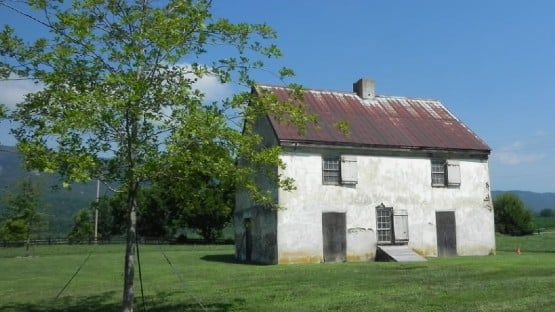
The White House, built in 1760 in Page County, will be undergoing an interpretive rehabilitation to highlight the three distinct phases of its 265-year history.
“The Plein Family is proud to make this investment for the local community and beyond. It is so important to preserve our local history so that both present and future generations can enjoy and learn from it,” said Scott Plein, the founding principal of Equinox Investments, a real estate investment, development and management firm specializing in community planning, entitlements, and project development in Northern Virginia.
Constructed in 1760 by Martin Kauffman II, the White House, located adjacent to Route 211 and the South Fork Shenandoah River, is a two-story, stucco-clad building that is viewed historically as an important example of 18th century Rhenish log and stone houses, exhibiting the influence of early Swiss and German building practices in the area.
Architectural plans and preservation treatment methods for the project have been developed by Annie Mathot of Bluebird Design Company in Staunton and Deneen Brannock of Commonwealth Preservation Group in Norfolk.
Their plans have been reviewed for adherence with the Secretary of the Interior’s Standards for Rehabilitation, including review and approval by the Virginia Department of Historic Resources and the National Park Service.
Contractors for the rehabilitation include Urban Development Partners in Winchester, a specialist in historic renovations. Some of their notable work includes the renovation of Winchester’s Fort Loudoun in 2017.
The rehabilitation project, which will take an estimated 8-12 months to complete, will highlight three major periods in the White House’s long history: its initial construction in 1760, a subsequent remodel circa 1822, and its involvement in the Rural Electrification program of the early 20th century.
The most visible changes to the building will be the complete repair of damaged stucco on the building’s exterior and replacement of the modern metal roof with period-appropriate wood shingles, the goal there being to align with the original appearance of the White House.
Other projects will include repointing of deteriorated stone and brick features, restoration and repainting of plaster on interior walls, refinishing and repair of pine flooring, cleaning and repair of late Federal woodwork details, and restoration of the damaged stone staircase leading to the barrel-vaulted cellar.
A major goal of the project is the structural stabilization of the White House. At more than 250 years old, the house has withstood multiple floods from the nearby South Fork Shenandoah River that have damaged its structural integrity.
The building will be stabilized with a concrete slab on the ground floor and steel ties on the second floor.
Upon completion of the rehab project, the Plein Family plans to open the White House on an invitational basis for educational tours, including for school groups, university classes, researchers, historic societies and descendants of the Kauffmans.
The tours will be managed and conducted by the White House Farm Foundation, a nonprofit foundation with a mission centered on conservation, education and local history.
Support AFP


 Share
Share

Chris Graham