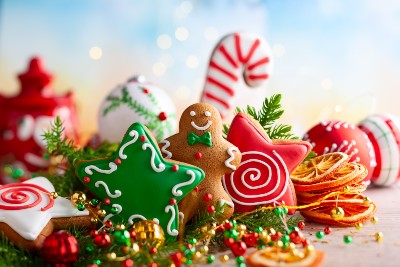
Electric lights, decorated trees, eggnog, custard, cookies, and more. In America, decorations and special foods take center stage for many winter holiday celebrations.
But these traditions did not all begin in the United States. Many of these holiday customs originated in Europe, while others have medieval roots, with influences from the Mediterranean, Asia, and the Arabian Peninsula.
Two Virginia Tech professors in the Department of Religion and Culture — Matthew Gabriele, chair and professor of medieval studies, and Danille Elise Christensen, assistant professor — recently explained how these popular holiday traditions have influenced American celebrations today.
Why do people decorate with lights during the holiday season?
Gabriele: It started with candles, primarily in the early modern period in Germany. Immigrant communities brought this practice to the U.S. in the 19th century, but it wasn’t adopted by mainstream white Protestant America until near the end of the century, thanks in part to Queen Victoria of England. She and her German husband (Prince Albert) decorated a tree with candles, and that was sketched as an image that circulated across the Atlantic.
How did using Christmas trees and greenery as decorations become a holiday custom?
Gabriele: Although evergreen trees were used in the polytheistic Roman feast of Saturnalia, the history of greenery around Christmas only really dates to the 15th or 16th century and to Germany.
Immigrants in the 18th and 19th century brought that tradition to the U.S., but it was rejected by white Americans until Queen Victoria and her popularity in the U.S., especially among the upper classes, helped bring the tradition across the Atlantic.
Throughout this period, though, the trees would be decorated sometimes with candles, but more often simply with colorful treats, such as apples or cookies, or homemade ornaments.
What about using lights to decorate trees? How did this trend begin and take hold?
Gabriele: President Franklin Pierce put up the first White House Christmas tree in 1856, and then the tradition spread from there. But candles on a dry tree are not a great idea, and so it still wasn’t super popular.
This changed with electricity. Supposedly, in 1882 a rich New Yorker who worked for Thomas Edison got the idea to create special red, white, and blue bulbs, hook them to a generator, and put them on his tree. He then put the tree on display next to a window, and it became a revelation, even being written about in the national media at the time.
By around 1900, Edison was selling “Christmas lights,” and early in the 20th century, it became quite common for those who could afford it to decorate their trees as such. These decorated trees were embraced by local governments and businesses and put on display, sometimes outside, and then in turn, were adopted by individuals for their homes. So, decorations began inside and moved outside over about half a century.
Meanwhile, food is often at the center of holiday celebrations.
There is meaning behind popular cuisine, desserts, and beverages used to celebrate several December holidays.
They include Hanukkah, the eight-day Jewish Festival of Lights; Yule, which marks the Winter Solstice; Christmas, a season commemorating the birth of Jesus Christ; and Kwanzaa, a celebration of African and African American community, family, and values.
Food focused on light and warmth
Christensen: Here in the Northern Hemisphere, midwinter foodways often emphasize light, whether they be sugar cookies shaped like the Star of Bethlehem, or a bûche de Noël (Yule log cake) that represents a bonfire.
Foods fried in oil help underscore the theme. During Hanukkah, for instance, latkes (shredded potato fritters) and sufganiyot (jelly-filled doughnuts) are important reminders of miraculously long-burning lamp oil. Sephardic Jews also eat sweet balls of fried dough called buñuelos.
In Mexican tradition, buñuelos take the form of crispy, sugar-topped discs sometimes spiced with anise (think licorice) or orange. They are eaten during pre-Christmas processions called Las Posadas, after reenacting Mary and Joseph’s candlelit search for a place to rest.
At this time of year, warmth matters, too. Roasted chestnuts offer a good excuse to build a fire. And the West Indian curries and African stews often eaten during Kwanzaa — the flavors blending together to symbolize values like ujima (collective work and responsibility) — combine soothing temperatures with heat-packing spices.
Foods that demonstrate wealth and generosity
Christensen: Holiday foods also tend to emphasize luxury. Everyday breads are replaced by enriched versions heavy on butter, eggs, and sugar, such as stollen and panettone. These and other foods, like fruitcake and gingerbread, also rely on dried fruits, citrus, and spices that historically were expensive. They were all imported to medieval Western Europe from the Mediterranean, the Arabian Peninsula, and Southern Asia.
Seasonal beverages
Christensen: Eggs and sugar dress up hot drinks, too, at this time of year. Boiled custard is a favorite in Central Appalachia (including Southwest Virginia; look for it at the grocery store), as is its nutmeg cousin, eggnog. Most Americans think of wassail as a citrusy spiced cider or wine, but historically it was creamier, thickened with custard and cake crumbs.
Another sweet hot drink is atole (before colonization, it was called atolli), commonly served alongside buñuelos and tamales during Las Posadas. Thickened with masa harina (corn flour) or an alternative like toasted cornmeal, atole can be flavored with sweet corn, as is traditional, or with cinnamon, anise, almonds, or citrus zest. Add melted chocolate to atole, and you’ve made champurrado, a thick, hot Mexican beverage.
For additional information about food traditions, visit The Food Timeline, a resource started by librarian Lynne Olver in 1999 and now managed by the University Libraries Special Collections and University Archives.




 Share
Share

AFP