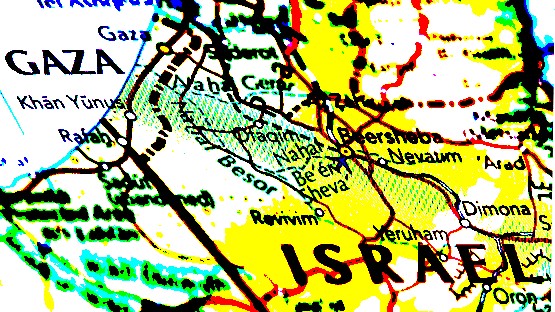
Israeli forces are justifying the murders of six journalists in Gaza on Sunday by claiming that one of them was the “head of a terrorist cell” affiliated with Hamas.
And now right-wing tabloids are smearing Al Jazeera correspondent Anas al-Sharif by pointing to old social media posts in which he praised the Oct. 7, 2023, attacks on Israel.
OK, I’ll bite – is that what makes him a terrorist?
Israel Defense Forces says it has evidence that al-Sharif was a member of a Hamas terror cell in 2019, but it hasn’t shared that evidence publicly.
So, as with so much that has been going on in Gaza for the past two years, we either take their word for it, take the word of their plants in the international right-wing media, or we sit and spin.
No doubt, me writing this article is going to get me some hate mail, but so be it.
“This is a pattern we’ve seen from Israel – not just in the current war, but in the decades preceding – in which typically a journalist will be killed by Israeli forces, and then Israel will say after the fact that they are a terrorist, but provides very little evidence to back up those claims,” Jodie Ginsberg, the CEO of the New York City-based Committee to Protect Journalists, told the BBC.
Israel has not been allowing foreign-based reporters into Gaza to be able to report firsthand on the situation there, leaving it to the relative few reporters on the ground who were already there to tell the story.
Israeli forces have exploited the information gap to deny the claims of atrocities coming from inside Gaza as being Hamas propaganda, and targeting journalists like al-Sharif, both figuratively – by casting doubts as to their legitimacy as journalists – and literally.
The Paris-based Reporters Without Borders says the IDF has killed more than 200 journalists in Gaza since the start of the war in 2023.
“This massacre and Israel’s media blackout strategy, designed to conceal the crimes committed by its army for more than 21 months in the besieged and starving Palestinian enclave, must be stopped immediately. The international community can no longer turn a blind eye and must react and put an end to this impunity,” said Thibaut Bruttin, the director general of Reporters Without Borders, which also goes by its French acronym, RSF.
Also killed in the Sunday attack were Al Jazeera correspondent Mohammed Qraiqea, video reporter Ibrahim al-Thaher, cameraman Mohamed Nofal, and Moamen Aliwa, a freelance journalist who worked with Al Jazeera – as well as another freelance journalist, Mohammed al-Khaldi, creator of a YouTube news channel.
The attack also wounded freelance reporters Mohammed Sobh, Mohammed Qita and Ahmed al-Harazine.
This isn’t a somebody else’s problem problem. I’m personally very much cognizant of the reality of the threats journalists face from political actors, because I’ve had my life threatened by a member of a far-right militia who wanted to exact revenge for unflattering coverage of a favored politician.
ICYMI
Difference being, I’m not in a war zone, with the might of one of the most powerful military organizations in world history bearing down on me with impunity.
I’ve been hesitant to speak out on the Israel-Gaza war, and I’m not proud of the reason why – that I don’t see Hamas as being a legitimate actor in this situation; coming right out and saying it, Hamas has been as bad or worse than right-wing Israelis in terms of the treatment of everyday Gazans since it assumed political power in 2007.
I understand why Israel views the removal of Hamas from power as a primary national-security motive.
That aim, enhanced national security, though, obviously doesn’t justify genocide.
Which we wouldn’t know about without the work of the handful of journalists still alive inside Gaza, risking their lives daily, hourly, to report to the world the atrocities going on in front of them.
Support AFP


 Share
Share

Chris Graham