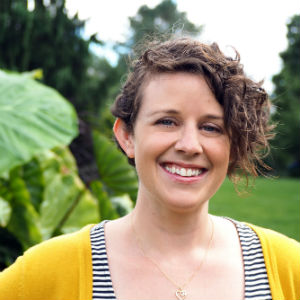
New Orleans and words — two lifelong passions for Katie Carmichael, an assistant professor in the Virginia Tech Department of English — are melding together through a National Science Foundation grant for collaborative research on post-Hurricane Katrina sociolinguistics.
For years, the storm has been the epicenter of her research.
When the news about the hurricane first reached Carmichael in August 2005, she was driving on the Blue Ridge Parkway to Northern Virginia to begin a yearlong study-abroad trip to France. Suddenly her phone began beeping with text and voice messages. Pulling over onto an overlook, she returned calls and learned about the storm’s havoc on New Orleans, the city of her birth and home to Tulane University, where she was a junior at the time.
Although Carmichael had grown up in the Mid-Atlantic, New Orleans, with its colorful history and culture, resonated with her. When she returned to the city for her senior year, she found it transformed. She quickly realized that the hurricane had changed more than the landscape; it had also changed where locals lived, with whom they interacted and, she suspected, the way they spoke.
Even before the hurricane, Carmichael had decided to delve into sociolinguistics, the study of how society and culture influence words and speech patterns. “I’ve always been interested in language,” she said, “and what the words you choose to speak reveal about you.”
And New Orleans interested her, not only because it was her birthplace and where she studied, but because of its unique linguistic phenomena. The city’s history as a large port and a center of slave trade had brought together the languages and speech patterns of Creoles, African Americans, European Americans, and Latinos.
In the aftermath of Hurricane Katrina, Carmichael’s research has focused on understanding the deeper linguistic changes that occurred because of the storm. Thanks to the National Science Foundation grant, she will be able to define what the effects of displacement and migration have on language spoken in the city.
With collaborator Nathalie Dajko, an assistant professor of anthropology and linguistics at Tulane, and a team of undergraduate researchers from both Virginia Tech and Tulane, Carmichael will interview 200 lifelong residents of different ethnic backgrounds and neighborhood origins to collect the largest and most diverse data sample ever assembled in the city.
“Dr. Carmichael’s team of undergraduate researchers will work with her in the Virginia Tech Speech Lab,” said Bernice Hausman, chair of the Department of English. “While exploring the dynamic changes in New Orleans speech patterns, the students will develop their skills in linguistic analysis and gain insights into the research process.”
After the hurricane, the city depopulated for a month, and places once delineated by ethnicities and cultural groups emptied. As the city repopulated and recovered, it redefined itself.
Gentrification of flood-resistant areas that had once housed lower-income populations changed the culture of each location. With a lack of employment or permanent shelter, many did not return to New Orleans. Although redevelopment in favor of wealthier landowners was a trend in the city before the storm, the hurricane sped these changes, creating lasting displacement and a mass diaspora for many lifelong residents.
New cultures arrived in the city, bringing new language patterns and cultural ideals.
“This is what I want to study linguistically,” Carmichael said. “You have these sociopolitical effects felt by all walks of life in New Orleans.”
Carmichael’s research will explore the social factors that affect language practices. She said divisions between old and new populations are now prevalent, and when these occur, society tends to view certain types of language as more authentic than others.
One component of the grant will involve an outreach project that enables the people of New Orleans to characterize their language in their own words and describe what it means to use different phrases and ways of speaking in relation to their personal identities. Their narratives will be captured on a website, and Carmichael will use their stories as part of dialect-awareness presentations she will deliver in the New Orleans school system.
“We want people to value the diversity and linguistic expression as part of cultural identity,” she said. “Our hope is that if we can talk to younger New Orleanians to instill a sense of pride and identity, we can help turn the tide of creating a valued space for these ways of speaking.



 Share
Share

AFP