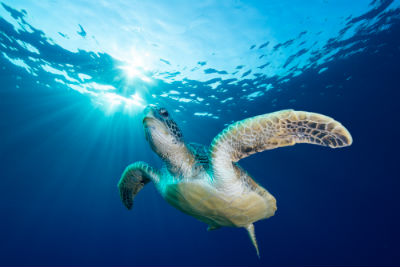
Dear EarthTalk: How are reptiles faring these days in the face of climate change and other environmental threats?
– L.M. Smith, Boston, MA
Reptiles, like other animals and plants, face growing threats as human influence on the environment increases. Certain reptiles are especially threatened; some 61 percent of turtles are threatened or extinct. Tracking the exact consequences of human activity on reptiles, however, has been difficult as research has primarily focused on mammals and birds, which draw more public attention, although evaluations have found reptiles to be more threatened than birds.
A recent study that observed 10,196 species determined that 21.1 percent of reptiles are at risk of extinction. These species contain an estimated 15.6 billion years of phylogenetic diversity (PD). This science uses a phylogenetic tree, which shows how closely related species are, to describe the amount of biodiversity in an ecosystem and obtain a more useful measurement than just counting numbers of species. In addition, the adaptations of reptiles to ecological conditions perform help sustain ecosystems, including supporting food chains. Threats to reptiles include habitat loss and environmental damage, invasive species, diseases, pollution, exploitation, poaching and global climate change.
Habitat destruction is the largest threat. As urban sprawl, overgrazing and desertification—which in turn prompt expansion of logging and agricultural operations—put greater pressures on land, reptile habitats have been overtaken by humans, creating increasingly stressful conditions for reptiles. Shrinking habitats increase edge effects—which are the effects of separating habitats (like with a road) such that animals cannot reach resources or mates in other parts of the habitat. Now climate change is exacerbating these pressures. Since many reptiles are ectothermic—they cannot generate internal heat and instead rely on external conditions (e.g. sunlight) to warm themselves—temperature increases due to climate change affect them significantly. Many arid-climate reptiles (e.g. lizards and geckos) are already experiencing extremely high temperatures, and minor increases could make their already limited habitats unlivable.
Furthermore, reptiles are particularly prevalent in regions of Southeast Asia, where disruptions to monsoon cycles can obstruct development of reptiles in embryo. Many species—turtles, crocodiles and alligators, for example—lay eggs in wet conditions. Newly-dry and disrupted regions threaten their abilities to survive, cause slow development or growth and skew the natural selection of sex ratios.
Some good news is that methods implemented to protect other types of animals—reducing tropical deforestation, controlling illegal trade and improving productivity in agriculture such that agricultural lands do not need to be expanded—benefit reptiles similarly. However, the current crisis behooves more action to improve conditions for reptiles in particular.
Readers should encourage their representatives to take action. Reptiles play a crucial role in the Earth’s ecosystems, and concerted solutions have the potential to make all the difference.
CONTACTS: The Amphibian and Reptile Extinction Crisis, biologicaldiversity.org/campaigns/amphibian_conservation/index.html; “A global reptile assessment highlights shared conservation needs of tetrapods,” nature.com/articles/s41586-022-04664-7; “Climate Change Impacts on Tropical Reptiles: Likely Effects and Future Research Needs Based on Sri Lankan Perspectives,” frontiersin.org/articles/10.3389/fevo.2021.688723/full.
EarthTalk® is produced by Roddy Scheer & Doug Moss for the 501(c)3 nonprofit EarthTalk. See more at emagazine.com. To donate, visit earthtalk.org. Send questions to: [email protected].

 Share
Share