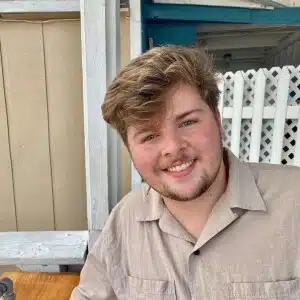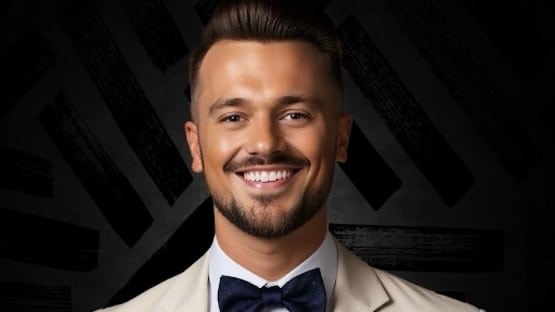
The road to champagne dreams and caviar wishes isn’t paved overnight. For Brad Gilmore, it’s been 15 years of measured progress and constant redefinition, allowing his love for cinema and professional wrestling to guide his course.
The slogan, coined by Robin Leach on Lifestyles of the Rich and Famous, was co-opted by Gilmore’s co-host on the Hall of Fame” podcast and radio show, Booker T. Since 2015, the duo have broadcast live on ESPN Houston 97.5 FM. A decade later, it’s become a nationally syndicated program.
In addition to Hall of Fame, the broadcaster hosts a sports and entertainment podcast called The Collection, as well as The Spotlight, for the Houston-based CW39. Now, Gilmore has tackled a new endeavor: launching a publishing company, Redmane Publishing House.
To kick off this new arm of his media portfolio, the Houston native has embarked on the ambitious task of releasing three books in 30 days, in what he’s christened as “Project 33.” The first is a retrospective look at the Back to the Future franchise, Why We Love Back to the Future. The second is a children’s story about Gilmore’s own cat, called Luna’s Night Out. The final book is one near to Gilmore’s heart and the business that’s afforded him so much: Making the Towns.
Doubling as a screenplay, Making the Towns is Gilmore’s love letter to professional wrestling and road trip films, like Martin Best’s Midnight Run or Kevin Smith’s Jay and Silent Bob Strike Back.
The story centers on Lucky Dice Vegas, a veteran journeyman wrestler who’s watching the business he’s loved pass him by. His next assignment: mentor the younger Nick Nelson, a prodigy who’s being groomed to win the championship that Vegas could never attain.
Described by retailers as being “funny, foul-mouthed, and full of heart,” the tale draws from Gilmore’s own experiences in the professional wrestling business, working for Booker T’s own promotion, Reality Of Wrestling.
Gilmore’s love for professional wrestling began at a young age, tuning into Monday Night RAW at the height of the Monday Night Wars. Like millions of other Americans, Gilmore was captivated by the antics of a fellow Texan, “Stone Cold” Steve Austin.
Like most wrestling fans, Gilmore’s interest waxed and waned as he matured — in favor of music, and the fairer sex, of course. It wasn’t until a chance encounter occurred with another legend of the Lone Star State, that Gilmore found his foot in the door.
“I came up in Houston as a musician. I was playing in bands locally, and we got signed to a record deal, and that record deal led us to being interviewed on a radio station. That radio station afterward came to me and said: ‘Hey, you’re pretty good at this. Maybe you should do a radio show. So at 18 years old, they gave me my own radio show. And what was really cool.”
A few years into his radio show, Gilmore was scrolling Twitter one morning when he saw a post from the WWE about Booker T.
“My first live event ever was a SmackDown house show at the Toyota Center in Houston, Texas, in 2006, where the main event was Rey Mysterio versus King Booker. That was the first show I ever went to.
“So, I’m like, ‘Oh man, Booker T’s the best.’
“I click on his profile, and I’m looking through what he was doing, and he had a tweet up there that said, ‘Looking for a ring announcer for my Reality Of Wrestling promotion. Looking for a commentator. Submit your resume here.’
“So, there was an email. I sent a quick little note: who I was, what I had done… I lied about the majority of it — said that I called different things and I was a sports broadcaster. I’d never done anything in the world of sports. Three weeks went by, and I got a phone call, and they said, ‘Can you visit us down at the gym? Booker T wants to meet you, and he wants to have you audition for his show.’
“So, three or four of us went down there for the audition. I did the absolute worst out of everybody. I made a Donnie and Marie Osmond joke, which was a reference well before my time. I couldn’t remember the names of certain moves. A couple of days went by, and I got a phone call saying, ‘Hey, we don’t want you for the commentator role, but our ring announcer just got strep throat. You have a good look to you. You’re young.’
“Booker has a really big emphasis on people being young.
“So, they said, ‘Do you want to come ring announce? You’ve done that before, right?’
“I said, ‘Yeah, yeah, sure, done it a hundred times. You know, I wrote the book on it.’
“I went down there for Reality Of Wrestling on that Saturday in November. So, it’s 14 years ago this month. That’s how it all started, and Booker said, ‘come back next month,’ and I’ve been back ever since.”
In due time, Gilmore’s working relationship with Reality Of Wrestling expanded in new and interesting ways, affording him the opportunity of a lifetime.
“So, it was 2015, and Booker called me. And he said, ‘Hey, I have this radio show. I’m going to start hosting it on my own.’ He had another co-host at the time who was more of a radio guy. “He’s like, ‘But I want to bring someone in who’s got a young voice and could do, like, maybe read some stuff off of social and bounce questions off me every so often.’
“He was like, ‘You’ve done radio. You come and do it.’ I’m like, ‘Sure, Booker T, whatever you say.’
“I remember being live on the air, and we had a guest on, or Booker had a guest on, and the guest said something profane, and they had to dump it, right? They hit a dump button in the radio station, so they dropped a call. And Booker on an improv goes, ‘What do you think, Brad?’
“And I was like, ‘Whoa, I wasn’t ready for that,’ right? I wasn’t ready for someone to ask any — I just thought I was reading questions off of paper. So, I remember him saying that, and immediately, I fired some joke at him. He fired a joke back at me, and then we’re kind of going at each other, and at this time, I’d worked with him for a couple years, but I didn’t know him, know him, that well. You know, this was still very much a working relationship.”
In the decade since that radio spot, Gilmore has become one of wrestling radio’s defining voices. He credits much of that success to his mentor.
“Working with Booker has been the complete joy of my life, in all honesty. He’s an A1 human being, first and foremost. He’s a guy who — we’d be friends, even if it wasn’t for professional wrestling, because we get along so well.
“He’s been an amazing mentor. I can’t say enough good things about him. I sing his praises to anybody to listen.”
However, it’s easy to find the common theme across all of Gilmore’s successes. Emblematic of his roots in professional wrestling, it’s his ability to adapt and improvise.
“I never have a plan. I’ve had no plan. That’s my whole life. You know, uh, ‘My plan is no plan.’ That’s what “Macho Man” [Randy Savage] once said, and I agree with it, because I did not expect to be in professional wrestling. I did not expect to be on the radio, television, print, any of that. I didn’t expect to be a critic for the Critics Choice Association, talking about movies professionally.
“I didn’t think I’d be sitting across from Robert De Niro at the Plaza Hotel talking about, like, none of this. I didn’t expect any of this to happen.”
Now, Gilmore looks to apply those lessons and his experiences to his screenplay, Making the Towns.
“Being in professional wrestling for as long as I have, there’s a few things, right? You understand what these guys, especially on the independents, do. I think we romanticize the territories for great reason, because those are the guys — the carpenters — that built the business that we enjoy today. But, the independent talent, man, they go from three, four, five shows a weekend. You know? Friday night, two on Saturday, if they can, two on Sunday, if they can… They’ll be driving from one part of the town to the other.
“I mean, I’ve had guys, you know, drive two hours to Austin after wrestling the first match at Reality Of Wrestling, to try to get there to the next show. So it’s a real big dedication.
“What I loved about Reality Of Wrestling is we’ve toured as well. I mean, we’ve done shows in Las Vegas, really the first independent promotion to ever put on an event at the MGM Grand. I mean, that’s a pretty awesome thing that we were able to do.
“So, I took those experiences, and I wanted to create a film — a story — an adventure of these two guys going from town to town, making the towns and the hijinks that people get into.”
While Nick Nelson may be more of an archetypal role, many of the characters in the screenplay draw from the larger-than-life personalities Gilmore’s encountered.
“There’s a guy named Lightning Larry Spence, who’s the promoter. You know, Booker’s voice was in my head. There’s a woman named Sherry Spence, who, Sharmell, was in my head — the ‘Queen,’ the Hall of Famer herself.”
Some names are less inspired.
“There’s a director on Reality Of Wrestling named Kevin. So, the director in the movie’s name is Kevin.”
Others, like the main character, Lucky Dice Vegas himself, are more so an amalgamation of different figures.
“[Vegas] is a guy who’s like, you know, hovering around that 40, 41-year-old mark, who, at one point, was lauded as the next big star in pro-wrestling[…]
“I didn’t realize it till after the fact that a lot of Lucky Dice Vegas is drawing inspiration from the career of Diamond Dallas Page, which is a guy who didn’t make it until later in life. Didn’t start until 38. He won the world title at 41, right? So, there’s some Dallas, who’s one of the all-time great guys[…] Just a quality human being, but he’s got such a great and positive story.
“So, Lucky, my main character, has some DNA of DDP.”
As a lifelong cinephile, Gilmore always wanted to write a screenplay. “Making the Towns” may have been an unlikely choice, but it’s one that he finds close to home.
“I wanted to write a movie. I wanted to, over the last couple of years, and I couldn’t think of the way in. And I had this one story that I was really bullish on. I said, ‘This is the story I’m going to write.’ I was talking to a friend of mine, Jeff Smith, who’s a documentarian and a screenwriter as well. Jeff Smith directed a documentary called Who Done It: The Clue Documentary, about the 1985 cult classic, to give him a shout-out.
“I sent him a text with all my pictures. I said, ‘Hey, I have these five ideas.’
“I put them in order, for which ones I think I could really do the best on. And ‘Making the Towns’ was number five on that list. I did not feel as confident in it.
“When he read through the pitches, he came back to me. ‘The only movie you can write is ‘Making the Towns,’ because you know it. You’ve been around these guys. You’ve experienced it. You dedicated your whole adult life to this industry. So, you can uniquely tell this story.’”
While most screenplays never come to fruition, Gilmore wasn’t content with Making the Towns becoming another statistic.
“I wrote it to write it, and then when I got finished with it — most screenplays, 95% of them, never see the light of day. They sit in someone’s drawer or on their desktop files forever, and they send them out; maybe they get read, maybe they don’t. I wanted to usurp that idea.
“I said, ‘You know what? I spent a long time thinking about these characters and putting this story into play. I want to publish this.’ I’m going to publish it as a screenplay so that, if it develops its own audience and people begin to like it, and it makes the towns, if you will, and it gains popularity; perhaps then studios will be calling, or it gets in the right person’s hands, and they go, ‘Hey, I don’t like this story the way you wrote it, but I love the concept. Let’s workshop it. Let’s make it a series. Let’s make it a feature.’
“I would love for these characters to come to life on the big screen in the same vein, you know, people who, who, uh, inspired me to write this, or the, the Kevin Smiths and the Quentin Tarantinos of the world, who bet on themselves. Who wrote dialogue and wrote characters and scenes that either they knew, or they had imagined for years and brought them to life.”
Gilmore also has a desire to recontextualize the perception of professional wrestling, which has been informed by films like Darren Aronofsky’s The Wrestler or Sean Durkin’s The Iron Claw.
“[Aranofsky’s film] does capture a very real slice of professional wrestling. There’s not one wrestler or someone in the industry or around the auxiliary of the industry in the ecosystem that saw it and thought that it was a false note. Like it hit home for a lot of guys. I mean, I remember talking to some of the boys in the locker room and they’re like, ‘Oh yeah, when we saw that movie, we had to get up slow from our seats thinking, what did we just commit our lives to?’ So, he did a really, really good job.
“The Iron Claw tells a story that I’m very familiar with, being here in Texas. It did fudge some things for the dramatic effect, but it’s still a very quality story.
“But, where’s the positive pro wrestling? We have so much fun in this business. I’ve had so many more laughs being around wrestling than in any other industry that I’ve ever been a part of. So, where are the positive stories? And this is a comedy at the very root of it. Yes, there’s drama, there’s hard moments, there’s tough moments, there’s arguments… But at the end of the day, it shows a fun side of the professional wrestling business. Not like, I’ll give you a better example, not like Dark Side of the Ring, which I have an issue with. I take issue with that show.
“I understand that people like it and, you know, people watch it and they’ve done several seasons and that’s all well and good. And, I appreciate them for, you know, wanting to tell a wrestling story, but rest, there’s a light side of the ring too.
“There’s also the story of the guy who makes it, and does well, and, you know, paid all his taxes and saved for the future, and has a family, and it’s good. You know, I know that because I work with him. I see the guy, you know, I’ve seen the positive of pro-wrestling. So, I want, I want that story definitely to come through, and this is, you’re never going to hear me say something negative about this business, not because negativity isn’t around it, just because it’s been nothing but great to me.”
Gilmore hopes that Making the Towns and its sister projects will entice a wave of creators to work hand-in-hand with Redmane Publishing House to help bring their ideas to life.
“Not everyone’s going to be as passionate about a movie that came out 41 years ago as I am, or what happened to a cat that they let out, or want to tell a wrestling road trip story. But, they might be super passionate about something I’ve never heard about, that I have no idea about, that lives in a corner of the internet, that I’ve never wandered down, right? And that’s what the idea is to be. It’s like, yeah, bring me your idea. Let’s work on it together.
“I’ll tell you what I know from the publishing world, and I’ve written five books now. I know a thing or two, right? So, let’s let’s work together. Let’s figure it out.
“Are you going children’s? Are you going non-fiction? Are you going fiction? Do you want to write a screenplay like I did? I could give you the tools. I can show you the infrastructure. Let’s work on it together. And anything I ever do is always creator-friendly. You know what I mean? I have, you know, several people under my podcast network where I’m like, look, you own it. You want to go, go. I’m just here to get you started and set up.”
Gilmore emphasizes the importance of agency and collaboration in the creative process, a philosophy that he credits Booker T for cultivating.
“Booker’s given so many opportunities; there’s so many young people who come through the doors at Reality Of Wrestling. The only thing he wants them to do more than anything is to leave, right? He wants you to sign somewhere. Go. You know, that’s what our whole goal is, to turn out as much talent as we can. You see Zilla Fatu too. EK Prosper, Roxanne Perez… We just had two people sign WWEID contracts: Lady Monica Monroe and Josiah Jean. All within the last year or two.
“So, yes, with Redmane, I wanna do the same thing. If you’re young, you’re out there, you want to tell your story? Let me show you how I know how to do it, and let’s work on it together.”
In addition to his numerous broadcasting duties, Gilmore’s spent the past month on a rigorous junket to promote all three books. When we got on the horn, he was waiting outside of a theater before a movie screening. That’s the sort of schedule that would make any newsman’s head spin. Gilmore seemed unfazed. Maybe that’s because the six-time world heavyweight champion taught him how to stay on his toes. Maybe it’s because he’s not afraid to do the work.
How else is he going to make those champagne dreams and caviar wishes a reality?
Support AFP



 Share