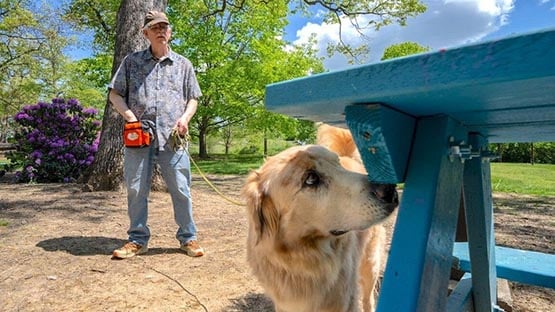
Man’s best friend could one day play a critical role in the agricultural community with their keen sense of smell, able to root out destructive pests including the spotted lanternfly and fungus like powdery mildew.
Dogs have a sense of smell that is tens of thousands of times more acute than their human owners. Recreational scent work requires some training but could one day lead to valuable contributions to the farming community.
“There are thousands of people out there doing scent work with their dogs just for fun,” said Erica Feuerbacher, an animal behaviorist and associate professor in the School of Animal Sciences at Virginia Tech. “What [the] study shows is that this can be more than a hobby — these citizen-scientists and their dogs can be a valuable resource for fighting the spread of an invasive pest.”
The new study found that companion dogs can effectively detect the egg masses of the spotted lanternfly, an invasive insect that’s damaging farms and forests in Virginia and throughout the eastern and central U.S. Finding the masses, which resemble mud smears, is critical to destroying the bugs and limiting their destruction.
“With proper training, dog owners can turn their pets into powerful partners for conservation,” said Sally Dickinson, the study’s lead author.
More than 1,000 dog owners expressed interest in the study, and 182 teams were selected as participants, who were then paired with a local trainer. After several months of training, the dogs were put to the test and were successful finding live egg masses by their scent.
Two of the dogs selected for the study in Virginia, a Tibetan terrier and a pit bull mix, trained with devitalized spotted lanternfly egg masses two or three times a week for 15 to 30 minutes for six months.
Study participant Bill Wellborn of Roanoke said his 7-year-old Tibetan terrier, Pepe, enjoyed the challenge.
“Anytime you can stimulate your dog, it’s good for them,” said Wellborn. “Pepe obviously enjoys it, and it’s a way we can take dog skills and training to help our community.”
Katie Thomas of Radford and her pit bull mix, Finch, also volunteered for the study, putting their seven years of recreational scent work to use.
“Being able to do the same thing for the greater good — for citizen science — adds another layer we didn’t have before,” she said.
A separate study completed with researchers from Texas Tech University found that trained pet dogs could also detect powdery mildew, a major fungal disease that can cause major destruction to grapes and vineyards.
“This research is about more than detection,” said Dickinson. “It’s about empowering people to work alongside their dogs to protect the places and communities they care about.”
Related stories
- Local dog, Beckett, who can jump real far, is a nationally ranked good boye
- Bruce the Bat Dog makes MLB debut with Washington Nationals: He’s a good boye
- Mixed breed dog survives lepto diagnosis; vaccine now considered essential
- In memory of Rivan: Four Department of Corrections K9 dogs to receive protective vests
- Waynesboro: Barkley, beloved K-9 dog with the city PD, passes away
- ‘A little miracle kid’: West Virginia dog beats the odds, survives poisoning from fungi
Support AFP


 Share
Share

Crystal Graham