Two floods in August 2020 were enough of a wake-up call for the City of Staunton to devise its own city-wide flood mitigation plan.
Flooding in Texas in early July that killed 132 individuals, including 36 children at Camp Mystic, is become more prevalent thanks to climate change causing heavy downpours of rain the likes of which Staunton is not prepared to absorb in a short amount of time.
The Central Shenandoah Planning District Commission’s Hazard Mitigation Plan provides Staunton with some knowledge to build a flood mitigation plan on.
“It calls out flooding as one of those key problems that all of the localities in the area are going to be facing and give suggestions and ways to move forward in an impact way,” said Katie Shoemaker, senior engineer with Wetland Studies & Solutions Inc.
Shoemaker spoke at Staunton Library Monday night during a community listening session intended to gather from the public what residents want in the city’s plan.
Shoemaker said the plan will also look at current work the city is conducting thanks to a 2021 study by Wiley Wilson and the available science on flooding.
“Those kinds of studies have a lot of useful information, a lot of work that’s already been done, and we want to build off of that and not duplicate it,” Shoemaker said.
Willow Hughes, the city’s Environmental Programs Administrator, said the city has moved away from individual projects to focus on what may benefit the city overall in the event of flooding.
According to Shoemaker, Monday night’s session was planned as a discussion with the community to gather feedback. Any flood mitigation plan will require urban resiliency, the ability for the city to withstand the shocks of flooding and also to recover, and opportunity for the city to respond so as to improve resiliency over time.
“And this particular resilience plan, aimed toward flood resilience for the city, the goals are to help the city be better prepared for when floods do happen, better able to respond adequately when floods do happen and then recover from those floods and build back,” Shoemaker said. “And, not just build back, to have it happen again but in key in on resilience, building back in a way that makes the city and the community better able to handle floods in the future.”
An effective plan requires staff identifying potential hazards and vulnerabilities in the city, analyzing risks, proposing strategies and solutions, and developing a scorecard of projects.
Most importantly, a flood mitigation plan will enable Staunton to apply for and be eligible for state grant funding to further projects that prepare the city for flood events.
Before the August 2020 floods, Staunton experienced one other major event, or flood of record, in 1896. The first recorded flood was in 1870. The city was incorporated in 1871.
“The main goal today is to get input from all of you about where you see problems, what kinds of problems you’ve been seeing, and where you see opportunities to implement solutions,” Shoemaker said.
Shoemaker offered strategies for the city to reduce incident of flooding events: green infrastructure, increase parks and greenways, nature-based solutions, flood shields for homes and businesses, install check valves on water and sewer lines, elevation of properties and utilities out of flood plain, a monitoring and early warning system. Staunton already has an early warning system with rain gauges throughout the city to alert residents and businesses of possible threat of flooding.
“We’re in kind of a tense time right now. We’ve had daily rains that have been pretty big,” said Staunton Housing Planner and Grant Coordinator Rebecca Joyce. Virginians may be having flashbacks to Hurricane Camille in 1969 after the flood in Texas.
While the city has an emergency operations plan through the fire department, until a final flood mitigation plan is developed, personal property is at risk. Joyce suggested that all households consider flood insurance and prepare emergency supplies in the event that they must leave their homes quickly. Supplies should include medications and pet supplies, and pet owners are encouraged to prepare to leave with their pets.
“If it’s not safe for you, it’s also not safe for your pets,” Joyce said.
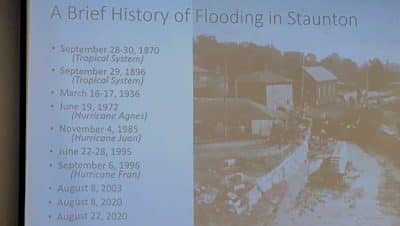
Hughes said that city staff hope to draft the plan before December 2025, conduct an internal review in January 2026, conduct more public outreach in February or March 2026 and have a final draft of the plan in March or April 2026.
Wetland Studies & Solutions Inc. Manager of Engineering Nathan Staley said that thunder storms pouring rain on Staunton for 24 hours are no longer the problem. The problem is the two-hour storms that provide torrential downpours, which the stormwater management system and the soil cannot absorb quickly enough.
Shoemaker said that input on what the community considers important can be included as priorities in the plan.
Staley encouraged community members to think about who in the community may be missing from the discussion and to invite them to participate.
“Because the intent is that it needs to be the entire community,” Staley said of the collection of input.
New housing developments create more housing for residents, but less green space to absorb rain. Fred Blanton lives near Crucible Coffee Roasters and said that when he and his partner built their house on a vacant lot, they planted 100 trees. As a result, they have no rain run off on their property, which their neighbors were concerned about.
“The reality of this is none of us is immune to this,” Staley said of the threat of flooding.
The city’s online survey is collecting information and data for the final draft.
Related stories
- Staunton: City looks to address flood risks, public asked to weigh in
- JMU students’ architectural design eases flood mitigation concerns at Wharf Lot
- Staunton: Tunnel work at Wharf Lot begins city-wide flood mitigation efforts
- Staunton: City’s first-ever flood resiliency plan to provide ‘holistic look’ at response
- City of Staunton launches awareness system as part of flood mitigation strategy
- Waynesboro: 40 years of work mitigated flooding damage from Helene
Support AFP


 Share
Share

Rebecca Barnabi