
A reader who regularly drives Route 254 from Staunton to Waynesboro noticed a sign a couple of months ago advertising a something called a “biosolids land application” at a farm near the highway’s intersection with Brower Road, and asked us if we knew what that was.
We didn’t, so we checked, first asking Augusta County government for help, then when we were told by the local folks that we needed to get in touch with folks in Richmond, we tracked down somebody at the Virginia DEQ.
It took some time to get the final answer, but we were eventually able to get to the bottom of things, though as it turns out, it was well after what was going on had already gone on and passed into the night.
What even is a ‘biosolids land application’?
Seems like a good place to start. According to the DEQ, biosolids are sewage sludge that has been “treated to meet the standards established in state and federal regulations for land application, marketing or distribution.”
“These regulations require that the sewage sludge undergo established treatment to meet the pathogen control levels, established treatment and management practices to meet the vector attraction reduction, and contain concentrations of regulated metals below established limits,” an explainer on the DEQ website tells us. “Only after the sewage sludge has undergone the established treatments and monitoring to become ‘biosolids’ can the material be safely recycled and applied as fertilizer to improve and maintain productive soils and stimulate plant growth.”
The DEQ regulates all land application of these sludge-based biosolids in Virginia, with the Virginia Department of Health playing a role in monitoring the health issues related to biosolids applications.
“Regulations require nutrient management plans for all fields receiving Class B biosolids, unannounced inspections of the land application sites, certification of persons land applying biosolids, and payment of a $7.50 fee per dry ton of Class B biosolids land applied,” the DEQ explainer tells us.
The fee is paid by the generator of the biosolids, and helps to fund the biosolids regulatory functions of DEQ and the Department of Conservation and Recreation, as well as local government monitoring programs.
The signs advertising an “application” of biosolids aren’t referring to an application for a permit, like you might be used to seeing when you drive by a property that is up for a rezoning, and you see a sign letting you know about the rezoning request.
The word “application” here means, biosolids are being applied.
Specific to the location in Augusta County
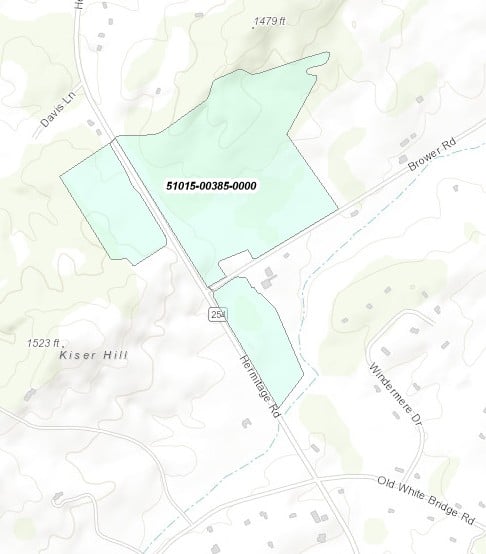
Irina Calos, the communications team lead for the Virginia DEQ, explained to us, by email, that the land application site on Route 254 is permitted with Houff Corporation, and the farm at the location is owned by David and Yvonne Rosson of Afton.
Per the Augusta County local government website, the 240.8-acre farm was most recently assessed for $1.267 million.
According to Calos, Houff applied anaerobically digested Class B biosolids from the North River Wastewater Treatment Facility (located in Mount Crawford) at the Rosson farm on Oct. 12-13.
“They applied on the portions of the corn fields that had been harvested, but not all the corn was harvested before the land application crew had to move their equipment to another site. Houff’s staff indicate that they don’t have plans to return to the site this year,” Calos said in the email.
The reader who reached out to us with the question first did so on Oct. 18.
According to Calos, the signs are required to go up at least five business days before biosolids are delivered to the site, and they are to remain up for at least 30 days after the application is complete.
That would have been mid-November, but Calos told us in an email last week that the signs were up through the end of the month.
Support AFP


 Share
Share

Chris Graham