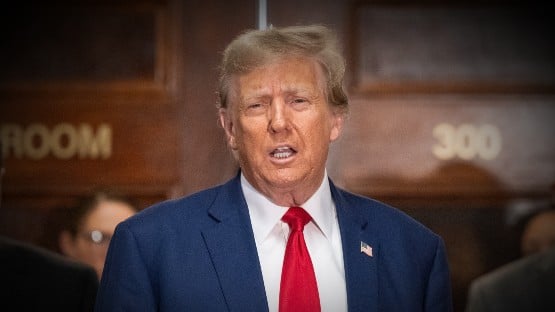
Donald Trump’s address to the nation about the Iran war failed to persuade anyone beyond his devoted base that the war has strengthened America’s national security. Instead, it exposed a president struggling to control a conflict he couldn’t clearly define, projecting an unsettling portrait of confusion.
At one moment, he celebrated “mission accomplished,” claiming victory over Iran’s military capabilities; at the next, he vowed to “finish the job.” His incoherent claims, shifting objectives, and self-congratulatory tone only deepened doubts about the logic and purpose of the conflict.
His shifting justifications, exaggerated claims, and disregard for facts revealed not confidence but weakness, leaving even his closest advisers unclear about what victory means.
Refusing to call it a ‘war’
In a bizarre twist, Trump refused to call the ongoing conflict with Iran a “war,” preferring the term “excursion,” even as he compared it to Vietnam, Iraq and Afghanistan.
The contradiction reflected both rhetorical manipulation and historical amnesia. His linguistic gamesmanship was meant to minimize accountability while evoking the stature of past commanders in chief.
Instead, it exposed his incoherence — an effort to claim victory without admitting the moral and strategic costs of open warfare.
The enriched uranium mystery
Trump briefly touched on Iran’s stockpile of 60 percent enriched uranium, claiming that U.S. strikes “obliterated” Iran’s nuclear sites and stating that “it would take months to get near the nuclear dust,” presumably referring to the enriched uranium itself — a statement as absurd as it is woefully convoluted.
The comment was emblematic of a speech full of exaggerations and distortions, casting further doubt on nuclear security.
Boasting about a declining economy
Trump lauded what he called “the greatest economy in history,” disregarding data showing rising inflation, growing long-term unemployment, and a ballooning deficit.
His address read more like a campaign rally than a sober wartime report. By reciting outdated talking points, he appeared detached from the economic hardships Americans face.
Far from projecting confidence, his hollow rhetoric amplified the perception of a president insulated from reality and desperate to sustain the illusion of competence.
Energy independence and the gas price paradox
Declaring that the U.S. is self-sufficient in oil and gas production, Trump ignored an inconvenient reality: Americans are paying more than $4 per gallon, nearly 40 percent higher than before the war.
His attempt to blame “global speculation” sidestepped the fact that his own actions destabilized markets.
The contradiction between his claim of independence and the economic pain at the pump highlights his disconnect from policy consequences, eroding trust in his economic leadership.
Misreading Iran’s motives
In his address, Trump misinterpreted Iran’s attacks on Gulf states, presenting them as acts of unprovoked aggression rather than strategic retaliation.
He seemed unaware — or unwilling to acknowledge — that Iran targeted U.S. bases because it cannot strike American soil.
This failure to grasp the logic of deterrence blinds his administration to predictable regional escalations. The omission signals not strength but ignorance of the basic dynamics driving the very conflict he initiated.
Ignoring Israel’s role in the conflict
Notably absent from Trump’s remarks was any mention of Israel’s hand in shaping the war’s trajectory. Benjamin Netanyahu’s influence in urging direct confrontation with Tehran is well documented, yet Trump avoided the subject entirely.
This selective silence suggests both political indebtedness and reluctance to face domestic criticism.
By obscuring Israel’s part in the conflict, Trump distorted the public’s understanding of responsibility and reinforced the perception of a presidency guided by personal alliances over national interest.
Bluster and comparisons to predecessors
True to form, Trump filled his speech with boasts about accomplishments allegedly surpassing those of Barack Obama and Joe Biden.
He portrayed himself as the only leader willing to act decisively, yet offered no evidence that his approach yielded better results. The hyperbolic comparisons betrayed insecurity rather than strength.
His address became an exhibition of ego, not leadership — reaffirming the view that for Trump, the battlefield is not Iran but the contest for personal validation.
Blaming European allies over the Strait of Hormuz
Trump chastised European allies for failing to join his effort to reopen the Strait of Hormuz. He insisted the U.S. no longer needs Middle Eastern oil and that Europe should “handle its own mess.”
This unilateral tone further alienated NATO partners and deepened existing tensions across the Atlantic.
His message offered nothing new to alter the bleak trajectory of the conflict, reinforcing their fears that Washington is more committed to escalation than diplomacy.
Far from rallying unity, his remarks confirmed Washington’s isolation and reinforced perceptions of an erratic, unreliable superpower.
The myth of renewed American respect
Trump’s speech, to be sure, laid bare his repeated claims in the past that “America is more respected than ever.”
The reality is starkly different: the U.S. is increasingly feared, distrusted, and viewed as unpredictable.
His aggressive rhetoric and disregard for alliances have corroded the moral authority that once underpinned American leadership.
What he presents as power is in fact isolation — a superpower adrift, its reputation diminished by a president who confuses intimidation with respect.
A speech that exposed America’s limitations
Trump’s address did not convince the public or America’s allies that the war against Iran advanced U.S. national security. Instead, it revealed a superpower constrained by its own contradictions — alienating partners in the Gulf, straining ties with Europe, and exposing the fragmentation of American strategy.
Rather than inspiring confidence, his words magnified distrust and uncertainty.
Trump appeared weaker, discombobulated, arrogant, and bombastic as usual — his opponents gratified, his supporters demoralized and perplexed.
No exit strategy in sight
Despite his extended justifications for continuing hostilities, Trump failed to present any plan, timeline, or measurable goal for ending the war. He offered no vision for stabilization, no diplomatic channel, and no criteria for success.
This omission underscored an administration operating on impulse rather than strategy. As he said in the past, he will feel it in his bones when to end the war.
The absence of an exit plan speaks volumes — it reflects a president driven by political optics rather than substance, leaving America entangled in yet another costly quagmire.
Trump’s speech failed to convince anyone beyond his devoted followers that the war enhanced America’s security. His contradictory claims and hollow boastfulness projected weakness, not power, alienating allies and deepening mistrust.
What emerged was a portrait of a leader lost in his own illusions, isolated and increasingly irrelevant.
Support AFP



 Share
Share